
The World’s Most Mysterious Volcano Can Finally Be Explained
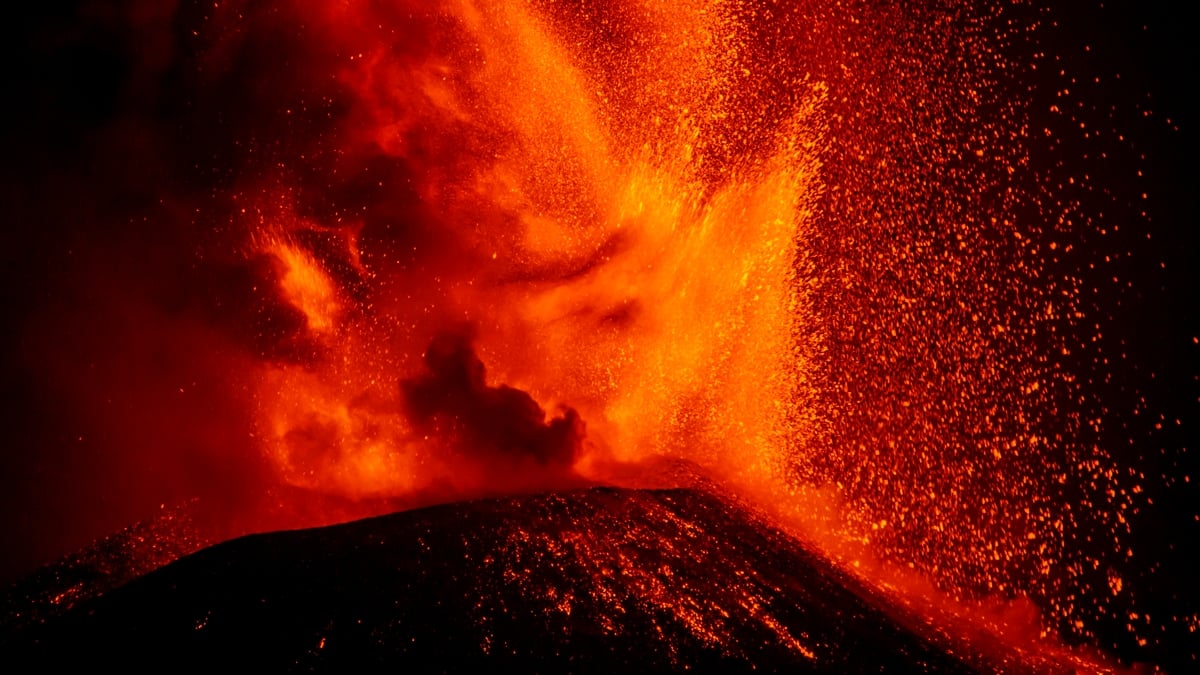
Mount Etna is more than half a million years old, but this massive stratovolcano in Sicily still has plenty of gas left in the tank.
The 3,400-meter behemoth is the most active volcano in Europe, often producing several eruptions per year.
In fact, Etna is suspiciously spry. It’s known for releasing alkaline lavas, unlike most stratovolcanoes, and it does so more prolifically than should be possible, based on the time needed to produce volatile-rich alkaline lava.
This makes Etna an enigma. Despite its long historical record – plus extensive monitoring and research in modern times – no known geological process can fully explain how the volcano formed, or where it keeps getting all the alkaline magma for its frequent eruptions.
A new study offers clues, though. Etna is apparently fed by a rare magma mechanism unknown until recent decades, typically associated with small submarine volcanoes, not hulking stratocones like Etna.
The findings suggest Etna formed and functions differently from most other volcanoes, the researchers suggest, and that it “may be a unique place on Earth” due to the unusual way it liberates magma trapped in the planet’s low-velocity zone and spews it onto the surface.
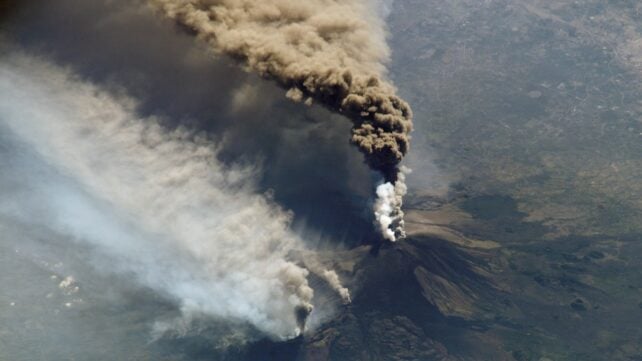
These are valuable insights for volcanology in general, and especially for efforts to assess specific hazards posed by Etna. The volcano looms dangerously near the cities of Catania and Messina in eastern Sicily, both home to hundreds of thousands of people.
Volcanoes develop when mantle material melts into magma and rises, ascending through the crust until it reaches the surface and hardens. This typically happens in one of three ways.
As two tectonic plates pull apart, they let mantle material rise and melt, releasing lava at the plate boundary that solidifies into new oceanic crust.

Alternatively, as one tectonic plate slides under another in a subduction zone, the subducting plate carries water into the mantle and reduces its melting point, fueling potentially violent eruptions.
Or finally, within the interior of tectonic plates, a hotspot of superheated mantle material can rise to the surface, often resulting in shield volcanoes like the ones that created Hawaii.
Most of Earth’s volcanoes fit into one of these categories, but not Mount Etna.
It’s a stratovolcano located above a subduction zone, yet the chemical composition of its lava resembles that of hotspot volcanoes – despite the lack of any known hotspots nearby.
In hopes of learning why, the authors collected samples from Etna to help them reconstruct the chemical profile of its lava over the last 500,000 years.
Etna’s lava showed a surprisingly consistent composition throughout its history, even amid tectonic changes that could easily influence local volcanoes.
That suggests Etna doesn’t work like traditional volcanoes, whose eruptions tend to feature recently formed magma.
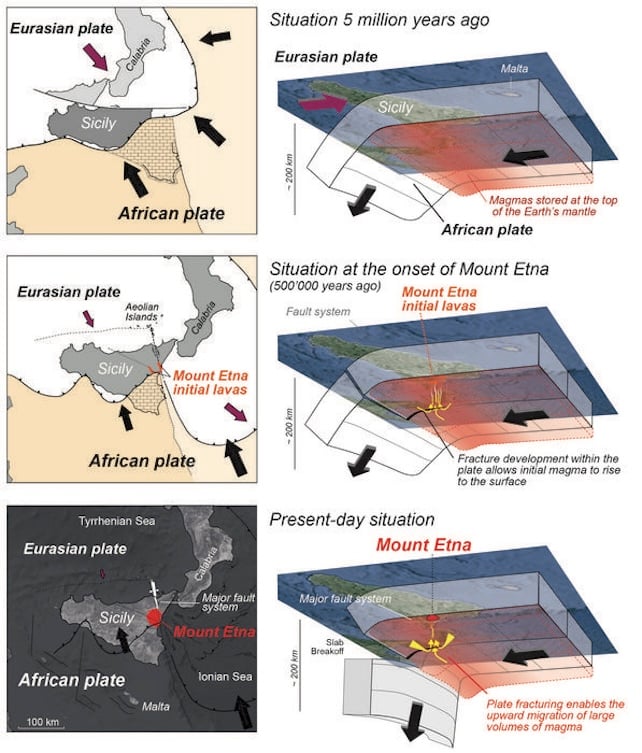
Instead, Etna seems to receive a slow supply of existing magma that was trapped between the upper mantle and the base of tectonic plates about 80 kilometers below the surface.
Alkaline lava formation depends on a low degree of partial melting in the mantle to preserve alkali contents, but this means large amounts can’t form quickly. Etna churns out alkaline lava, however, due to its unique magma source.
As the African Plate subducts below the Eurasian Plate, alkaline magma from some of these upper-mantle pockets evidently rises through cracks in the crust like water being squeezed from a sponge.
Etna may therefore be a “petit-spot” volcano, a category first identified in 2006 and characterized by magma drawn from pockets in the upper mantle.
Related: One of Earth’s Most Explosive Volcanoes Is Quietly Refilling With Magma
It’s still an oddity, though, since petit-spot volcanoes tend to be diminutive, not enormous like Etna.
“Our study suggests that Etna may have formed through a mechanism similar to the one that generates petit-spot submarine volcanoes,” says lead author Sébastien Pilet, a geoscientist at the University of Lausanne.
“This is unexpected, as such processes had previously only been observed in very small volcanic structures, typically rising no more than a few hundred meters.”
The study was published in the Journal of Geophysical Research: Solid Earth.
What did you think of this news? Leave a comment below and/or share it on your social media. This way, we can inform more people about the hottest things in technology, science, innovation, and gaming!
This news was originally published in:
Original source

