
Scientists Discover an Amazing New Use For Your Leftover Coffee Grounds
Scientists in South Korea have found a clever new use for your old coffee grounds: Insulation.
A team from Jeonbuk National University (JBNU) converted coffee waste into a material that was just as effective at insulation as materials currently used in buildings.
The advantage is that the new material is made from renewable sources rather than fossil fuels and, when it comes time to dispose of it, it’s biodegradable.
“Coffee waste is produced on a massive scale worldwide, yet most of it ends up in landfills or is incinerated,” says Seong Yun Kim, materials engineer at JBNU.
“Our work shows that this abundant waste stream can be upcycled into a high-value material that performs as well as commercial insulation products while being far more sustainable.”
Collectively, the world drinks about 2.25 billion cups of coffee every day – and that translates into a huge amount of discarded grounds. Most of this waste is burned or buried, which is as bad for the environment as dumping it down the drain.
Instead, scientists are increasingly finding more useful things to do with old coffee grounds. Recent studies have explored adding the stuff to concrete and other paving materials, using it to remove herbicides from the environment, and even extracting new drug compounds from it.
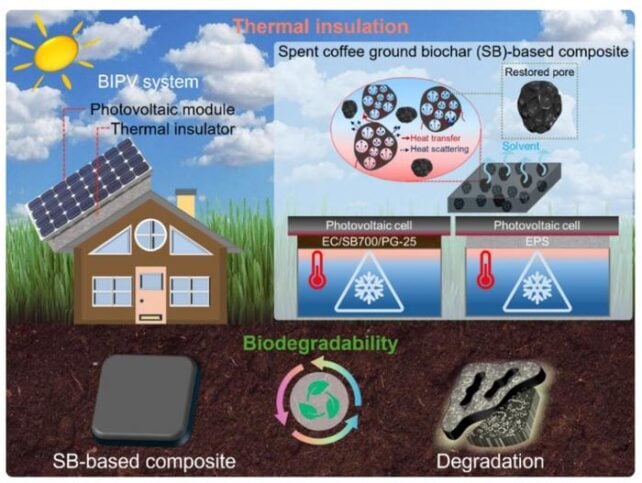
In the new study, the JBNU team investigated how well coffee grounds could function as a thermally insulating material.
First, spent coffee grounds were dried out in an oven at 80 degrees Celsius (176 degrees Fahrenheit) for a week. Then, they were cooked at much higher temperatures to produce a carbon-rich material known as biochar.
Next, this biochar was treated with environmentally friendly solvents – water, ethanol, and propylene glycol – and then mixed with a natural polymer called ethyl cellulose. Finally, the powdery mixture is compressed and heated into a composite material.
The polymer stabilizes the biochar, while the solvents are added to prevent the polymer from clogging the material’s pores. Those pores are an important property: they trap air, which is a very effective insulator against heat.
A material’s thermal conductivity is expressed as watts per meter per Kelvin – basically, how much thermal energy (watts) will pass through a material of a certain thickness (meters) given the temperature difference (Kelvin) between the two sides.
Materials with conductivity below 0.07 watts per meter per Kelvin are generally considered insulators. The most effective version of the JBNU team’s coffee-based composite boasted a thermal conductivity of just 0.04 watts per meter per Kelvin.

In lab tests, the researchers placed a range of insulating materials, including their coffee-based one, beneath a solar cell and measured the temperature of the air in a small chamber below the cell.
This tiny benchtop model replicated how insulation blocks excess heat radiating from solar panels, preventing it from penetrating rooftops and heating homes.
The version with the new material stayed consistently cooler than the one without.
The new material’s performance was on par with that of expanded polystyrene, one of the best commercial insulating materials currently available.
The difference, though, is that polystyrene is a synthetic polymer made from fossil fuels, so its production and eventual disposal are far more environmentally harmful.
In biodegradability tests, the coffee-based material had lost more than 10 percent of its weight after just three weeks. Polystyrene, on the other hand, remained basically unchanged after the same amount of time.
Related: Scientists Discover an Amazing Practical Use For Peanut Shell Waste
The researchers suggest that this kind of material could be best used for insulation in buildings, keeping the interior cool even while solar cells are working hard on the rooftops.
“This approach not only improves material performance but also contributes to a circular economy,” says Kim.
“By turning waste into a functional product, we can reduce environmental burdens while creating new opportunities for sustainable materials.”
The research was published in the journal Biochar.
What did you think of this news? Leave a comment below and/or share it on your social media. This way, we can inform more people about the hottest things in technology, science, innovation, and gaming!
This news was originally published in:
Original source
