
Ancient Landscape Reveals Bones of Humans Who Lived 100,000 Years Ago
A monumental archaeological excavation in Africa has uncovered the lives of the humans who lived there 100,000 years ago.
Thousands of stone artifacts and vertebrate remains, as well as sediments, suggest repeated visits by Homo sapiens in a wooded environment, a resource-rich refuge on the wild savannah of what is now the Afar Rift region of Ethiopia, before modern humans dispersed into Eurasia.
But not, perhaps, entirely without peril. Three partial human skeletons that survived the ravages of millennia reveal three very different fates: relatively rapid burial, burning, and being ravaged by wild animals.
“During recurrent ephemeral occupations of this rich landscape, humans shared this catchment with an array of animals,” writes a team led by archaeologist Yonas Beyene of the French Center for Ethiopian Studies in Ethiopia.
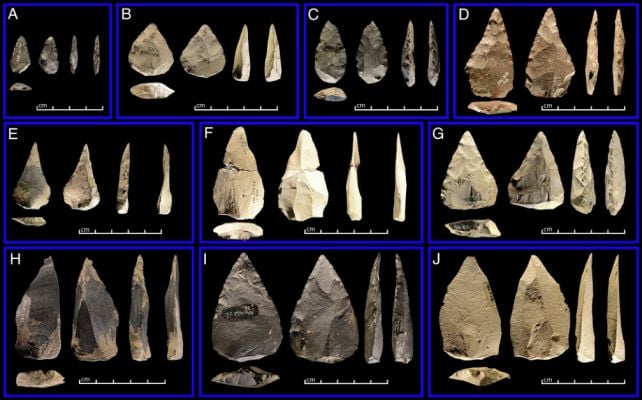
“Procurement of locally exposed raw material,” the team continues, “enabled fine and heavy-duty tool manufacture during occupations of unknown frequency and duration.”
“The results of this manufacture – and sometimes the remains of the human visitors – were embedded in overbank silts on an aggrading floodplain distal to the main river channel. They are now being revealed by slow wind and water erosion at Faro Daba.”
The Halibee archaeological site, which is part of the Middle Awash study area in Ethiopia’s Afar Rift region, is known for its extraordinary richness.
Beyene and his colleagues have been carefully excavating the site for years, uncovering evidence of repeated human use, remarkable because it’s all in the open landscape rather than buried and protected in a cave, as ancient hominid sites so very often are.
Their most recent effort focused on sediment layers dating back to around a centamillennium (100,000 years) ago.

It’s not just the number of artifacts and the open-air location that make Halibee special. The manner of their preservation matters, too. In caves, sediment layers build up slowly through long-term, continuous occupation. This makes them invaluable historical records, but it can be difficult to tell who did what and when.
Halibee was once a floodplain, and occupation was more sporadic. Humans would visit and depart, their abandoned items rapidly covered by sediment deposited by river floods, helping preserve clearer snapshots of individual visits. As a fertile landscape, it would also have attracted a wide range of animals.
Many of the stone tools and bones found at the site were simply left close to where they were dropped, giving Beyene and his colleagues a rare look at how early humans used the environment around them.

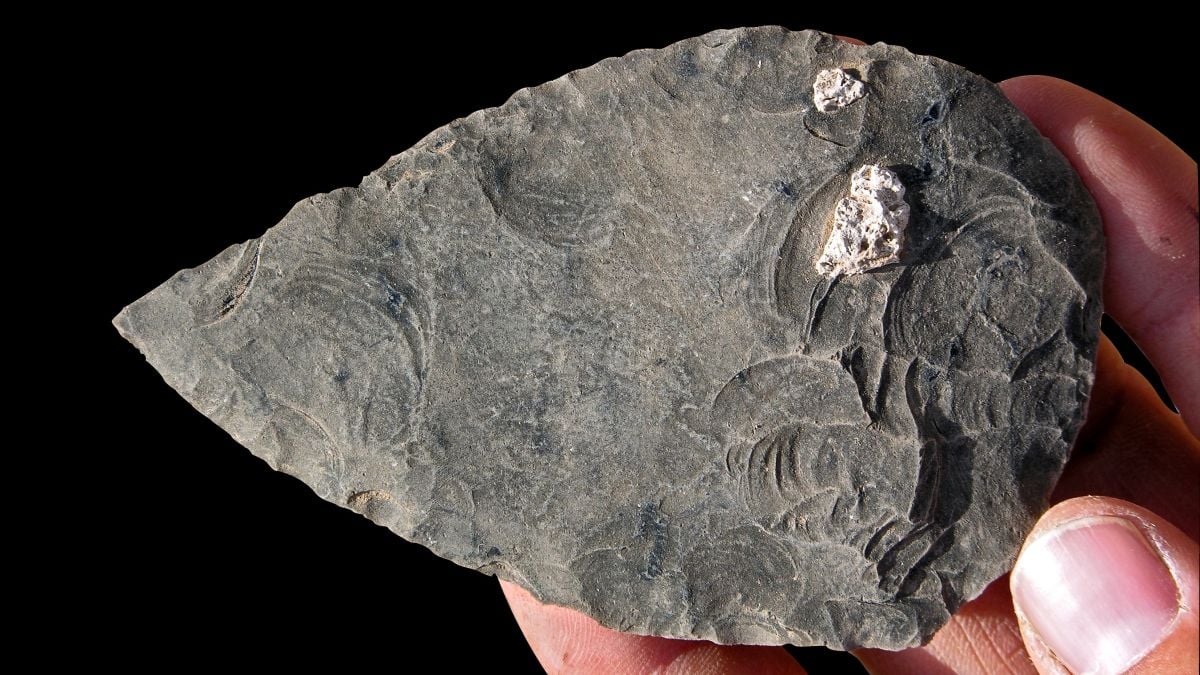
Stone tools found at the site show that the people visiting the area made both finer cutting implements and heavier-duty tools from locally available rock. Between 65 and 82 percent of all stone artifacts from each excavation were made from locally available basalt. There was also evidence of tool manufacture at the site.
Just 2 percent of the artifacts were obsidian, which was not locally available, suggesting trade or movement.
Meanwhile, a wide range of animal bones was excavated, including those of monkeys, antelopes, galliform birds, snakes, lizards, rodents, and even large predators, such as a feline the size of modern lions. Interestingly, there was no evidence of butchery marks on any of the animal bones.
And then there were the human remains, and this is where it gets interesting. The bones of three individuals paint three different pictures about what could happen after death.
The first individual was likely male, and the skeleton was in remarkably good shape, given the passage of time. The conditions of his bones suggest that his body was buried while the skeleton was still complete, articulated, and had soft tissue; that is, relatively quickly after death.
There is no evidence to suggest that this burial was a deliberate funerary rite. It may have been naturally covered up by rapid seasonal flooding, for example. Future discoveries, the researchers say, may reveal more.
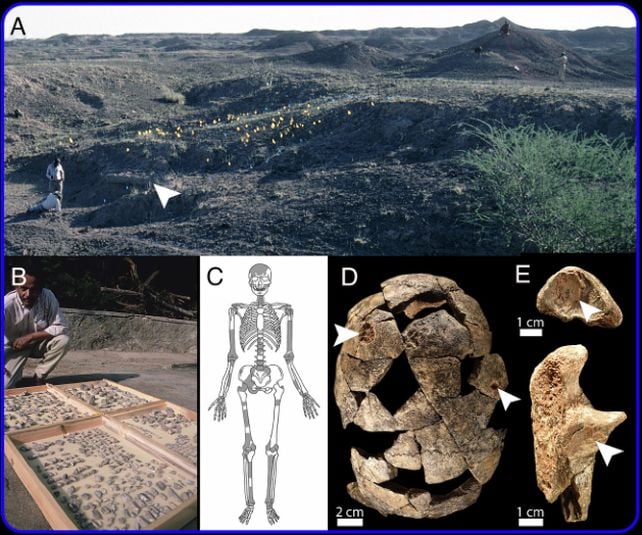
The second individual is known only from a molar and some small bone fragments that show signs of charring – and, as with the buried man, it’s impossible to know whether this was the result of human activity or a natural wildfire.
Finally, the third individual reveals the brutal reality of life in the Stone Age savannah. The bones, the researchers write, evince “extensive evidence of perimortem carnivore-induced damage, with ancient pitting, tooth scores, and fractures. Joints are missing.”
These marks, they say, are “perimortem”, dating to around the time of death. However, as with the other two individuals, the exact circumstances are unclear – it’s impossible to tell whether carnivore-inflicted injuries played a role in the person’s death, or were the result of scavenging not long after it.
Related: Did This Species Bury Its Dead 120,000 Years Before Us? New Claims Reignite Debate
Taken together, the discoveries bring back to life a place where humans and animals once existed side by side. The evidence they left behind of their lives and deaths represents a treasure trove that, Beyene and his colleagues say, will form a cornerstone of the region’s archaeology.
“The surface and subsurface resources embedded in Ethiopia’s Halibee member will last for generations,” they write in their paper.
Further investigations of the Halibee site should, the researchers predict, contextualize the discoveries already made there, “just as the Middle Pleistocene evidence lying directly below the Halibee member will contribute to understanding how behaviors, anatomies, and environments of the Middle Awash inhabitants changed across deep time.”
The findings have been published in the Proceedings of the National Academy of Sciences.
What did you think of this news? Leave a comment below and/or share it on your social media. This way, we can inform more people about the hottest things in technology, science, innovation, and gaming!
This news was originally published in:
Original source
