
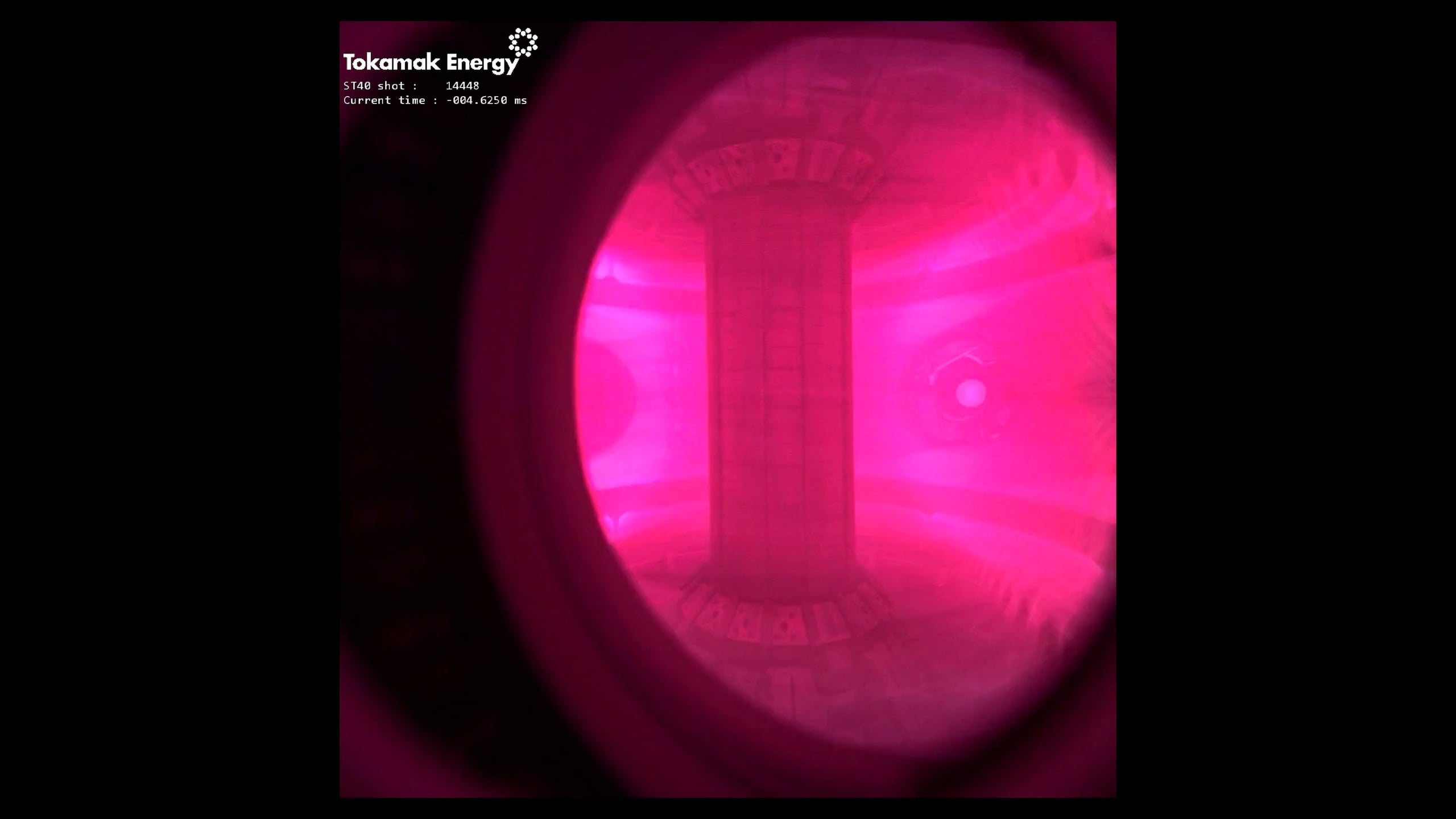
Watch Plasma Erupt in Full Color Inside a Fusion Reactor at 16,000 FPS
When the tokamak powers on, something magical happens in the confines of its reinforced belly.
Plasma born of heavy hydrogen blooms into brilliant pink, roiling and writhing around the doughnut-shaped chamber.
Then, tiny grains of lithium tumble into the maelstrom, sparkling like scarlet fairy dust before bursting into streaks of vivid green-yellow light.
Thanks to a high-speed color camera, we can watch this process in action as the plasma heats up inside Tokamak Energy’s ST40 machine, creating some of the conditions future tokamaks will use to smash atomic nuclei together to generate the fusion energy that could one day power the world.
But it’s not just the splendor of the sight that’s a marvel.
Plasma fusion has a long way to go before it’s close to ready for practical application – and watching the path of blazing lithium could help physicists overcome one of the major hurdles the technology faces: how to safely vent the tremendous heat escaping from a fusion plasma.

A tokamak needs to confine plasma at temperatures of millions of degrees to force atomic nuclei together.
But that confinement is not easy – and some of the tremendous energy swirling around inevitably escapes the confined plasma.
It has to go somewhere, so tokamaks are designed to channel as much of that escaping heat as possible toward components called divertors.
Currently, tokamak experiments are relatively brief. In a future fusion power plant, however, those components will have to withstand punishing heat loads for long periods without rapidly disintegrating.
Divertor heat load is such an important problem that it is one of the key factors shaping the design of future spherical tokamak power plants. In experiments on ST40, researchers have measured heat fluxes as high as 150 megawatts per square meter.
Heat exhaust is therefore one of the problems researchers are using ST40 to investigate – including whether the plasma itself can be coaxed into helping.
Tokamaks have, of course, been equipped with high-speed, high-resolution cameras for almost as long as there have been tokamaks.
High-speed color imaging isn’t entirely new, either: A color camera was deployed on Russia’s T-11M tokamak in 2014, as described in a 2016 paper.
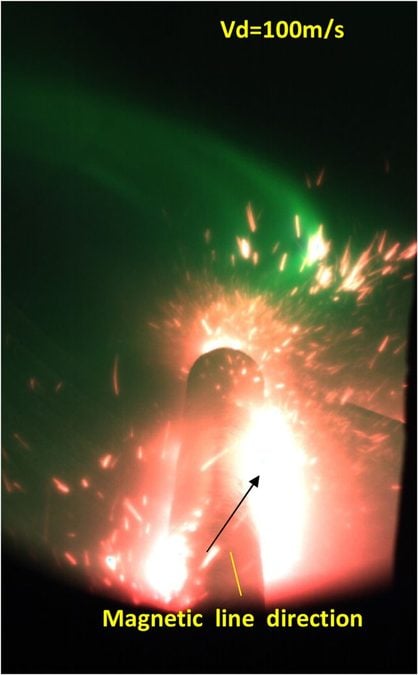
However, that paper noted a significant wrinkle. Although it was also tracking lithium at the plasma boundary, the camera was operating at 1,000 fps – not fast enough, the researchers noted, to follow the evolution of lithium filaments over time. For that, they said, speeds of more than 10,000 fps would be needed.
The camera trained on the interior of ST40 records at 16,000 fps.
Here’s what it’s looking for.
Normally, impurities in the plasma racing around inside a fusion reactor can create significant problems, causing heat to radiate away more quickly, which cools the plasma and can interfere with the conditions needed for fusion.
But if that cooling happens in the right place at the plasma’s edge, it could actually be an advantage – it could reduce the heat blasting the divertors, while the interior of the plasma torus remains hot enough to sustain fusion conditions.
This is the idea behind an experimental operating regime called the X-point radiator, or XPR.
The plasma is confined by a powerful magnetic field. The X-point is a region in that magnetic field near the divertor, where the magnetic field forms a distinctive X-shaped structure.
By encouraging impurities to radiate energy away around this region, physicists hope to cool the plasma before it reaches the divertor, reducing the punishment those components have to endure without cooling the fusion-producing core.
Lithium is one of the materials physicists have been experimenting with to see how that cooling can be controlled.
And that’s what those spectacular colors are doing.
Counterintuitively, the colorful plasma captured by the camera isn’t the hottest part of ST40. The fusion-hot core is too hot to produce the visible light we’re seeing; instead, the camera reveals what’s happening in the comparatively cooler plasma around its edge.
The pink glow comes from the deuterium gas fed into the tokamak, which emits a combination of red and blue wavelengths.
When the tiny, sand-sized grains of lithium first enter those cooler outer regions, neutral lithium atoms become excited and glow a brilliant crimson red.
As the lithium penetrates deeper into the hotter, denser plasma, however, its atoms lose an electron and become positively charged lithium ions. These Li⁺ ions emit a distinctive greenish-yellow light.
And because they’re now electrically charged, the lithium ions follow the magnetic field – turning those vivid green-yellow streaks into a glowing tracer of the otherwise invisible field lines confining the plasma.
A temperature map of the tokamak would be relatively easy to obtain even in black and white. What the color camera gives physicists is a way to trace different atoms and ions under different plasma conditions, revealing where the lithium travels and how deeply it penetrates.
Combined with spectroscopy, which precisely identifies the wavelengths of light being emitted, the high-speed footage gives physicists another way to see whether impurities are radiating energy where they want them to.
If they’re not, physicists can change the conditions and try again, learning how to keep the cooling where they want it – knowledge that could eventually shape how future fusion reactors dispose of their tremendous heat.
And there are early signs that the XPR approach could work.
In preliminary results from experiments in ST40, researchers report that they have been able to produce a radiating region that moves across the X-point and significantly cools the plasma edge. When this happens, measurements show that the heat reaching the divertor falls.
The researchers think much of the radiation in those experiments came from carbon knocked off the tokamak walls, rather than the deliberately introduced lithium. But experiments using lithium and neon to further reduce the heat load are now underway.
Computer modeling suggests lithium could be particularly useful because it may be possible to concentrate it around the divertor, where its cooling effect is wanted, without allowing enough of it upstream to degrade the performance of the plasma core.
And Tokamak Energy plans to push the idea even further.
ST40 is currently undergoing a major upgrade to replace its carbon armor with molybdenum, introduce systems for coating its plasma-facing components with lithium, and add new diagnostics to scrutinize what happens at the plasma edge.
After that, perhaps we’ll get to see even more spectacular colors shimmering out of space – carrying with them information that could help bring us closer to the fusion future.
This article was fact-checked by Rebecca Dyer and edited by Rebecca Dyer. While we pride ourselves on our process, we are only human. If you spot a mistake, please let us know.
What did you think of this news? Leave a comment below and/or share it on your social media. This way, we can inform more people about the hottest things in technology, science, innovation, and gaming!
This news was originally published in:
Original source
