
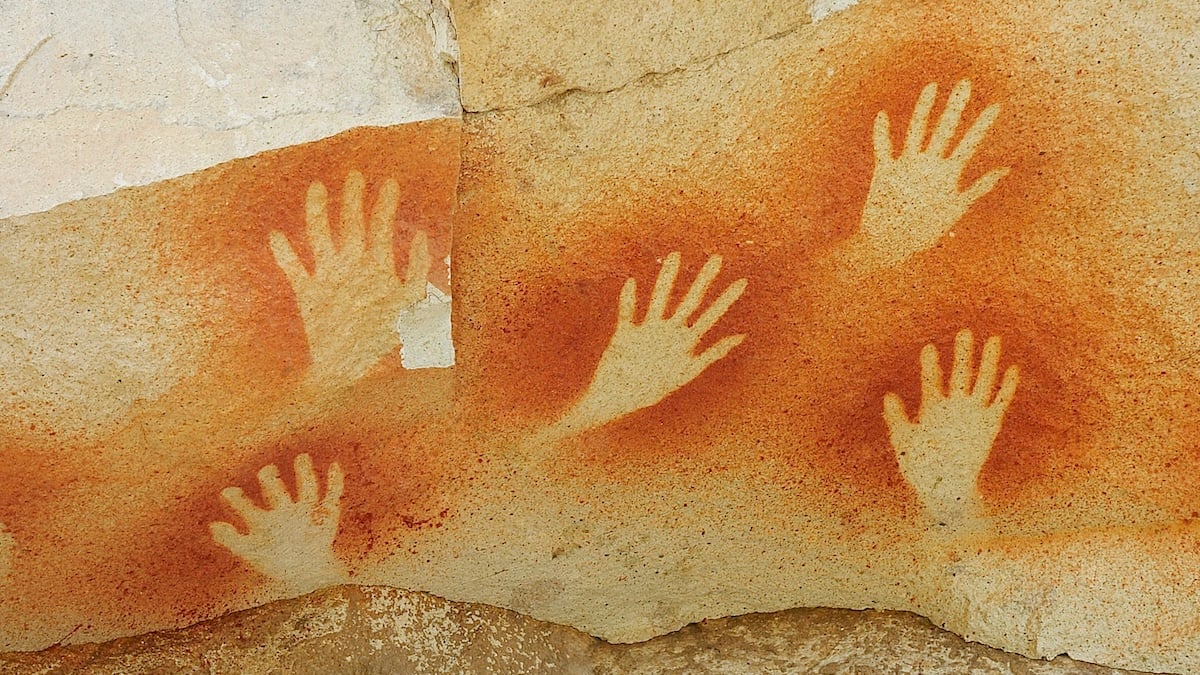
Two Ancient Clues May Finally Explain Why 90% of Us Are Right-Handed
It doesn’t matter where you’re from or what cultural background you have – about 90 percent of people are right-handed.
Have you ever wondered why?
According to new research, the preference dates right back to our distant hominin ancestors. We prefer one hand over the other because we walk on two legs – and our bigger brains decided the right hand was favored.
That means it’s not just us Homo sapiens with a preference. The team estimated that Neanderthals were also mostly righties, and the farther away you get from us on the family tree, the weaker the preference generally gets.
“This is the first study to test several of the major hypotheses for human handedness in a single framework,” says Thomas Püschel, evolutionary anthropologist at Oxford University in the UK.
“By looking across many primate species, we can begin to understand which aspects of handedness are ancient and shared, and which are uniquely human.”
Previous research has shown that left- or right-handedness is mostly determined by genetics, and fetuses demonstrate a preference as early as eight weeks in the womb.
But it goes back way farther than your father. Archaeological evidence, first reported in 2016, suggests that hominins were favoring their right hands as far back as 1.8 million years ago.
For the new study, scientists from Oxford and the University of Reading in the UK set out to explore how, when, and why the preference came about.
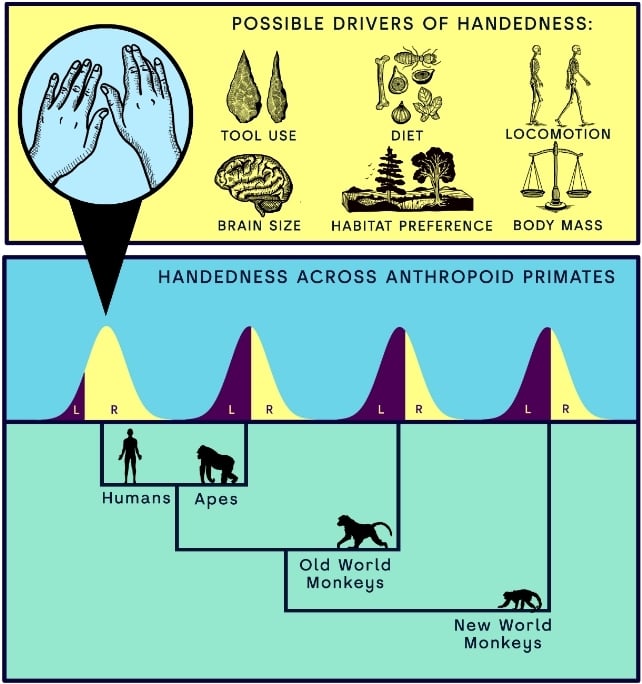
It’s been hypothesized that right-handedness may have started when our ancestors started using tools, or came down from the trees, or began walking upright, or around the time of biological changes like body mass or brain size.
To start with, the team performed a meta-analysis on data involving over 2,000 individuals from 41 species of monkeys and apes, including humans. These were then examined using models that account for evolutionary relationships between species.
The researchers were looking for signs of a bias towards one hand over the other, and the strength of that preference.

There was little evidence of any bias for most species, but humans stood out as an anomaly, with a strong preference for the right hand.
Only the East Javan langur (Trachypithecus auratus) had a stronger rightward bias, and intriguingly, orangutans and snub-nosed monkeys showed a slight preference for their left hands.
When the researchers examined which of the hypothesized factors seemed to play a role, they found that the strongest associations with handedness were with brain size and the relative length of our arms and legs.
From this, the team could then extrapolate the model to our extinct relatives, such as Neanderthals, to see if they might have had a bias towards one hand or the other.
A fascinating pattern emerged from the data, with H. sapiens slotting into a clear evolutionary trend.
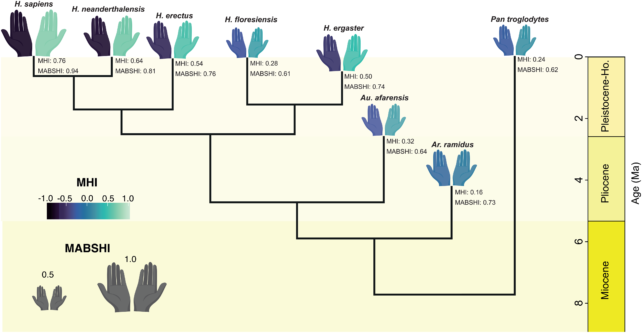
Our older ancestors, such as Australopithecus afarensis, only showed slight preferences for their right hands. But by the time the Homo genus appeared on the scene, that bias was building.
H. ergaster and H. erectus showed increasing rightward preferences in the model, and Neanderthals, our closest cousins, showed stronger bias yet again, second only to us.
One obscure little relative could be the exception that proves the rule. H. floresiensis – the so-called “hobbits” of Indonesia – had only a very slight preference for either hand, about on par with modern-day chimpanzees (Pan troglodytes).
This could back up the researchers’ hypothesis that it was big brains and bipedalism that drove handedness. After all, these hobbits still had relatively small noggins and hadn’t fully given up their tree-climbing ways.
Together, the findings suggest that the quirk of favoring a hand so strongly occurred in two stages.
First, our ancestors began to walk upright, which freed up their front limbs to do other jobs and allowed hands to evolve into the sensitive instruments of fine motor control we rely on today.
Other animals can have preferences for the eyes or limbs of one side over the other, and research shows that those that do tend to perform better at survival tasks. Maybe early human ancestors gained an edge from this early kind of hands-free bias, too.
But why then did 90 percent of us ‘choose’ our right hands, in what should be essentially a coin toss?
That might come down to the way our beefy brains are wired, so that each hemisphere specializes in different tasks. As this neural efficiency developed and brains grew bigger, a right-hand preference could have become baked in – marking the second stage in this handedness progression.
“The initial locomotor change prompted by bipedalism can be seen as providing ecological and anatomical opportunities for manual specialization, while encephalization may have later reinforced and further canalized population-level patterns of lateralization,” the researchers write.
“Furthermore, culture may have acted concurrently with or amplified the effects of this emerging trajectory of hominin right-handedness.”
Related: Rare Genetic Variants Are Curiously Connected With Being Left-Handed
The scientists suggest that there are still open questions to answer, such as why there are any lefties left at all, and whether similar evolutionary patterns can be seen in other animals with preferred limbs, such as parrots and kangaroos.
The research was published in the journal PLOS Biology.
What did you think of this news? Leave a comment below and/or share it on your social media. This way, we can inform more people about the hottest things in technology, science, innovation, and gaming!
This news was originally published in:
Original source
