
The Secret to Why Sloths Are So Slow May Be Hidden in Their DNA
Sloths are unusual: they’re the slowest-moving mammals on the planet, have the slowest metabolisms too, and do not constantly regulate their body temperature.
Now, a new genetic study has uncovered clues to how these famously unhurried creatures evolved such an extreme low-energy lifestyle.
An international team of researchers has conducted a comprehensive analysis of the two-toed sloth (Choloepus didactylus), comparing it with dozens of other mammals, including fellow xenarthrans the anteater and the armadillo.
Their analysis revealed several DNA sequences that can move or copy themselves into new positions within the genome.
Known as ‘transposons‘ or ‘jumping genes’, they form a major part of the story of how an animal evolved.
In the case of the sloth and its branch in the evolutionary tree, evidence of these transposons jumping around stretches back over 30 million years.
But what really grabbed the researchers’ attention was that a number of these genes were linked to mitochondria, which function as powerhouses inside cells, and to other genes involved in metabolism.
“Our findings suggest that sloths might have evolved genetic ‘backup systems’ that help compensate for their ‘relaxed mitochondria’ and support their unique lifestyle,” says biodiversity genomicist Camila Mazzoni, from the Leibniz Institute for Zoo and Wildlife Research in Germany.
In other words, the low energy demands of sloth cells may have allowed mutations to accumulate in their sluggish mitochondrial genomes.
The ‘jumping genes’ may be a way of compensating, creating alternative genetic routes to keep the animal running. But we won’t know without further research.
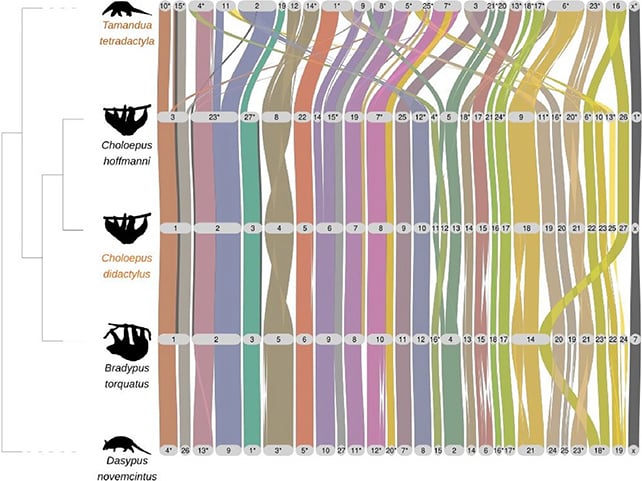
Notably, several of the genetic sequences found here have been conserved across approximately 30 million years. They appear to have originated in a common ancestor of modern sloths, but after sloths diverged from anteaters and armadillos.
“Sloths have the slowest metabolism of any mammal, yet they remain healthy,” says Mazzoni.
“Understanding how they achieve this may reveal new insights into how cells manage energy efficiently.”
Enabling a languid lifestyle may be the key benefit – and the findings from this study have implications for human health, too.
“Many human conditions – including diabetes, aging-related disorders, neurodegeneration, and muscle wasting – involve problems with energy production and mitochondrial function,” says molecular biologist Pedro Galante, from the Hospital Sírio Libanês in Brazil.
Conditions like obesity can have an impact on mitochondria, for example, and disruption to these power stations has been linked to diseases such as Parkinson’s.

The thinking is that if sloth DNA can teach us how to keep a mammal healthy even when it’s running at less than full capacity, this could give us a way to protect these energy-producing units in human cells.
“While further research is needed, sloth cell lines may offer a natural model for understanding how organisms cope with low-energy states, and what goes wrong in disease,” says Galante.
“In the long term, this could inform research into tissue preservation, critical care medicine, aging, metabolic disease, and even long-duration space travel.”
This will need to be carefully done, though.
The DNA edits introduced by jumping genes can lead to diseases such as cancer in humans, making it even more remarkable that sloths have such a high tolerance for them.
The next steps here are to look more closely at the copy-and-paste genes that sloths have hung on to for tens of millions of years and find out exactly what they’re doing biologically – specifically with regard to mitochondria and metabolism.
These fascinating creatures have evolved to have characteristics that might otherwise be considered problematic – being fast rather than slow is usually seen as the best bet for survival – and part of the explanation for that can be found right inside sloth DNA.

Related: Sloths The Size of Elephants Roamed America, Before Abruptly Vanishing
“Evolution has already run billions of experiments,” says bioinformatician Marcela Uliano-Silva, from the Wellcome Sanger Institute in the UK.
“By studying unusual animals like sloths, we sometimes uncover biological solutions that humans never evolved.”
The research has been published in BMC Biology.
What did you think of this news? Leave a comment below and/or share it on your social media. This way, we can inform more people about the hottest things in technology, science, innovation, and gaming!
This news was originally published in:
Original source
