
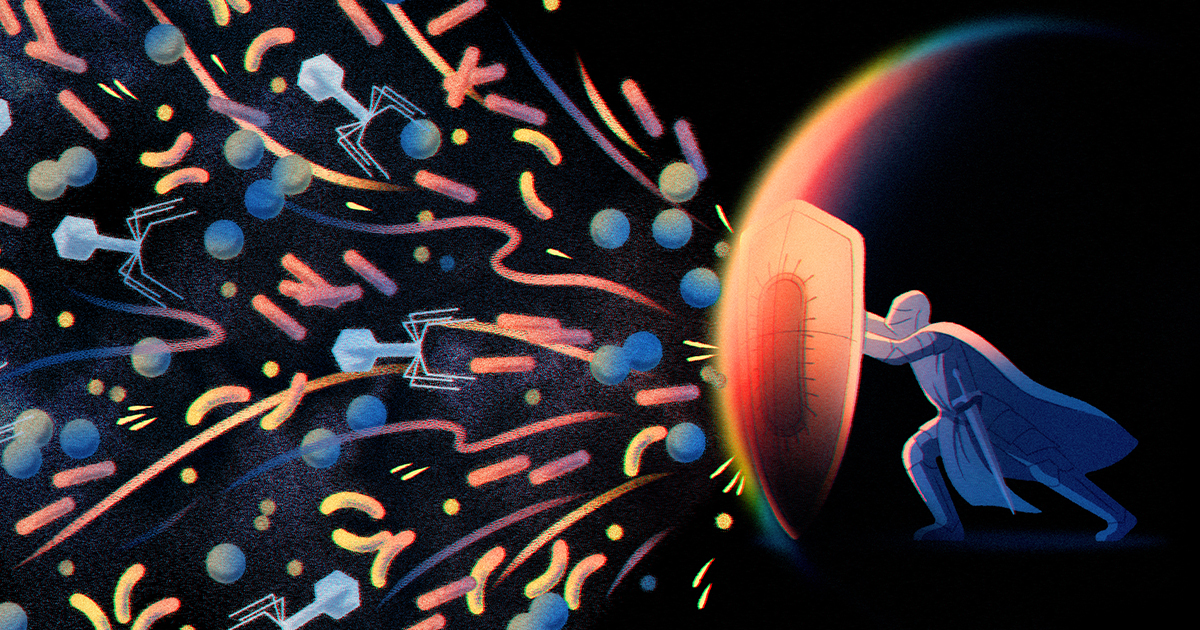
The Ancient Weapons Active in Your Immune System Today
Evolutionary arms races — where one species is pitted against another, driving the evolution of new or more sophisticated weapons as each tries to gain the upper hand — are ubiquitous in nature. One of the oldest and fiercest battles has been waged for billions of years between bacteria and the viruses that infect them. This escalating warfare has selected for bacteriophage viruses (or “phages”) that devise new ways to invade bacterial cells and, in turn, for bacteria that devise new ways to fend phages off. In their attempts to outmaneuver one another, each species will try anything to stay one step ahead.
In recent years researchers have come upon a surprising finding: Some of the machinery that bacteria use to defend against phages exists, almost unchanged, in our own cells. According to dozens of discoveries made over the past decade, the rules of engagement between cells and viruses were written billions of years ago and still largely define how our innate immune system, the first responder to infection, defends us against viruses and bacteria today.
“Seeing that the rules of host-virus interactions are unchanged over billions of years is a really hard thing to digest,” said Philip Kranzusch, a microbiologist at Harvard Medical School who was one of the first researchers to discover that a key component of human immunity also exists in bacteria.
The pace of evolution for viruses is “insanely high,” he said, compared to that of long-lived, multicellular eukaryotes like ourselves. Indeed, to keep up with the rapid pace of microbial evolution, animals have evolved targeted defenses such as antibodies that adapt to novel viruses as they invade. And yet, strangely enough, our frontline immune defenses seem to share many antiviral tools with bacteria. “Why would the rules be so fixed?” Kranzusch said.
Two recent waves of discovery broke this field open. First, in 2018, researchers reported a variety of novel bacterial defense systems against viruses, which now number in the hundreds. The second wave, starting around 2019, showed that some of these bacterial mechanisms exist in plant and animal cells, including our own — and that they still work the same way they did in those distant ancestors.
“Those two things combining together is what really made the field explode: There’s lots of new phage defense systems, and, hey, those systems are directly related and relevant and mechanistically going to tell us information about human immunity,” said Kranzusch, who will receive the National Academy of Sciences Award in Molecular Biology for his research in the field at their 163rd annual meeting on April 26, 2026.
These and other discoveries that followed reveal an unexplored landscape of human innate immunity — one that could lead to new medical treatments and biotechnological tools, much as the discovery of the bacterial immune system CRISPR-Cas made genome editing possible.
“There’s a lot to do, and it’s really important to do it,” Kranzusch said, “which is why so many labs have jumped in on it.”
Defense Islands
Until the last decade, biologists knew of only two ways that bacteria defend against viruses. In the 1950s, they discovered restriction-modification enzymes, which are bacterial proteins that cut DNA from invading viruses at specific sequences. These enzymes eventually became laboratory workhorses that enabled the revolution in genetic engineering. Then, in the early 2000s, researchers described CRISPR systems, which also recognize and cut specific DNA sequences and are now widely used for genome editing.
Around the time CRISPR was being discovered, Rotem Sorek, a microbial immunologist, was working on bacterial genomics as a postdoc at Lawrence Berkeley National Lab. “I immediately thought that that’s one of the most interesting things in biology I ever bumped into,” he recalled. However, it also became clear to him that most bacteria don’t have CRISPR. In that case, he wondered, how do they fight phages?
Because both restriction modification enzymes and CRISPR had led to important biotechnological tools, “I thought that if we discovered more immune mechanisms, it might be useful,” Sorek said. “That was the source of the motivation.”
A few years later, after he established his own lab at the Weizmann Institute of Science in Israel, Sorek and his team observed that big constellations of immune genes, including restriction-modification enzymes and CRISPR arrays, tended to cluster together in the same region of bacterial genomes. He and other labs observed that genes of unknown function within these “defense islands” or “genomic islands” could potentially represent novel anti-phage mechanisms.
To find out, Sorek’s team developed a computational pipeline to discover more defense islands. Then he experimentally pitted each predicted defense system against a variety of phages, setting up bacteria-versus-phage duels in petri dishes. In 2018, his team showed that many of the unknown genes in these defense islands did, in fact, function as a variety of anti-phage defense systems.
Through this approach of computational prediction followed by experimental screening, several research teams discovered hundreds of new systems of innate immunity: a veritable “explosion of phage defense,” Kranzusch said. (Just this month, in April 2026, two research teams used machine learning to identify hundreds of thousands of candidate anti-phage defense systems, and they have already validated dozens of them.)
“It was so exciting because it suggested that there was just this big landscape of new types of defense systems that no one knew about,” said Alex Gao, a computational biologist at Stanford University who has experimentally verified anti-phage activity in 29 out of thousands of predicted bacterial defenses. “It was hiding under our noses in this big vat of data.”
Soon, the discovery of a critical pathway in human innate immunity would collide with this explosion of phage defense mechanisms, revealing a vast, unexplored territory in plant and animal immunity.
STING Cycle
How can a cell tell that it has been invaded by a virus? One sign is the presence of DNA where it doesn’t belong in the cytoplasm — a sign of infection or severe stress.
In 2013, the biochemist Zhijian “James” Chen and his team at the University of Texas Southwestern Medical Center discovered how human cells generate an innate immune response when they detect this kind of misplaced DNA. When the enzyme cGAS senses DNA in the cytoplasm, it produces a secondary molecule called cyclic GMP-AMP (cGAMP). Then cGAMP activates the STING protein, which sets off a signaling cascade that ultimately turns on immune genes. These immune genes kick off an inflammatory response — the first line of defense against an invader.
The STING protein, and the downstream process by which it activates inflammation, were described back in 2008. But no one knew how STING was activated. Chen’s work — describing a new human innate immune pathway called cGAS-STING — filled in the gap. In 2024, Chen received the Lasker Award for this breakthrough.
“Chen’s paper was brilliant — an instant classic,” Kranzusch said. “It made everything else make sense.”
Almost everything. One thing that didn’t quite make sense was how the essential cGAS-STING mechanism could have evolved in humans. “It’s hard to understand how that would come to be,” Kranzusch said.
To dig into its evolutionary history, he looked for other proteins that produce cGAMP in other species. When he found one — a bacterial enzyme that makes cGAMP, described by John Mekalanos’ lab at Harvard Medical School in 2012 — Kranzusch, who at the time was a postdoctoral fellow at the University of California, Berkeley, worked to understand its molecular structure.
The bacterial protein did not share a DNA sequence with the human cGAS. So it was a huge surprise when he found that the two proteins were virtually identical in shape and structure. “I always remember that day,” he recalled, “because I ran into my adviser’s office and I’m like, ‘You’re not going to believe this.’”
In 2016, when Kranzusch launched his own lab at Harvard Medical School, he and Mekalanos, along with postdoctoral fellows Aaron Whiteley and Ben Morehouse, continued the search. Their careful structural work on a variety of bacterial cGAS-like enzymes, all of which produce cGAMP or related dinucleotide signals, showed that these enzymes look just like human cGAS too. They published their findings in a series of papers in 2019 and 2020.
The findings were remarkable. After billions of years of evolution, human cGAS and its bacterial equivalents were not recognizably related at the level of DNA or even amino acid sequence. Out of a 300-amino-acid-long sequence, the bacterial and human cGAS proteins share only five or six amino acids, said Whiteley, who now runs his own lab at the University of Colorado, Boulder. Yet the shape of the part of the protein that produces the dinucleotide cGAMP signal has remained structurally unchanged for all that time.
“The structure, that’s key to function,” Whiteley said. “The protein can’t change in structure. But it can change in sequence to try and disrupt all the ways the virus is trying to antagonize the system.”
The discovery of the structural similarity was surprise enough. But did these bacterial enzymes, like human cGAS, protect against foreign viruses? Yes. That same year, Sorek’s team showed that the bacterial cGAS enzymes did in fact work as an anti-phage defense.
Both teams eventually found STING in bacteria as well. When they confirmed that the bacterial STING functioned in immune defense much like the human STING, “all the dots really started to connect,” Kranzusch said. “Then we had everything.”
The hardest part of this work was neither solving the protein structures nor testing their functions. “The dogma in the field was that immune proteins should not be old. And that was the really hard part to overcome with the cGAS-STING pathway,” Kranzusch said.
“We knew it was conserved, and it was doing the same function, and it was maintained across billions of years of evolution,” he continued. “As the data became overwhelming, that broke down the barriers for all sorts of other findings in the field.”
Cast of Characters
Since the discovery of the uncanny correspondence between bacterial and human cGAS-STING, computational analysis of bacterial defense islands has predicted hundreds of distinct mechanisms of innate immunity. Some of the mechanisms cleave viral DNA or RNA transcripts to kill the viruses; others terminate the reproduction of new viral DNA. “Quite a few of these defense systems turn out to be suicidal,” said Eugene Koonin, an evolutionary biologist at the National Institutes of Health who published a foundational paper on defense islands in 2011. That is, they cause the cell to self-destruct, thereby preventing further spread in the viral population.
But over billions of years, phages have evolved ingenious countermoves to evade such defenses. For example, in response to bacterial cGAS-STING, phages deploy molecules that sponge up the cyclic dinucleotide signals (cGAMP) that connect the sensor (cGAS) to the effector (STING). This effectively short-circuits and overcomes the defense.
Countering that, bacteria evolved a mechanism called Panoptes — first described in 2025 by Whiteley, Morehouse, and their colleagues — which constantly generates cGAMP signals that are similar but not identical to those generated by cGAS. An invading phage then sponges up the cGAMP decoys, allowing the true signal to reach its target (STING) and trigger cellular self-destruction.
This trick works only because the cGAS and Panoptes dinucleotides are different enough for the cell to distinguish them and similar enough that the phage can’t tell the difference. It’s a dangerous balance — one that probably frequently misfires.
“This is the marvel of bacteria,” Whiteley said. “They’re replicating so rapidly that they can try a lot of things that don’t work in order to find the very few that do.”
Another example of fascinating moves and countermoves can be found in a bacterial defense mechanism that depletes NAD, an essential cofactor. NAD is an electron carrier that, every second, greases the wheels of millions of biochemical reactions in the cell. By quickly destroying all cellular NAD, bacteria grind biochemical reactions to a halt, preventing viral replication. But phages, not to be outdone, have evolved ways to reconstitute NAD and evade this bacterial defense, Sorek’s team has found.
Then there’s viperin, a human protein that makes modified nucleotides that quickly terminate viral replication; its mechanism of action was deciphered in 2018. Soon after, Aude Bernheim, who was a postdoctoral fellow in Sorek’s lab and now leads her own research group at the Pasteur Institute in Paris, found homologues of viperin in bacteria. She also showed that they work the same way human viperin does.
Gasdermins are immune proteins present in the cytosol that kill the cell when it senses an infection by piercing a hole in the cell membrane. The mechanism for gasdermins in humans was described in 2015. In 2022, Tanita Wein, who trained as a postdoc in the Sorek lab and now leads her own research group at the Weizmann Institute, discovered that gasdermins work the same way in bacteria as they do in humans.
Researchers initially made headway in the field by mapping existing knowledge of human immunity onto bacterial genomes. Now they are doing the opposite: investigating whether the hundreds of new bacterial immune systems can be used to predict still unknown mechanisms in humans and other eukaryotes.
This predictive framework has already borne fruit. For example, Sorek’s team discovered a bacterial protein that, upon sensing infection, depletes ATP (molecular energy) from the cell, thus preventing the virus from replicating. They later found it in the genomes of animals, including corals and insects (though not humans). When tested in living tissues, the coral and insect proteins worked the exact same way as they do in bacteria.
“This is a very strong revelation, because doing research in bacteria is much easier than doing research in humans,” Sorek said. “One of the most important influences of our research is this ability to use bacteria to study higher organism immunity.”
An Evolutionary Cauldron
Although there are hundreds of bacterial defense systems, most bacteria have only about a dozen. They are inherently costly and always carry the risk of triggering accidental self-destruction, which limits how many any single bacterium can have. Some mechanisms, like restriction-modification enzymes, are common, while others are relatively rare. CRISPR exists in about 40% of prokaryotic genomes; viperins are present in only about 0.5%.
Many of the most common immune mechanisms in prokaryotes have not been inherited by eukaryotes, while some relatively rare ones have been inherited and have “flourished,” Koonin said. The question is: Why? Why don’t our cells have CRISPR? And why did cGAS-STING, a relatively rare immune mechanism in bacteria, become such a central tool in our arsenal?
In some cases, bacterial defense mechanisms could have been acquired by eukaryotes about 2 billion years ago, when an archaeal cell first engulfed a bacterial one — which eventually settled in as a mitochondrion organelle — and seeded the eukaryotic lineage. Other mechanisms may have been acquired later through horizontal gene transfer, a mechanism commonly used by bacteria to swap chunks of DNA, which occurs with less frequency in eukaryotes.
The acquisition “in itself is not such a big problem,” Koonin said. “How and why [rare defenses] replaced the most common prokaryotic defenses — that is more intriguing and, of course, not entirely clear.”
One possibility is that in bacteria, defenses often come with several genetic components organized in small arrays, or operons, that are regulated together. Restriction-modification enzymes, toxin-antitoxin genes, CRISPR and Cas, cGAS and STING — each is a system made of genes that sit next to each other in bacterial genomes. This makes it easy for bacteria to share the entire toolkit.
But in eukaryotes, because of the more complicated way our genomes are organized and regulated, genes’ operon organization is often disrupted. “Once you lose an operon, you are very unlikely to reacquire it by horizontal transfer,” Koonin said. “Once it is disrupted, it is effectively gone.”
When Tera Levin and Edward Culbertson, a postdoctoral fellow in her lab at the University of Pittsburgh, surveyed cGAS and STING proteins across a broad swath of eukaryotes, they found that it’s quite common to find one or the other missing. That begs the question of what one piece is doing when the other isn’t there.
“These components either aren’t there, or aren’t there in the combinations I expected — what are they possibly doing?” Levin said. “That is a question we encounter over and over again in this part of the field.”
It’s possible that the pieces evolved entirely new functions. For example, more than a decade ago, the evolutionary biologist L. Aravind showed that some restriction-modification enzymes became essential enzymes in eukaryotic epigenetics, where they place (or remove) epigenetic marks at specific locations on the chromatin. In 2025, his team showed that Wnt proteins, essential signaling molecules in animal development, also originate in bacterial conflict systems.
In this way, bacteria serve as a kind of “maker space” for accelerated evolutionary experimentation and innovation, generating novelty that then is seeded across life. This seeding is not just a thing of the distant past: Eukaryotes have continued to beg, borrow, and steal from bacteria and phages in more recent evolutionary time.
Several million years ago, the wild fruit fly Drosophila ananassae horizontally acquired a viral toxin gene that cuts DNA, probably from phages of endosymbiotic bacteria. In 2025, Noah Whiteman, a biologist at Berkeley, and his team discovered that the fruit fly uses this phage toxin not to kill viruses but rather to poison parasitic wasps that lay eggs inside fly larvae. Amazingly, the fly manages to wield this powerful new weapon without poisoning its own cells.
Unlike bacteria that can easily swap genes with their neighbors and evolve at warp speed, multicellular organisms are stuck with sexual reproduction — which means that evolution proceeds at a slower pace. By taking advantage of the rapid evolution of bacterial and viral weapons, insects and other eukaryotes can accelerate their own evolutionary process to stay a step ahead of their enemies.
“When you borrow a gene from another organism that’s evolving very rapidly, that’s a great strategy, because you can borrow tools at a faster rate than you could ever make them,” Whiteman said.
It’s now clear that bacterial communities are like a cauldron where new molecular weapons are forged and are always evolving. This microbial arsenal contains hundreds, perhaps thousands, of different defense systems.
Diverse eukaryotic lineages, from unicellular eukaryotes to plants and animals, have repeatedly borrowed, adapted, and lost defenses from this arsenal over evolutionary time. In this cauldron, the rules of all evolutionary warfare — microbial, animal, vegetal — continue to be written.
What did you think of this news? Leave a comment below and/or share it on your social media. This way, we can inform more people about the hottest things in technology, science, innovation, and gaming!
This news was originally published in:
Original source
