

Scientists Identify a Hormone Spike Linked to Anorexia Nervosa
Anorexia nervosa is a serious, life-threatening eating disorder that is notoriously difficult to recover from.
Doctors can help patients restore their nutrients and energy, while psychologists can help reshape the thought patterns that underlie the disorder.
But some 40 percent of hospitalized patients are re-admitted within six months of discharge.
Eating disorder researchers are desperate to understand the ways anorexia nervosa disrupts a patient’s metabolism.
What is it that makes this particular slope so slippery?
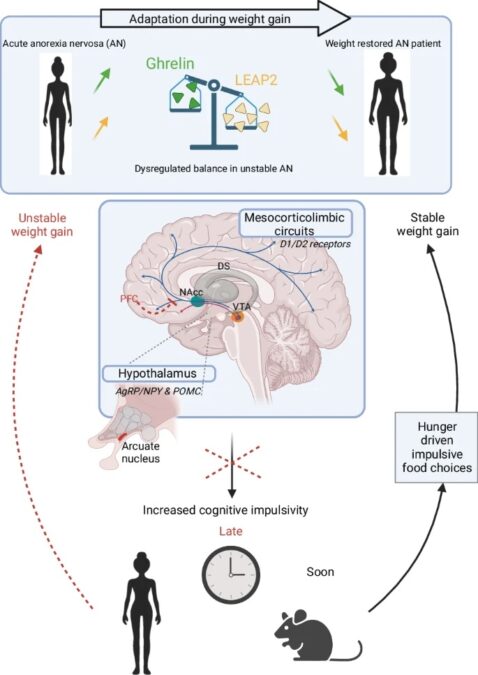
New research published in Translational Psychiatry suggests a hormone called ghrelin, and a ghrelin antagonist known as LEAP2 (liver-expressed antimicrobial peptide 2), may be involved.

Neuroscientist Virginie Tolle recently presented the research at the Federation of European Neuroscience Societies Forum 2026.
Tolle, who is based at France’s National Institute of Health and Medicine (INSERM), hopes these findings may eventually inform new treatments for patients with anorexia nervosa.
“[Anorexia nervosa] is characterized by self-imposed food restriction, often accompanied by hyperactivity, which together can lead to severe undernutrition and potentially life-threatening consequences. Indeed, anorexia nervosa has the highest mortality rate amongst all psychiatric disorders,” she notes.
“Despite its severity, there is currently no effective drug to treat this disorder. Existing treatments rely on nutritional rehabilitation and multidisciplinary care; however, recovery can take many months and relapse rates remain high.”
Tolle and her colleagues conducted research involving 30 women diagnosed with anorexia nervosa, aged 18 to 60 years.
These participants were part of a four-month program at a specialized eating disorders center, where they were undergoing refeeding treatment.
For the study, they gave blood samples before and after their treatment, and again six months down the track.
The researchers were looking for ghrelin, a hormone that the stomach releases when it’s time to eat. It’s unclear if ghrelin is released as a response to hunger, or as a way of signaling it.
What we do know is that in most people, when ghrelin is released, it means it’s time to eat. But for people with anorexia nervosa, Tolle thinks something may be going wrong.
The new results support that theory.
Tolle and colleagues report that the anorexia nervosa patients had about 20 percent higher levels of LEAP2 when first hospitalized, compared to what they had after four months of treatment, during which they re-gained weight.
As an antagonist of ghrelin, LEAP2 counteracts the body’s normal hunger signals.
“The ghrelin/LEAP2 ratio was negatively correlated with impulse control in patients after weight restoration, but only in those who maintained stable weight gain after discharge,” the team notes.
Among those who relapsed, LEAP2 levels were back up.

In parallel, the researchers conducted experiments on mice that had lost a quarter of their body weight, which reiterated the hormone’s involvement in impulse control.
To test impulsivity, the authors offered restricted-diet mice a small, immediate food reward, or, if they could stand being patient, a much larger meal.
Mice that had been starved became more impulsive, a behavior that only partially subsided with refeeding. Higher LEAP2 levels correlated strongly with impulsive behaviors that persisted after refeeding.
All this suggests this imbalance of hormones could be involved in maintaining the dangerous relapse cycles that make anorexia so difficult to recover from.
“Metabolic and cognitive consequences of food restriction may influence how food choices are modified in patients with anorexia nervosa, and may be associated with a greater likelihood of achieving stable weight gain,” the researchers write.
If the results can be replicated in a larger sample of human patients, blood tests looking for this biomarker could potentially help identify who is at risk of relapse before it actually happens.
The link between LEAP2 and anorexia nervosa could also help researchers develop badly-needed pharmacological treatments to catalyze the shift towards full recovery.
Related: The Neurological Basis of Anorexia May Have Just Been Discovered
“Our findings suggest that metabolic signals that normally regulate hunger adapt differently in pathological eating such as anorexia nervosa. These signals also influence the brain and decision-making processes,” Tolle says.
“What we have learned about LEAP2 suggest it is a potential target for much-needed new therapeutic strategies. In addition, our research identifies LEAP2 as a biomarker of relapse, suggesting it could be possible to test and monitor patients and adapt treatment as needed.”
The research was presented at the Federation of European Neuroscience Societies Forum 2026 and is published in Translational Psychiatry.
This article was fact-checked by Rachel Garner and edited by Peter Dockrill. While we pride ourselves on our process, we are only human. If you spot a mistake, please let us know.
What did you think of this news? Leave a comment below and/or share it on your social media. This way, we can inform more people about the hottest things in technology, science, innovation, and gaming!
This news was originally published in:
Original source
