
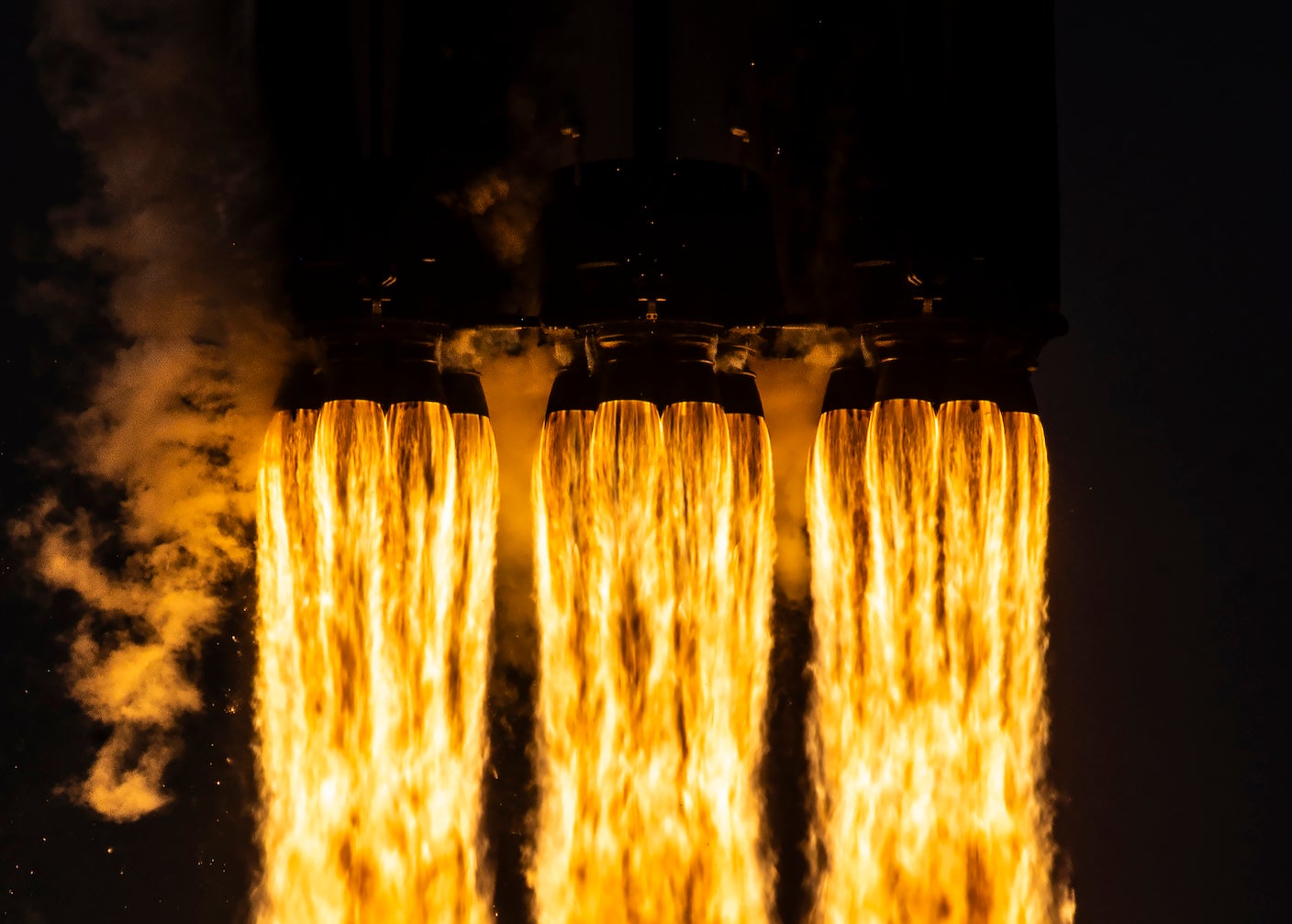
Rocket Launch Costs Have Fallen 96% Since 1960. They Aren’t Done Yet.
Rapidly falling launch costs are making space more accessible than ever. But new research suggests the economics are improving even faster than most people realize, potentially opening the door to entirely new industries beyond Earth.
For most of the space age, the cost of getting material into space was so vast that only the most well-heeled governments and corporations could participate. In 1960, getting a kilogram of payload into orbit would have cost you more than $87,000 (in 2024 US dollars).
But according to researchers at the University of Cambridge, that figure had collapsed 96 percent to $3,868 by 2025. The team’s modeling suggests this trend will continue apace for at least the next few decades, with prices forecast to hit just $1,569 by 2030 and as little as $273 by 2040.
The rapid decline in prices is thanks to a well-established economic principle known as Wright’s Law, which holds that technologies get predictably cheaper as cumulative production grows. The Cambridge team says the trends seen in launch costs could soon make a host of possibilities previously confined to science fiction commercially viable, including orbital solar power, asteroid mining, and space-based manufacturing.
“Space is no longer a science-fiction fantasy or a purely scientific pursuit, it is becoming a marketplace,” Alessio Terzi, who led the study, said in a press release. “Rapidly falling launch costs could open the way to space colonization and commercial activity far beyond low Earth orbit.”
To conduct their study, published in PNAS Nexus,the researchers assembled a massive dataset of rocket launches covering over 4,400 flights by more than 330 different rocket designs from 1960 to 2025. For each launch, they estimated the “unit flyaway cost,” or the total cost to manufacture, maintain, and launch the vehicles, excluding research and development investments.
They then checked how this data stacked up against Wright’s Law, which predicts that every time production volumes double the cost should fall by a fixed percentage. This is known as a technology’s “learning curve” as the reduction in costs is attributed to an industry getting better at producing the technology with experience.
The researchers found space launches obey the law almost perfectly, with every doubling of payload sent to orbit shaving 21.2 percent off the average cost per kilogram. More importantly, this represents a particularly steep learning curve compared to previous technologies.
Solar panels are often held up as the poster boy for learning curves, with prices falling 99.8 percent between 1975 and 2023. But while solar power’s total price reduction is higher than that achieved by launch vehicles, the technology got there by scaling deployment far more. When accounting for total production, solar’s learning curve lags launch costs at 20.2 percent.
The researchers also compared launch costs to another revolution in transport. Steamships transformed our ability to ship goods like wheat and cotton around the world in the 19th century. They found that steamship costs only fell 15.5 percent with each doubling of cargo.
“The cost of space launch technology is now falling faster than during one of history’s greatest transport revolutions,” said Terzi. “Steamships cut costs through explosive growth in global trade. Space technology, by contrast, has achieved even steeper declines at a far smaller scale. This suggests there is plenty of scope for further cost reductions and the industry may now be on the cusp of a comparable economic boom.”
There are, of course, caveats. The researchers note that the industry’s progress is inextricably tied to the fate of a single company. SpaceX already accounts for roughly 80 percent of payload reaching orbit. If the company successfully scales up its reusable, heavy-lift Starship vehicle it could massively reduce costs.
But a company with a stranglehold on the global launch market may be tempted to take advantage of its monopolistic position. This may also push foreign governments and companies away from relying on SpaceX even if it’s the cheapest option.
There’s also the danger that as costs fall and launching material into space becomes more accessible, low Earth orbit could quickly become clogged with debris that makes it increasingly difficult to reach orbit safely.
If these challenges can be sidestepped, the implications of such rapidly falling costs could be profound. The researchers suggest that everything from zero-gravity research and orbital tourism to factories churning out fiber-optic cables and 3D-bioprinted organs could become financially viable.
What did you think of this news? Leave a comment below and/or share it on your social media. This way, we can inform more people about the hottest things in technology, science, innovation, and gaming!
This news was originally published in:
Original source
