
Researchers Discover a Green Hydrogen ‘Goldmine’ Beneath Australia’s Red Dirt
The search is on for natural sources of hydrogen that could potentially fast-track humanity to a low-carbon energy future. As a fuel, it’s incredibly clean – but most hydrogen today is still produced using fossil fuels.
Being able to tap into abundant natural reserves of hydrogen would solve that problem, and there are several geological processes that can make it. One is when hot water hits the magnetite mineral found in iron ore.
There’s a lot of that iron ore underground across Western Australia, and researchers led by a team from Edith Cowan University in Australia, wanted to assess how much hydrogen gas could potentially already exist there, and be produced in the future.
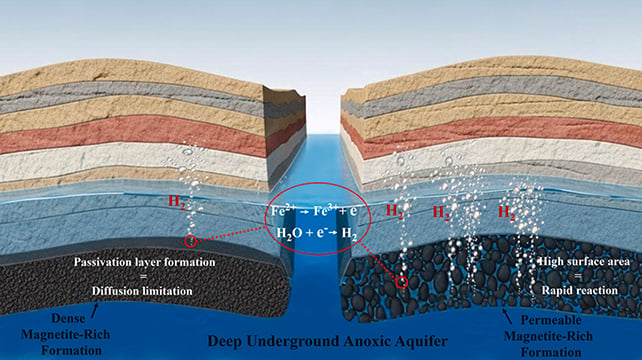
The results of their study, published in the International Journal of Hydrogen Energy, are promising – and give scientists a better understanding of the geological factors that control how much hydrogen magnetite can generate.
“Australia could be sitting on a massive, untapped energy reserve – and the potential is enormous,” says chemical engineer Alireza Keshavarz, from Edith Cowan University.
“There is enough hydrogen for Australia to benefit for generations, and potentially enough for us to become a major exporter of clean energy to the rest of the world.”
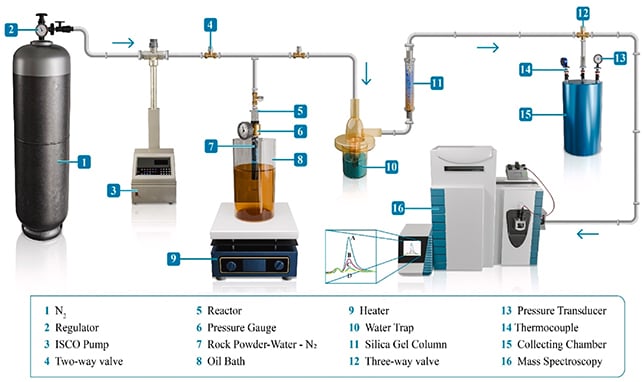
The researchers didn’t do any drilling for hydrogen here. Instead, they used lab experiments to test the reactions that happen when water and magnetite combine under high pressure, at temperatures of 200 °C (392 °F), for 60 days.
That goes some way to replicating the conditions underground, and not only did the researchers find that hydrogen gas was produced, they also established that magnetite powder produced far more hydrogen per gram than the magnetite slab. It worked out at about five times as much, gram for gram.
Not only does that suggest fractured, porous rocks with more surface area might be the best places to look for hydrogen gas, it also offers clues about how we might enhance hydrogen generation.

“Our findings show that hydrogen production depends not only on the amount of magnetite present, but also on how easily water can access fresh mineral surfaces through fractures, pores and permeable pathways,” says energy engineer Stefan Iglauer, from Edith Cowan University.
“This work helps bridge the gap between laboratory experiments and real geological systems.”
Other discoveries were made too.
The reaction that produced hydrogen also transformed much of the remaining magnetite into hematite, which may, at larger scales, act as a kind of protective layer, preventing more water from accessing magnetite.
Most previous experiments have involved magnetite powder, rather than the slab-like samples that were also included here, and knowing about the real-world geology involved will make future modeling more accurate.
“This comparison and characterization are important for two reasons,” write the researchers in their published paper. “First, the hydrogen production data from field-collected slabs directly represent the geological composition and geometry exposed to water in natural settings.”
“Second, the interaction between rock surfaces and water during hydrogen generation alters surface characteristics, which has significant implications for rock integrity in gas geo-storage applications.”
Related: Scientists May Have Figured Out How to Unlock The Energy of Ocean Waves
Plenty of challenges remain when it comes to finding, producing, and extracting hydrogen gas from these iron ore deposits, but the new study is a major step forward in understanding the potential amounts of hydrogen that magnetite could release – and the most efficient ways to produce it.
“If we can unlock this resource at scale, it could be transformative for our energy future,” says energy engineer Kaveh Moghanirahimi, from Edith Cowan University.
“We even see the potential for Western Australia to strengthen its energy independence during times of crisis through access to this naturally generated hydrogen.”
The research has been published in the International Journal of Hydrogen Energy.
This article was fact-checked by Rebecca Dyer and edited by Rebecca Dyer. While we pride ourselves on our process, we are only human. If you spot a mistake, please let us know.
What did you think of this news? Leave a comment below and/or share it on your social media. This way, we can inform more people about the hottest things in technology, science, innovation, and gaming!
This news was originally published in:
Original source
