

Physicists Just Achieved ‘Perfect Randomness’ For The First Time Ever
One of the hardest things to do in physics is to generate true, provably unpredictable randomness.
That’s because it’s impossible to determine randomness based on the output alone.
Dice may have nicks and flaws that influence how they roll.
Computer random-number generators are usually driven by algorithms.
Even coin flips are governed by physical forces that, in theory, could be predicted.
The difficulty lies not in generating numbers that appear random, but in showing that no one could have possibly predicted the outcome – that the system isn’t secretly affected by subtle hidden rules or biases.
Now, a team of physicists at ETH Zurich in Switzerland has overcome that challenge by leveraging one of the strangest phenomena in quantum mechanics: entanglement.

“The resulting sequence of zeros and ones is now really perfectly random, and we can even certify that,” says physicist Renato Renner of ETH Zurich.
Randomness is crucial to modern security.
It’s the core feature that makes passwords, authentication codes, and encryption keys harder to guess.
It’s the reason password generators will produce a string of meaninglessly jumbled characters rather than something like YourFirstPet123.
But the stakes extend far beyond a Flickr password to international security.
Recent examples of security weaknesses include the 2024 PuTTY vulnerability, in which one of the world’s most widely used SSH clients had a flaw in its random-number generation for cryptographic signatures.
And don’t forget the 2025 AMD Zen 5 RDSEED bug, in which a hardware random-number instruction would generate predictable values while falsely reporting success.

If a code is not perfectly random, it’s easier for attackers to guess.
“Any conventional electronic device, like a phone or a computer, is completely deterministic,” Renner told Adam Kovac at Scientific American, “so it’s actually very difficult for a computer or any other electronic device to generate a random value.”
To try to find a solution to this problem, the researchers turned to a quantum experiment known as the Bell test.
They created a pair of entangled quantum bits, or qubits, separated by 30 meters (98 feet) and cooled to temperatures close to absolute zero.

Entangled particles are those that, when measured, show similarities that cannot be explained by classical physics alone.
Measurements performed on the qubits produced correlations so strong that they could not be explained by ordinary hidden rules or pre-programmed behavior.
This achievement required major technical improvements to both the stability and speed of the experiment, allowing the team to perform more than a billion Bell-test trials over roughly nine hours.
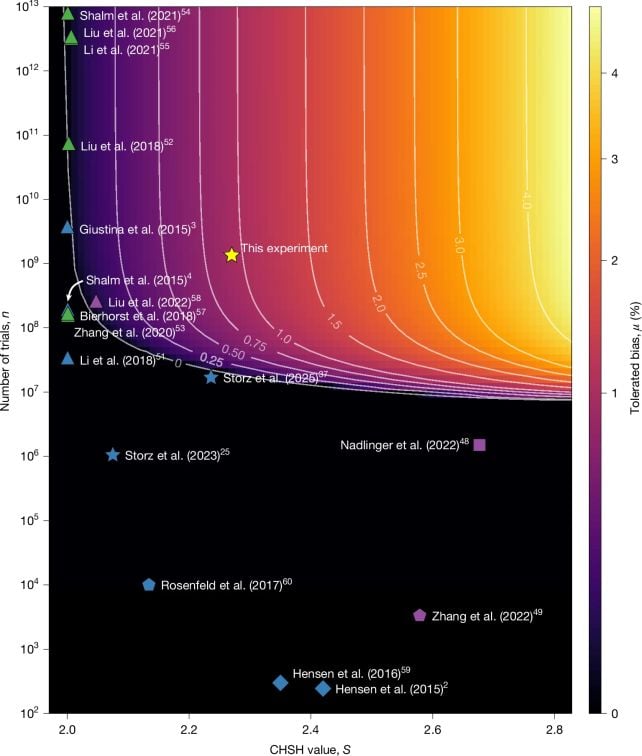
Previous quantum random-number generators could produce highly random outputs, but they still relied on trusted hardware and perfectly random starting conditions.
The ETH Zurich team instead demonstrated something called randomness amplification, deliberately starting with imperfect randomness – taking randomness that may contain subtle flaws or biases and transforming it into randomness that can be certified as perfectly unpredictable.
“Crucially,” they write in their paper, “randomness amplification has been proven to be impossible by purely classical means.”

The result is a system capable of generating certifiably perfect randomness, even when starting with flawed or imperfect randomness.
Related: Crystals Have Been Used to Generate Truly Random Numbers For The Very First Time
And it’s also device independent, which means the randomness does not depend on trusting the hardware itself, but on the quantum behavior observed in the experiment.
In the long term, the researchers say that their system could perform the same function atomic clocks perform for timekeeping – a physically certified source of randomness against which others can be measured and set.
“The technical improvements allowed us, for the first time, to create random numbers that will remain perfectly random for all eternity – no matter what analytical methods are used to assess their randomness,” Renner says.
The research has been published in Nature.
What did you think of this news? Leave a comment below and/or share it on your social media. This way, we can inform more people about the hottest things in technology, science, innovation, and gaming!
This news was originally published in:
Original source
