
Physicists Discover How Slime Mold ‘Makes Decisions’ Without a Brain
Slime molds are slippery, nebulous beings.
They’re not true molds. They’re not even fungi. For most of their lives, they exist as either plasmodia or amoebae, and they refuse to be held back by the rigid structures that govern other life forms.
Slime molds are also renowned for somehow, without brains or even nervous systems, exhibiting behavior that could be described as intelligent.
But what coordinates that collective motion? Is there really a central force?
A new study suggests there is – but probably not the one you’re thinking of.
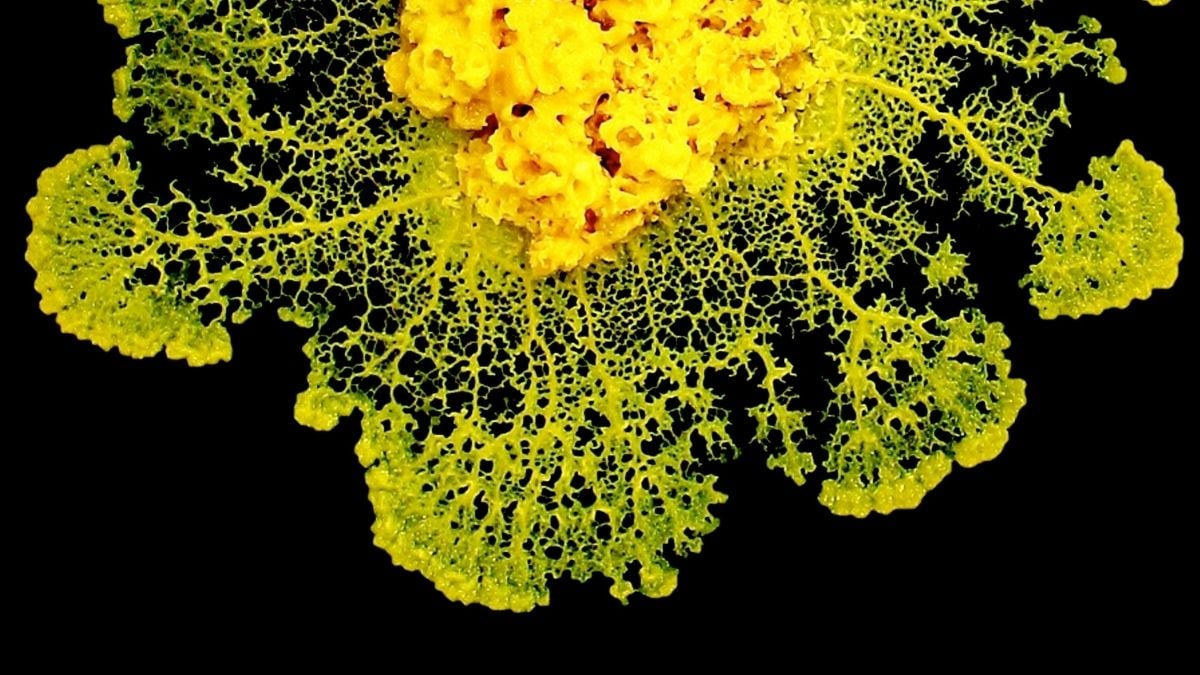
The most famous slime mold, and the protagonist of many scientific experiments, is the vivid yellow Physarum polycephalum, a scientific name that loosely translates to ‘the small bubble with many heads.’
That’s pretty apt: As a plasmodium, its single-celled body plan is pretty much a big bag of cell nuclei and goo.
This branching, blobby lifestyle makes it more physically mobile than the fungi it was once mistaken for. When P. polycephalum runs out of food, it can crawl to the next juicy log.
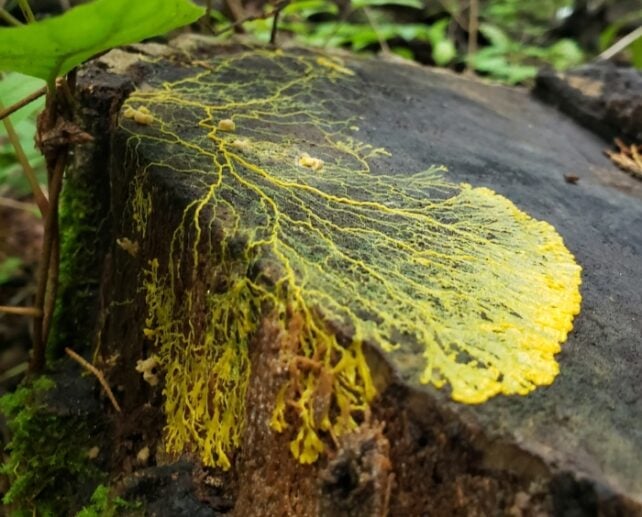
But this strange locomotion isn’t a blind search. Slime molds can somehow solve mazes in search of food and remember how to find it again.
And, in broad terms, they can ‘make decisions’, selecting a particular action against alternatives.
Now, scientists in Germany and the United States have begun to understand how this decentralized decision-making might work.
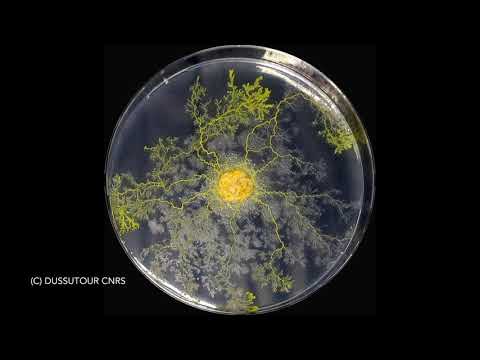
Because P. polycephalum has neither a brain nor nervous system, the definition of ‘decision-making’ here is quite different from what might be used in animal behavior studies.
But it can tell us a lot about how systems without neurons find a way to adapt behavior without the need for top-down control.
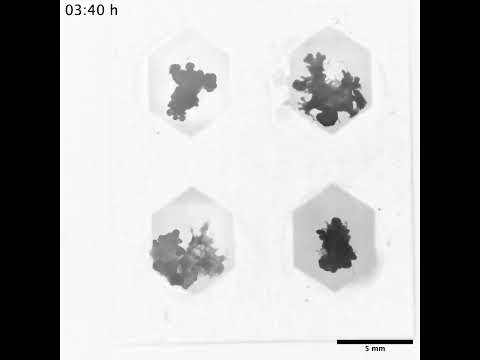
The slime mold is really averse to blue light, which means it’s possible to ‘trap’ it inside a barrier made of nothing more than the beams of glowing 470 nm light waves.
However, as footage from the new study shows, a starving slime mold will try to escape its blue-light barriers in search of food, sending out small, localized protrusions to find a way through.
In the moments before it does, it looks as though it’s bubbling, brewing, twitching, pulsing – until it rushes outward, free from the confines of the trap.
“Unlike neural systems, P. polycephalum relies on rhythmic peristaltic contractions to drive internal flows and redistribute mass, allowing it to adapt to its environment,” explain biological physicist Lisa Schick of the Technical University of Munich and her colleagues in a report of their findings.
“However, while previous studies have focused on the outcomes of these decisions, the underlying mechanical principles that govern this mass relocation remain unknown.”
Using blue light traps, Schick and team explored the routes taken by P. polycephalum when faced with a life-or-death situation.
The light traps used in this experiment look a bit like geometric stencil sheets you might’ve used as a child.
Blue light shines on the agar jelly surface, punctuated by gaps: regions without light that take the form of different two-dimensional geometric shapes (such as a triangle, square, or hexagon).
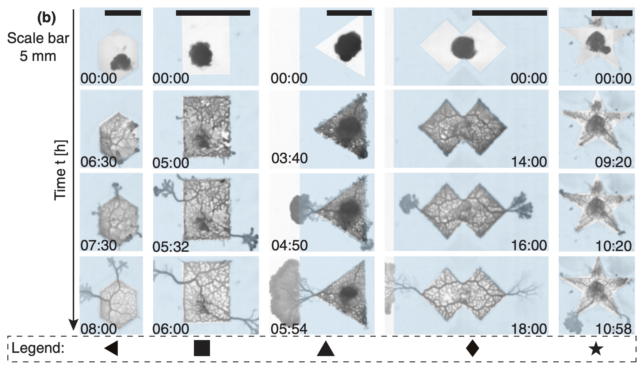
Scientists placed the starved slime molds into these light-free regions, trapping them – but only for a while.
Spurred by hunger, the molds started growing within an hour, then expanded their dense network of tubules with gusto to explore and fill the trap.
During this exploratory phase, slime mold movement is governed by a kind of localized cytoplasmic streaming, a flow of cellular fluid pushed along by molecular contractions.
Tentatively, seeking food and freedom, the molds extended small protrusions into the field of blue light in all directions. Most of these were quickly withdrawn, but some extended so far that the molds found a way to escape.
“Small protrusions emerge all around the trap boundary (exploration protrusions), yet escapes only happen close to the longest axis within the shape,” the researchers explain.

By the ‘longest axis’, they mean the longest possible line that can be drawn across the shape. Which seems a little odd: Why take the longest path and not the shortest route?
The researchers think it has something to do with the way slime molds mobilize.
“Only over the course of time does the organism ultimately settle on the contraction mode most efficient for transport, which coincides with the escape,” the researchers explain.
Remember those rhythmic contractions?
Well, each time the slime mold is testing an escape route, it’s effectively reorganizing its body, allowing the peristaltic contractions to course through its being, to find the most efficient way to move.

The longer the path, the more pressure the mold’s peristaltic contractions can build up, which means it can push more of its gooey mass outward in one go.
“The trap shape ultimately sets the mode most efficient for transport, allowing pressure to build up along the longest axis and driving the plasmodial escape,” the team explains.
Related: Scientists Found a Slime Mold Algorithm, And Asked It to Build a Universe
So while it might seem that the slime mold is ‘making decisions’ about which way to move, this study suggests it actually hinges on mechanical processes involving fluid flows.
“Our findings provide insights into the mechanics of decision-making in non-neuronal organisms, shedding light on how decentralized systems process environmental constraints to drive adaptive behavior,” Schick and team conclude.
The research has been published in PRX Life.
What did you think of this news? Leave a comment below and/or share it on your social media. This way, we can inform more people about the hottest things in technology, science, innovation, and gaming!
This news was originally published in:
Original source
