
Physicists Built a Spacetime Crystal – And Then Watched It Melt
We tend to think of melting as a relatively straightforward process – a solid material’s gradual slide towards liquid entropy.
There’s at least one material in the Universe that has a different way of doing it.
In an exotic form of matter known as a spacetime crystal, time and space can melt independently.
Using a tabletop experiment in which hundreds of plastic disks dance on a vibrating plate, physicists at Shanghai Jiao Tong University in China observed a spacetime crystal melting for the first time – and found that the process unfolds in three distinct stages.
The discovery, published in the Proceedings of the National Academy of Sciences, offers physicists their first opportunity to watch how this unusual state of matter falls apart.
The word “crystal” may conjure up shimmering prisms of translucent rock, but in physics it refers to how atoms are arranged in a material.
A crystal is a solid material in which the atoms form a highly ordered three-dimensional lattice that repeats in space – that is, any part of the lattice can perfectly superimpose any other part of the lattice.
A spacetime crystal is one where the structure repeats not only in space but also in time. The oscillations of the atoms form a repeating, stable rhythm that cycles over and over.
This state of matter is one that physicists are still trying to understand, but time crystals are tricky to build and trickier to keep stable enough to probe their properties.
One of the best ways to understand a state of matter is to watch how it loses its order.
For ordinary crystals, decades of studying melting have taught physicists about physical phenomena such as defects, symmetry breaking, and phase transitions. So it stands to reason that watching a spacetime crystal melt may also yield insights.
Quantum spacetime crystals would pose significant challenges to such an observation, however, so the researchers turned to a tried-and-true proxy: the classical analog.
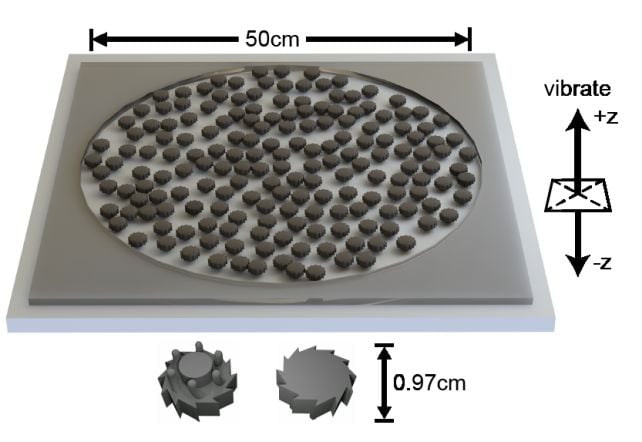
This system consists of a flat surface that the researchers vibrate at 100 Hertz (100 times a second).
It’s a little like a Chladni plate, but with one crucial difference. On a Chladni plate, grains of sand migrate until they outline the frequency’s standing modes.
Instead of grains of sand, this experiment uses tiny plastic disks, each with six angled pin-like legs on the underside. Each time the plate moves, the legs collide with it for just a brief moment, resulting in random kicks from the driving force.
So, rather than the neat ordering of the Chladni grains, the disks jiggle about chaotically.
But then if you pack enough of them together on the surface, something fascinating happens.
The disks spontaneously organize into a triangular crystal while the entire lattice begins rotating as a single rigid body, completing one revolution roughly every 5 hours. That synchronized motion can persist for almost a day despite substantial noise.
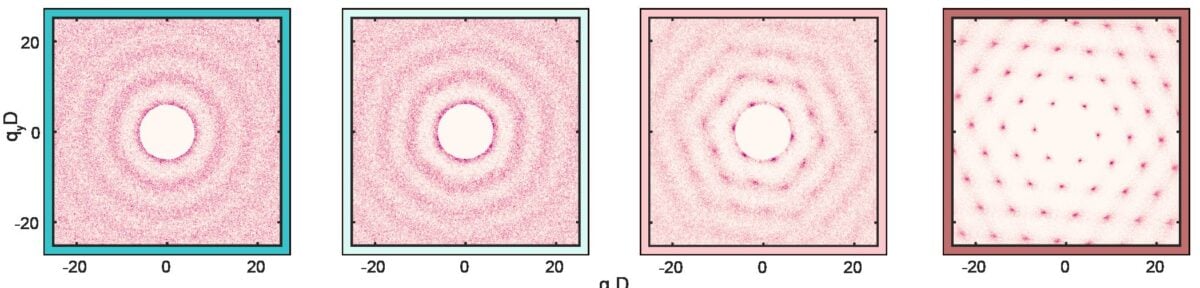
Critically, that 5-hour motion is distinct from the plate’s 100-Hertz vibration. The long-period oscillation therefore emerges independently of the driving, which merely supplies energy to the disks.
To induce the melt scenario, the researchers removed some of the disks to reduce the density. Rather than decaying back towards the initial chaos in a gradual way, the crystal melted in three distinct phases.
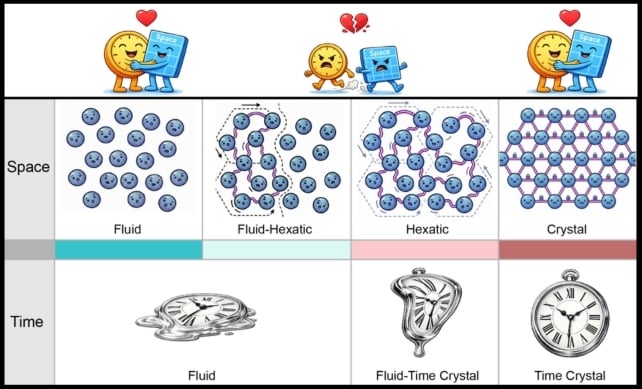
First, the synchronized timing began to fail in localized patches while the rest of the crystal continued its dance.
Then the rhythm fell apart completely, even while the crystal retained much of its spatial order.
Finally, the lattice itself broke apart and became analogous to a disordered fluid.
The researchers found that two different physical processes drive the melting. The loss of temporal order stems from weakening interactions between the particles, while the collapse of the crystal itself happens as defects spread through the lattice.

That result suggests that the rules governing order in time are fundamentally different from those governing order in space.
Related: Spacetime ‘Crystals’ Could Collapse Into Tiny Black Holes, Wild Paper Explains
This doesn’t mean all spacetime crystals melt this way – but it does show that space and time can disconnect from each other during melting, a discovery that opens new ways to explore phase transitions in classical systems.
“Our experimental results reveal an intricate three-stage melting scenario in which spatial and temporal crystalline order melt at distinct critical values and through different physical mechanisms, supporting the independence of these spacetime symmetries,” the researchers write.
“Our findings establish the existence of exotic out-of-equilibrium crystalline phases of matter in spacetime and open new avenues for realizing macroscopic classical systems that exhibit complex spatiotemporal symmetry-breaking patterns.”
The findings have been published in the Proceedings of the National Academy of Sciences.
This article was fact-checked by Rebecca Dyer and edited by Peter Dockrill. While we pride ourselves on our process, we are only human. If you spot a mistake, please let us know.
What did you think of this news? Leave a comment below and/or share it on your social media. This way, we can inform more people about the hottest things in technology, science, innovation, and gaming!
This news was originally published in:
Original source
