
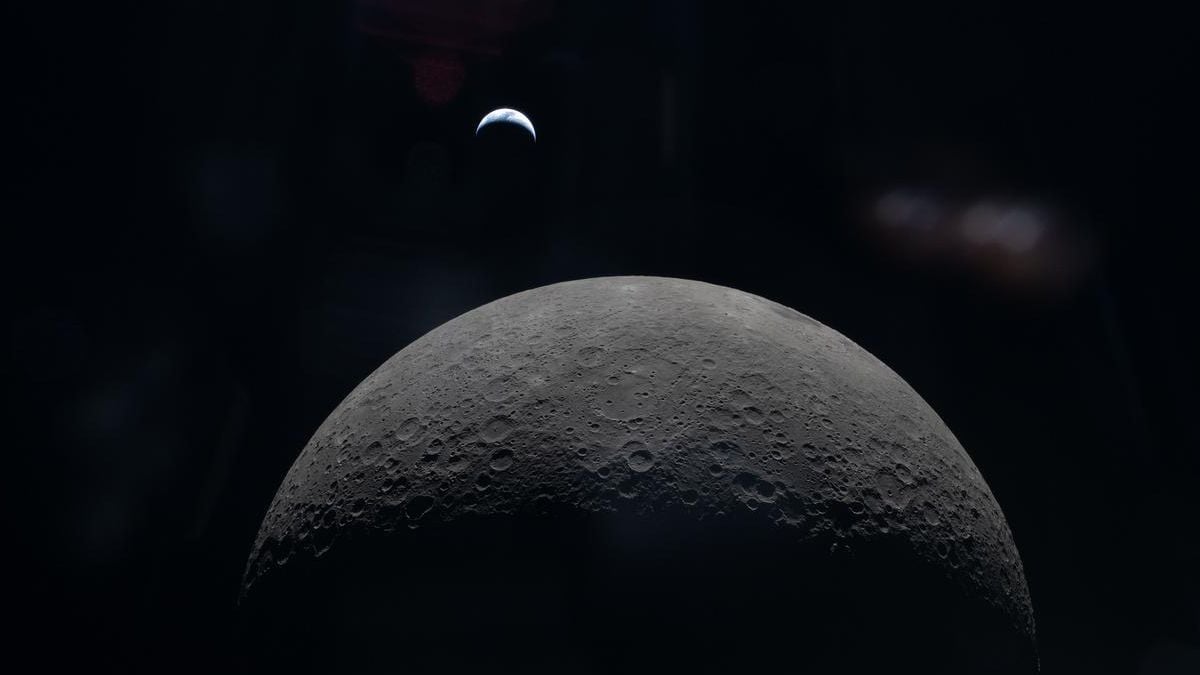
Moon Impact 3.5 Billion Years Ago Hints at Hidden Era of Solar System
Tiny crystal grains trapped inside a meteorite may be the key that unlocks a hidden era in the Solar System’s history of violence.
These particles are so small they can barely be seen without the aid of a microscope, yet they were forged in an asteroid impact that struck the Moon 3.5 billion years ago, according to a team led by planetary scientist Carolyn Crow of the University of Colorado Boulder.
Exactly where this impact took place is unknown, but the grains – a zirconium-rich mineral called baddeleyite – could only have been forged under extreme heat, suggesting the impact was a monumental one.
And there’s something else this phantom impact may be telling us.
Evidence from at least two other Solar System bodies – Earth and the asteroid Vesta – preserves the scars of heavy impacts from around the same time period, suggesting that 3.5 billion years ago, the inner Solar System was still playing asteroid pinball, long after it was thought to have calmed down.
“This new impact age, incorporated into a compilation of … Earth-Moon-Vesta impact events, provides unequivocal evidence of prolonged … bombardment of the inner solar system after the basin-forming epoch,” the researchers write in their paper.
Eons ago, when it was young, the Solar System was a turbulent place. It underwent multiple epochs of bombardment, in which asteroid-sized rocks flew willy-nilly, battering the recently formed planets and other bodies.
One particularly intense phase is the Late Heavy Bombardment, which several lines of evidence date to around 4.1 to 3.8 billion years ago. It was possibly triggered when shifts in the giant-planet architecture of the Solar System sent asteroids hurtling.
Much of Earth’s own impact history has been lost to erosion, tectonic activity, and geological processes, but some traces remain, suggesting Earth was subject to later periods of elevated impact activity.
Because the record is so poor, however, this idea has been difficult to investigate.
One possible place to look for further clues is the Moon, which doesn’t have tectonic activity or much in the way of erosion, but this comes with its own set of problems. Namely, craters hang around for an extremely long time, overlapping and erasing each other, so sorting out their histories is extremely tricky.
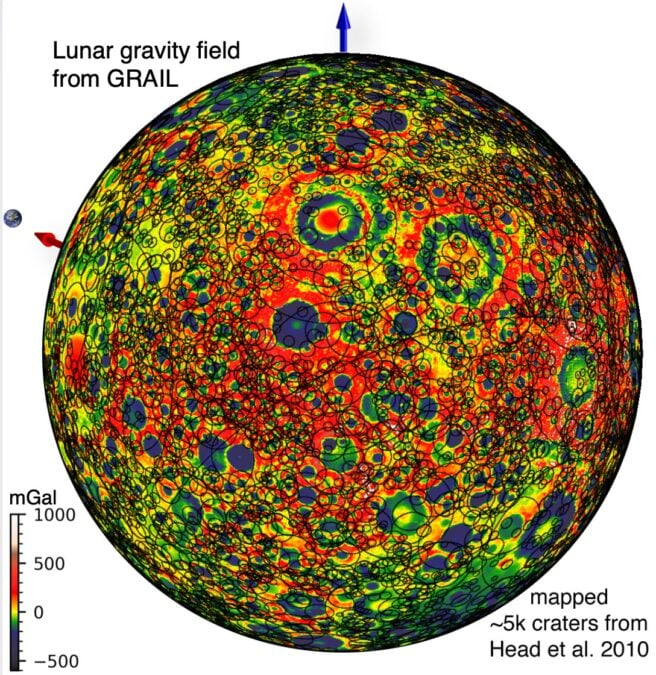
On the other hand, because the Moon’s surface has not been significantly eroded or recycled as Earth’s crust has, traces of ancient events can lie close enough to the surface to be gouged out and hurled to Earth as meteorites during later impacts.
One of these meteorites is Northwest Africa (NWA) 12593, a chunk of the Moon recovered in Mali and later acquired by researchers in 2017.
Actually, the meteorite records three separate impact events. The most recent of these is the collision that sent it to Earth, an unspecified amount of time ago.
Prior to that, an impact had turned part of the surface of the Moon into breccia, a type of rock made up of lots of chunks of rock glued together by smaller grains.
Breccias are especially common at impact sites, where enormous pressures shatter rocks and weld the fragments back together into new configurations like a mineral Frankenstein.
“Breccias are similar to what you would see if you went and chipped out a chunk of concrete. You would see all these little rocks, and then it’s fused together by the cement,” Crow says.
“But the meteorite is fused together by the impact process. You get all these chunks of different kinds of rocks that the impact hit into. These all get mixed up, and then it gets fused together like your concrete sidewalk.”
Finally, there’s the third impact.
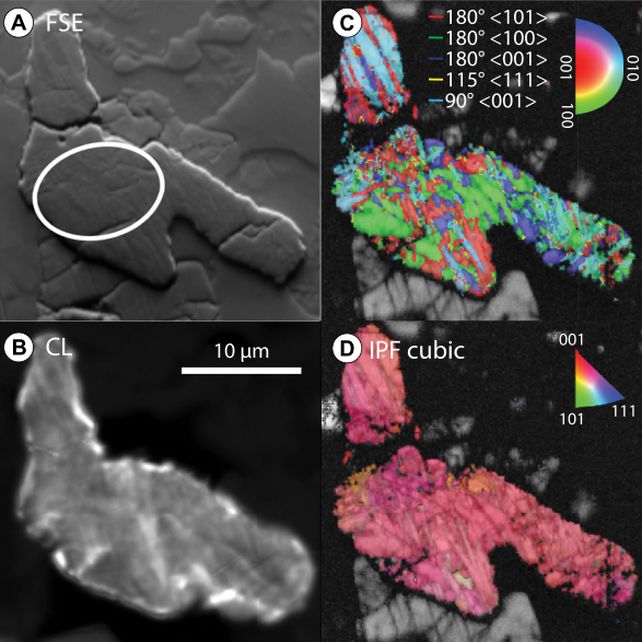
Hidden away within the breccia, Crow and her colleagues isolated 21 grains of baddeleyite, a mineral that is particularly useful for identifying impact events because it preserves phases of zirconia – cubic and tetragonal – that can only form under extremely high temperatures.
In seven of the grains, the researchers found cubic zirconia – suggesting the grains formed under temperatures exceeding 2,370 degrees Celsius (4,300 degrees Fahrenheit).
The researchers argue that this was a separate event from the one in which the breccia formed, because the temperature would likely have been significantly lower for the latter.
Next, the team determined the age of the grains by carefully measuring their lead content.
As the baddeleyite formed, it incorporated minuscule amounts of uranium, which over time decays into lead at a known rate. By taking a census of the lead, scientists can determine how long it has been decaying for – and thus how old the sample is.
This revealed that the grains formed around 3.486 billion years ago.
That’s around the same timeframe of impacts recorded in tiny molten blobs of impact debris bound up in ancient rock in Australia’s Pilbara desert, which suggests an impact 3.48 billion years ago, and a similar formation in South Africa consistent with a 3.47 billion-year-old impact.
In addition, a collection of meteorites originating from the asteroid Vesta contained rocks that showed a series of distinct, well-defined impact events between 3.85 and 3.47 billion years ago.

Combined, these lines of evidence produce a pattern that suggests bombardment may have lingered hundreds of millions of years after the commonly cited range for the Late Heavy Bombardment.
Cellular life was emerging on Earth during roughly the same period. Scientists are still trying to understand exactly what role, if any, large impacts may have played in shaping those environments.
Related: Asteroid Reveals The 5 Key Genetic Ingredients For Life on Earth
Several recent papers suggest that impact events may create hydrothermal systems – like hot springs – that are perfect havens for the microbes among the earliest life on Earth. This new result offers a new tool for understanding that pivotal time period.
“The question that we often have, even going back further, is what was the impact record when life was emerging?” Crow says.
“It is important for understanding how life is taking hold, how life is emerging. The cadence of these catastrophic events is an important part of the equation.”
The research has been published in Geology.
What did you think of this news? Leave a comment below and/or share it on your social media. This way, we can inform more people about the hottest things in technology, science, innovation, and gaming!
This news was originally published in:
Original source
