
JWST Reveals A Star-Scorched Mercury-Like Planet That’s Bigger Than Earth
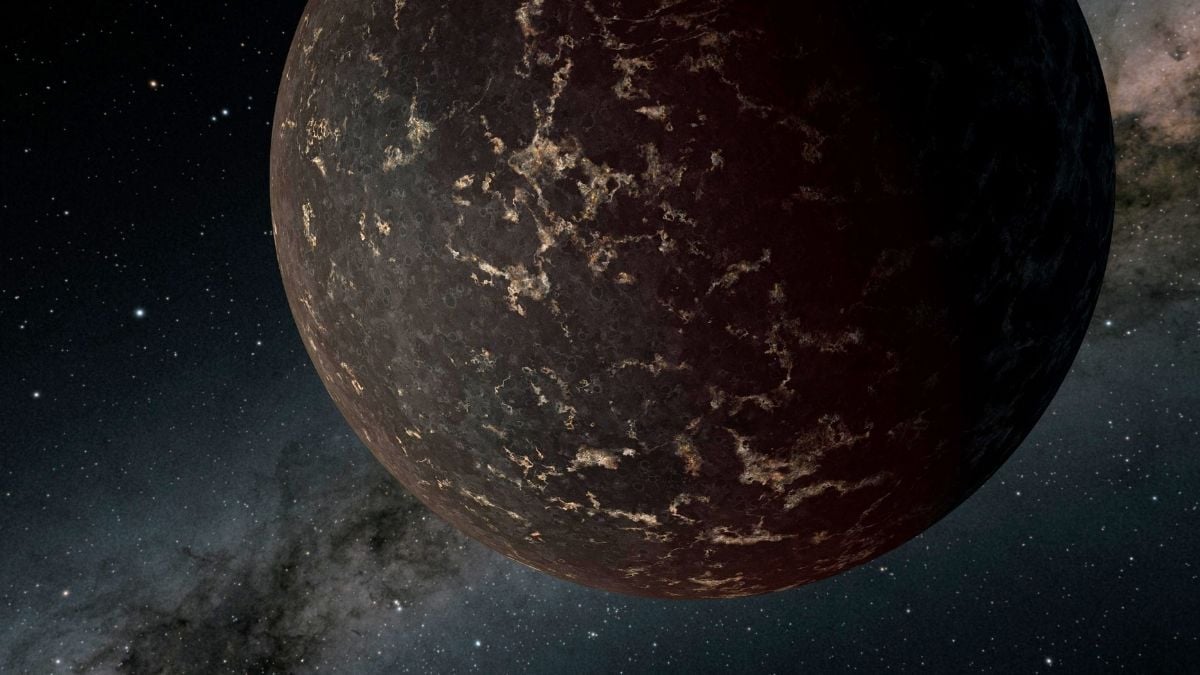
The James Webb Space Telescope (JWST) has revealed a dark, scorched world that may be similar to the Moon or Mercury but about 30 percent larger than Earth.
This discovery, recently described by a multi-institute team of astronomers, represents a ‘next-step’ scientific approach to characterizing planets outside the solar system, including their atmospheres, surface compositions, and geologic histories.
The exoplanet LHS 3844b was first discovered by astronomers in 2018, located only around 50 light-years away. The exoplanet is gravitationally gripped in a speedy, 11-hour orbit around a red dwarf star that’s less than one-fifth the mass and size of our Sun.
Since the exoplanet orbits its dim, red parent so closely – only three stellar diameters away – any atmosphere it may have had has likely been blasted away by stellar radiation, leaving a barren rock.
Its proximity also makes it tidally locked, so one side of the exoplanet always faces the star, while its other side is bathed in eternal darkness.
On the perpetual dayside, temperatures reach 1,000 Kelvin (more than 1,300 degrees Fahrenheit).
Previously, astronomers found some signs that LHS 3844b hosts tectonic activity similar to Earth’s crust: the first of its kind outside our own Solar System. But a closer look suggests otherwise.
Researchers used JWST’s Mid-Infrared Instrument (MIRI) to observe the local rocky exoplanet in mid-infrared light.
Yet even our most powerful space telescope can’t actually ‘see’ this dark orb, as we can see the members of our own solar system. Instead, JWST observed a portion of the planet’s infrared emissions to yield a spectrum, akin to an object’s light-based fingerprint.
Since each constituent element and compound emits and absorbs different wavelengths of light, determining the spectra of celestial objects allows astronomers to assess what they’re made of.
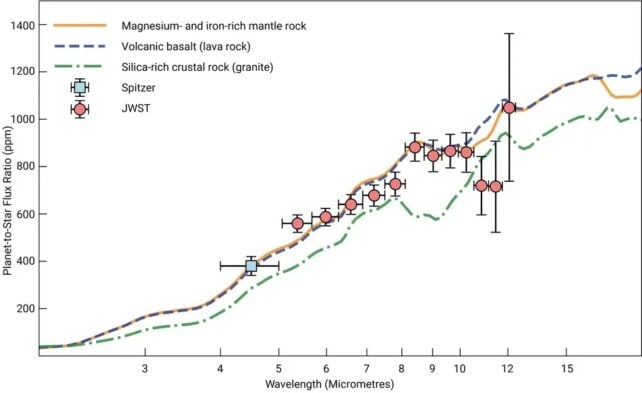
Researchers therefore calculated that the surface of LHS 3844 b may resemble lunar or terrestrial basalt, an igneous rock that forms when magnesium- and iron-rich lava quickly solidifies.
It may also resemble Earth’s mantle – which is also enriched in those elements – rather than the shallower crust that blankets our blue-green planet like an apple skin.
This suggests two possible scenarios for the exoplanet’s exterior. First, it may be made of recently formed rocky slabs, implying that LHS 3844b is geologically active, perhaps through volcanic processes.
Alternatively, it may be a dead, weathered world covered in regolith, pulverized by eons of bombardment from radiation and meteorite impacts; after all, it has no atmosphere to protect it.
Importantly, however, it seems to lack a silicate crust similar to Earth.
“One may conclude that Earth-like plate tectonics does not apply to this planet, or it is ineffective,” says Sebastian Zieba, a NASA Sagan Fellow at the Harvard & Smithsonian Center for Astrophysics.
“This planet likely only contains little water.”

So, is this a live or dead world? To approach an answer, the researchers melded cosmic and Earthly insights. On our planet and on other active solar system objects, such as Io, carbon dioxide and sulfur outgassing accompany volcanic activities.
However, JWST did not get a whiff of volcanic flatulence, hinting that LHS 3844b is an inactive world whose heyday has passed, potentially resembling our littlest planet Mercury.
To further constrain the planet’s characteristics, the researchers have already acquired additional JWST data.
Related: Scientists Found an ‘Impossible’ Atmosphere on a Tiny World Beyond Neptune
They’ll now have to tease out the intricate differences in how light reflects from surfaces of rocks, slabs, and potential powders of diverse sizes, textures, and solidities. Fortunately, astronomers have experience doing just that, in examining the solar system’s airless objects, such as asteroids.
Altogether, this offers a broadly fascinating avenue that can unveil untold alien worlds:
“We are confident the same technique will allow us to clarify the nature of LHS 3844b’s crust and, in the future, other rocky exoplanets,” concludes the study’s principal investigator, Laura Kreidberg.
This research was published in Nature Astronomy.
What did you think of this news? Leave a comment below and/or share it on your social media. This way, we can inform more people about the hottest things in technology, science, innovation, and gaming!
This news was originally published in:
Original source
