
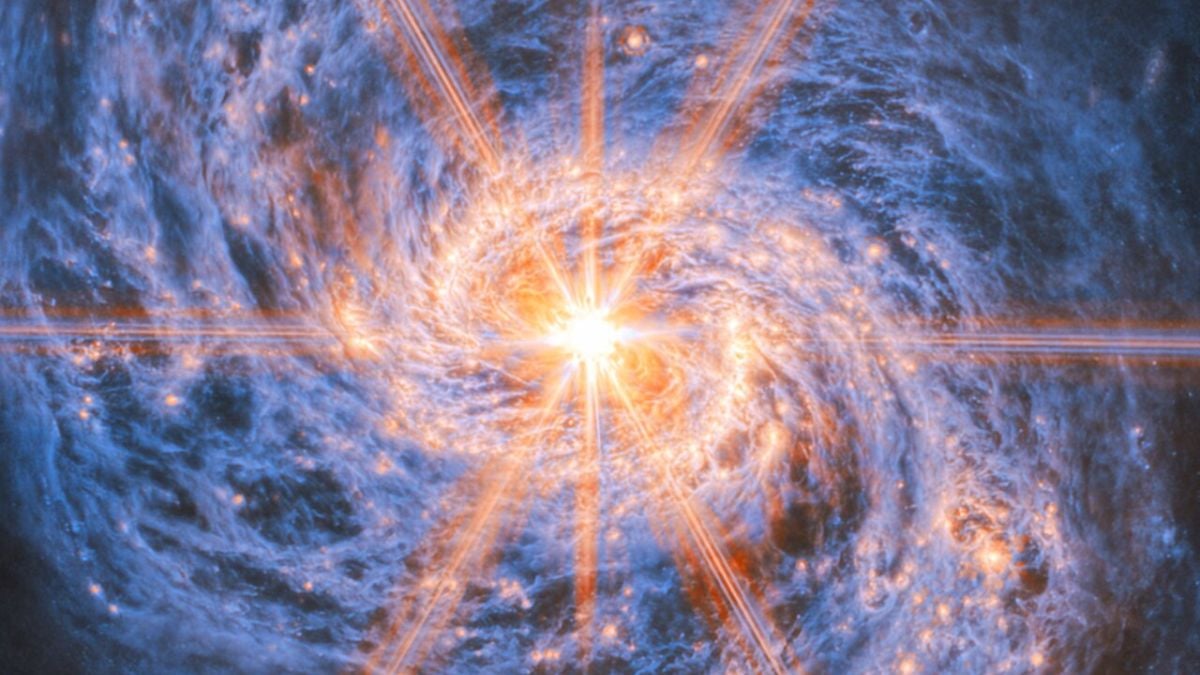
JWST Reveals a Hidden Structure in The Heart of The Squid Galaxy
A brightly gleaming galaxy streaked with dramatic dust lanes and glittering pockets of star formation is more than just a pretty face.
The Squid Galaxy – formally known as M77 or NGC 1068 – is the prototype galaxy of its kind, with a supermassive black hole blazing hungrily at its core.
Because this galaxy is so close to the Milky Way – about 35 million light-years away – and because it’s so bright, with its broadside directly facing us, it offers an excellent laboratory for understanding the wild dynamics of an active galactic nucleus.
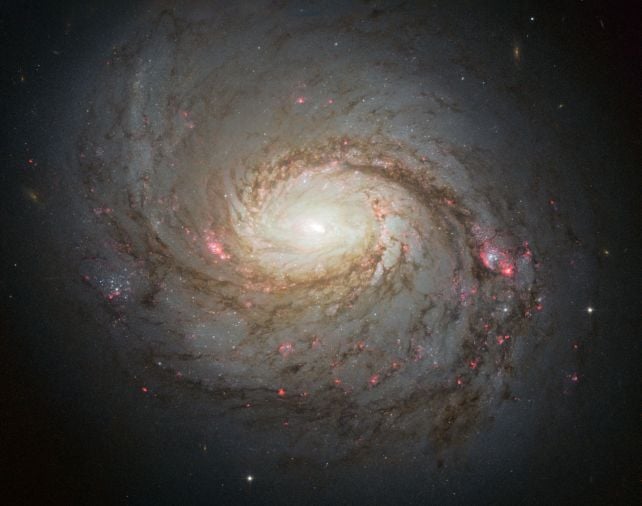
There’s just one problem. The Squid Galaxy is d-u-s-t-y, and its center even more so. That means peering into its heart to see the engine driving it is extremely tricky.
Fortuitously, this is exactly the sort of thing JWST was designed to do.
Infrared light isn’t blocked or scattered by dust the way shorter wavelengths are. So, with new near-infrared (NIRCam) and mid-infrared (MIRI) observations, JWST has revealed features of the Squid Galaxy that cannot be seen in optical, ultraviolet, or even radio wavelengths.
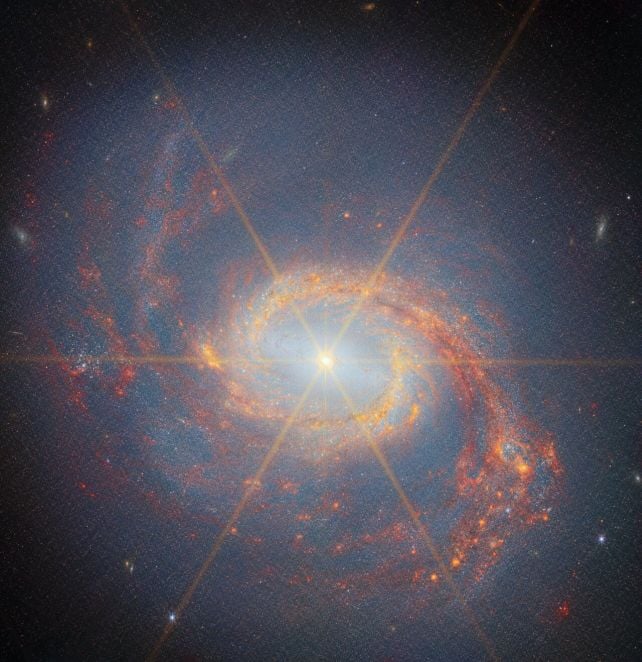
The new images show a ribbon of stars, gas, and dust — what’s known as a bar structure – across the center of the spiral galaxy that isn’t visible in optical wavelengths.
The images also cut through the massive volumes of dust in the center of the galaxy to reveal details around its core.
The mass that resides therein is thought to tip the scales at around 13 million times the mass of the Sun, but it’s not actually clear what form that mass takes. There’s recent evidence to suggest that not one, but two supermassive black holes may lurk at the center of the Squid Galaxy, locked in a tight binary orbit.
JWST probably can’t settle that question by imaging the paired binary directly – with a projected separation of just 0.1 parsecs, they’d be too close to resolve individually from tens of millions of light-years away, even with JWST’s spectacular resolution.
The telescope may, however, be able to reveal dust and gas motions around the galactic center that can tell us more about the nature of the black hole (or holes) stirring it up.
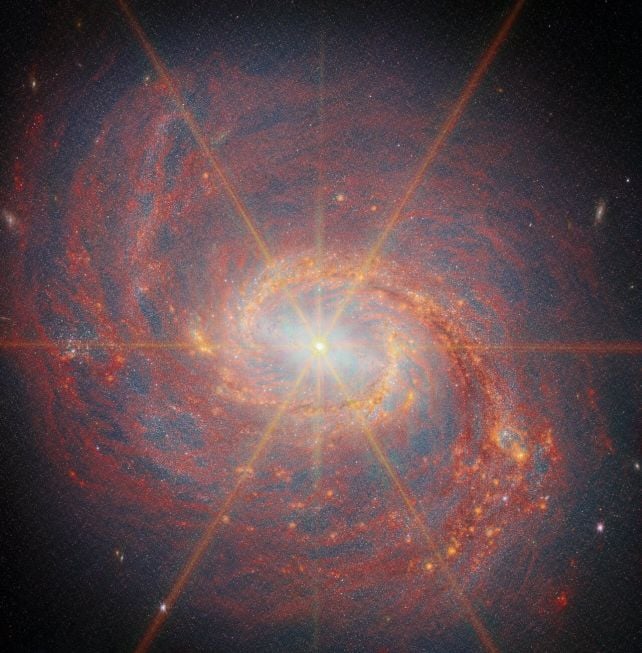
Also visible in the JWST imagery are scattered brightly glowing regions colored red. These are pockets of star formation that are created in the gas and dust along the galaxy’s spiral arms.
A star starts to form when a pocket of gas becomes dense enough to collapse under gravity, turning into the seed of a star.
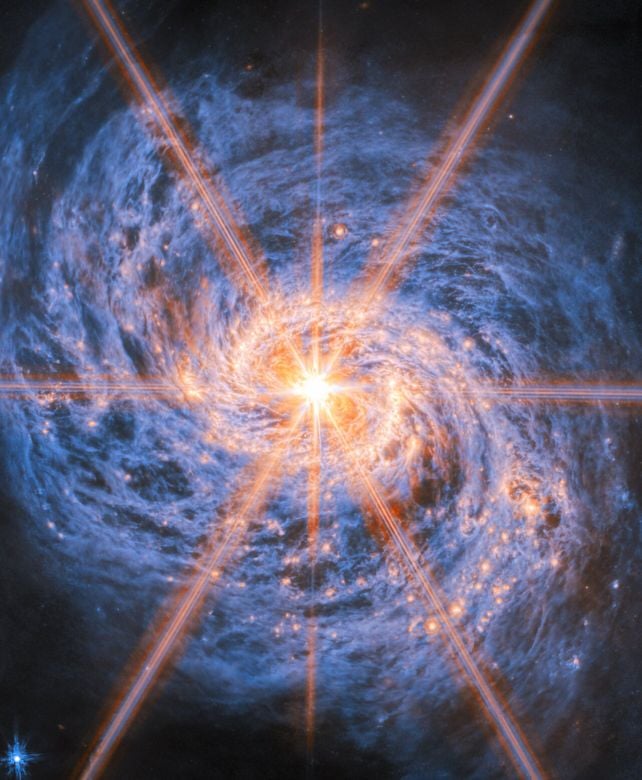
In the image, you can see a bright ring of star formation around the center of the galaxy, a few thousand light-years in diameter.
This is known as a starburst ring, and it’s been well-studied in the Squid Galaxy. Astronomers think this ring formed as a natural result of the galaxy’s architecture, which gravitationally concentrates gas in that region.
Other starburst regions are distributed along the galaxy’s spiral arms, too, indicative of a highly dynamic galactic environment.
So there’s already a lot going on – but there is more. In 2022, scientists revealed that they had traced a high-energy neutrino directly to the heart of the Squid Galaxy.

The galactic nucleus is estimated to consume material at a rate equivalent to around 0.23 times the mass of the Sun each year. That’s quite a steady clip, and all that material swirling around under extreme gravitational and frictional stress generates quite a bit of energy.
Related: Most Energetic Ghost Particle Ever Seen May Have Come From Black Hole Jets
High-energy neutrinos are born in extremely energetic situations, but are very hard to trace. The 2022 study suggests that the Squid Galaxy could be a giant atomic particle accelerator. If it is, it would be one of only a handful identified beyond the Milky Way.
By peering at objects like these in light that reveals secrets not normally visible to our eyes, JWST may be able to help answer some of the most intriguing questions about the Universe around us.
You can download the JWST images of the Squid Galaxy in wallpaper sizes from the ESA Webb website. Here’s the NIRCam image; here’s MIRI; and here’s the composite of both.
What did you think of this news? Leave a comment below and/or share it on your social media. This way, we can inform more people about the hottest things in technology, science, innovation, and gaming!
This news was originally published in:
Original source
