
Ghosts of ‘Forgotten’ Memories May Linger in The Brain, Study Suggests – And Could Even Be Restored
Some forgotten memories may be less like a deleted computer file and more like a dusty book buried deep in the stacks of an ancient library.
They’re no longer easy to find. But, under the right set of circumstances, they could be brought back.
So what’s forgotten may not be lost – at least in fruit flies (Drosophila melanogaster).
Scientists have discovered that even after a memory can no longer be recalled, it can persist in a hidden state in the fruit fly brain, ready to be revived by the right reminder.
The catch? The process of recovering a forgotten memory can also lead to false ones, according to a team led by neuroscientists Wenbin Yang, Benedetta Zattera, and Miguel Pavão-Delgado of the Friedrich Miescher Institute for Biomedical Research in Switzerland.
“We find in Drosophila that forgotten memories can persist as silent memory traces in circuits that lack the capacity to guide behavior,” they write in a paper published in Nature Neuroscience.
“We conclude that switching between silent and active memory states prevents information loss and establishes a conditional memory system that allows the brain to flexibly prioritize memory retrieval based on recent experiences.”

Memories are notoriously slippery little suckers. We might be able to recall moments from decades past in vivid detail; at other times, we might find ourselves looking around a room trying to remember why we entered seconds ago.
Neuroscientists have come to learn that, while some memories may be permanently erased, others can hang around in an inaccessible state, recoverable with reminder cues.
However, these very cues can distort the memory, especially under suggestive questioning, for example. And very little is known about the brain processes underlying the reconstruction of forgotten memories, whether the outcome is real or false.
To investigate, the researchers turned to one of neuroscience’s favorite model organisms – the fruit fly.
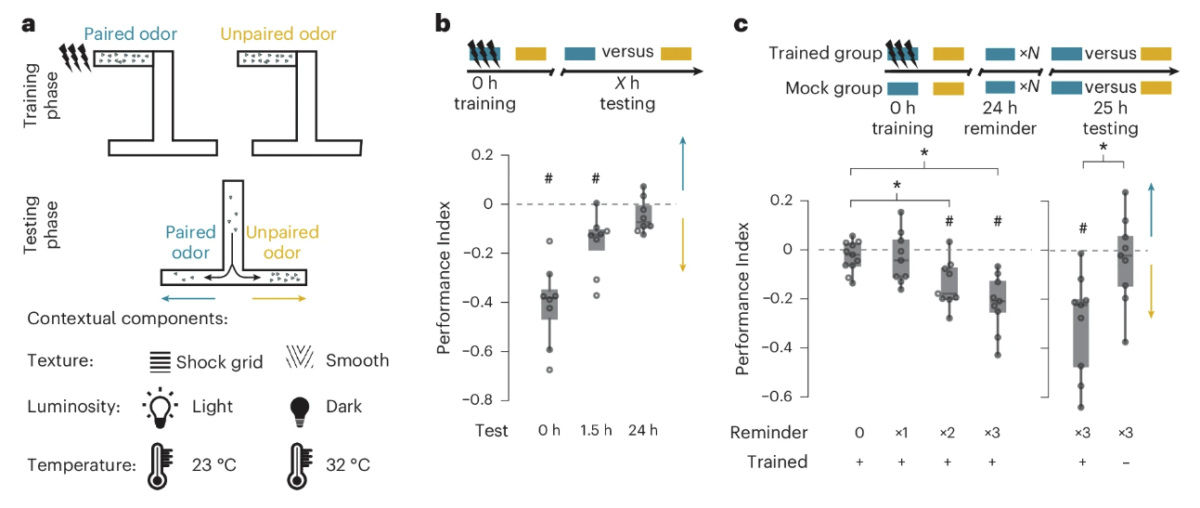
Flies can be trained to associate a particular scent with a mild electric shock, causing them to avoid that smell. The team found that this learned aversion disappeared within about 24 hours, suggesting the memory had been forgotten.
But then something unexpected happened.
When the researchers put the flies back in the chamber where they had received the aversion training, the memory came back, and the flies resumed their avoidance.
But the smell wasn’t enough on its own. The reminder had to recreate key parts of the original experience – including the chamber’s texture and lighting – before the forgotten memory resurfaced.
The results suggest that contextual cues such as texture and lighting are important for recall, implying that the memory isn’t being replayed so much as reconstructed.
To find out what the brain was actually doing while all this was taking place, the researchers recorded activity from the memory centers of the flies’ brains.
They found that, as the flies appeared to forget, the memory trace that drives avoidance behavior gradually faded. At the same time, a different, hidden trace became apparent in another set of neurons that don’t normally influence behavior.
The researchers call this a “silent memory trace.”
When all of those reminder cues lined up, activity shifted back into neurons involved in avoidance behavior, allowing the memory to influence the flies’ behavior again.
The researchers think the brain doesn’t move a forgotten memory from one set of neurons to another, but creates two versions of the memory from the outset – one that immediately guides behavior and another that stays hidden.
As the first fades, the hidden version becomes established, allowing the memory to be recovered later under the right circumstances.
They also suspect the brain activity responsible for making memories harder to access may simultaneously help create this hidden backup, although that idea still needs to be tested.
It also turned out that the recall process could be imperfect.
During training, the flies had also been exposed to a second odor that was never paired with electric shocks.
When the researchers later used that harmless odor as the reminder instead of the dangerous one, the flies began avoiding it anyway, as though it had predicted the shock all along. The flies had effectively formed a false memory.

Interestingly, the brain used different neural pathways for reconstructing real memories and creating false ones.
This suggests that the brain has separate mechanisms for faithfully recovering memories and for accidentally rewriting them.
Related: Memory Is Not Confined to Our Brains, Scientists Discover
The researchers note that the formation of false memories only occurred for odors used in the training context, suggesting that the false memories are the result of the inaccurate reconstruction of silent memory traces.
The researchers argue that, rather than being a flaw, false memories could be part of a system that, in other circumstances, could promote flexible adaptation based on learned experiences.
The research was carried out in fruit flies, not humans, so we cannot extrapolate that our own brains behave the exact same way. However, given that false memories are a known phenomenon, the research could give us some insight into how our own brains hide the ghosts of memories.
The findings have been published in Nature Neuroscience.
This article was fact-checked by Clare Watson and edited by Clare Watson. While we pride ourselves on our process, we are only human. If you spot a mistake, please let us know.
What did you think of this news? Leave a comment below and/or share it on your social media. This way, we can inform more people about the hottest things in technology, science, innovation, and gaming!
This news was originally published in:
Original source
