
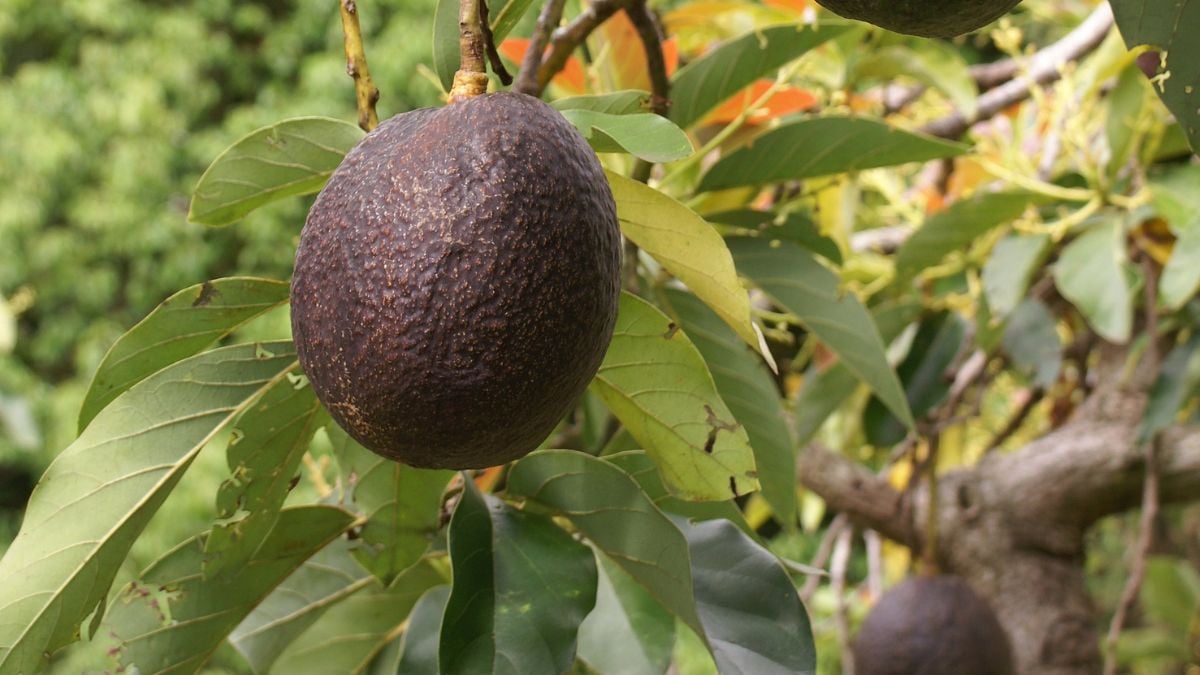
Avocados Switch Sex on a Daily Basis, And Researchers Finally Know How
At some point in evolutionary history, possibly around 400 million years ago, things started having sex.
This adaptational (and sensual) advance introduced multiple benefits by allowing increased gene sharing, thereby helping to prune deleterious mutations and boost general fitness.
Avocado trees also ostensibly like to have sex, but face a problem: Each tree’s flowers have both female and male reproductive organs, so they must somehow avoid self-pollination to derive such sexual benefits.
They do this through a clever evolutionary trick called temporal dichogamy, where the flowers of avocado trees (and many other angiosperms) functionally ‘switch sexes’ each day.
Yet the underlying genetic basis has fascinated and frustrated botanists and growers for over a century.
In a new study, a team of ecologists and agricultural engineers combined field observations with genetic analyses to finally crack the conundrum of avocado sexuality, revealing their dichogamy-defining gene variants.
“Our study provides a genetic explanation for a century-old mystery of avocado pollination,” says Jeffrey Groh, an evolutionary geneticist now at the University of California (UC) Berkeley.
At any moment, an avocado tree may be functionally female or male, with its flowers either receiving or releasing pollen, respectively.
They also display complementary sexual schedules.
“A-type” avocado trees open their female flowers in the morning and their male flowers in the afternoon, while a basically equal population of “B-type” avocado trees do the opposite – avoiding perils of self-pollination.
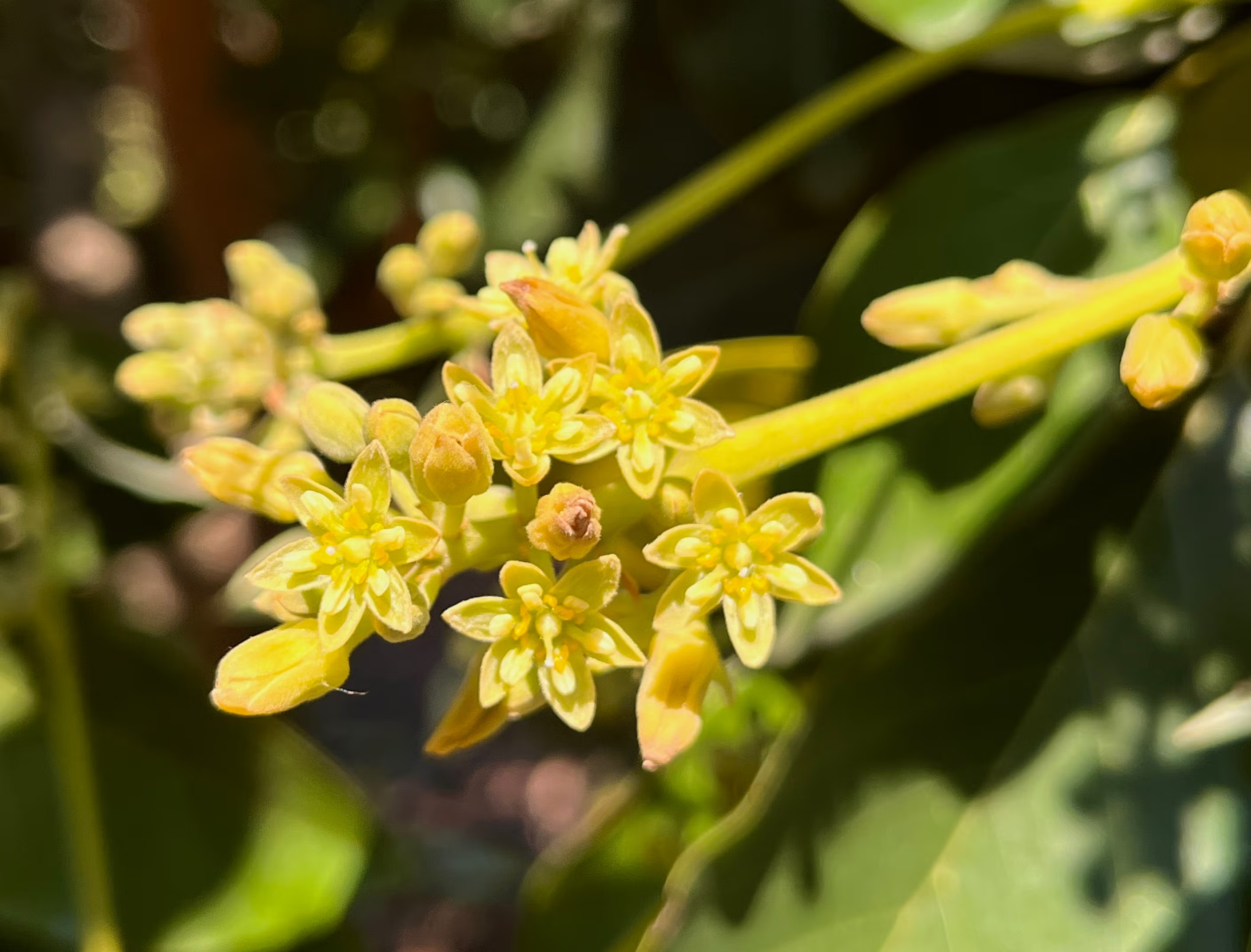
“Flowers are not just static decorations; they are highly evolved and dynamic structures. We can see this in the pulsating rhythm of avocado flowers opening and closing throughout the day,” says Groh.
“Through the power of genetics, we can detect traces of this rhythm far into the ancient past.”
To approximate an avocado gender reveal, the researchers mapped the genomes of hundreds of avocado trees in varying detail, including the activity of genes at specific times of the day.
They also conducted an avocado ‘sex watch,’ spending days and nights documenting the hour-by-hour opening and closing of thousands of flowers that react to tiny changes in temperature and light.
The researchers discovered evidence that the activity of a single gene, named SDMYB, oscillates like a clock and controls A- or B-type flowering behaviors.
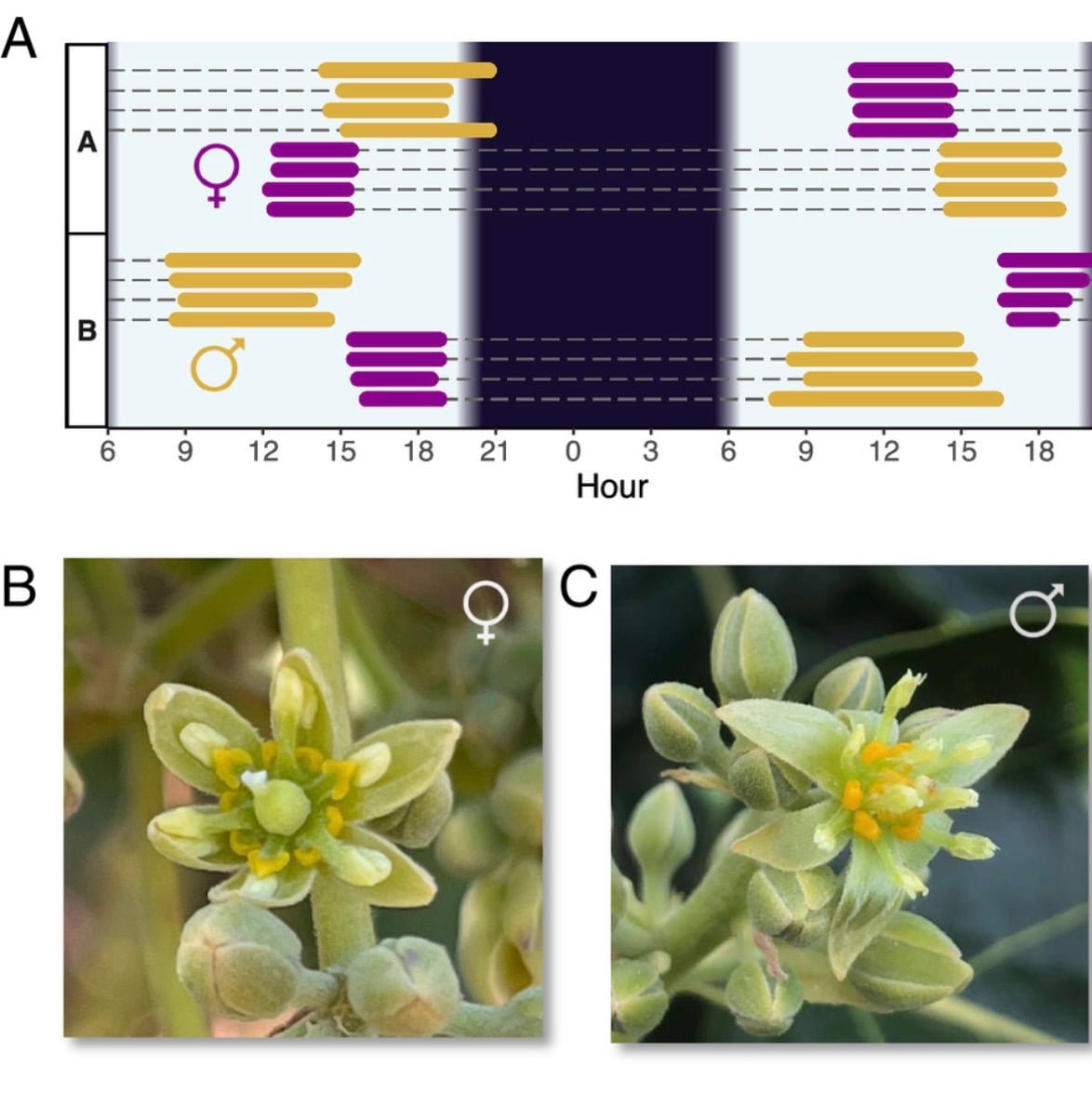
The SDMYB gene comes in two variants, known as alleles. A-type trees carry one of each gene variant, while B-type trees hold two copies of the recessive version, providing a revelation that promises to supercharge avocado science.
“These genetic markers will greatly speed up avocado breeding and research,” explains Graham Coop, an evolutionary geneticist and professor of evolution and ecology at UC Davis, as well as the study’s senior author.
“This has been a major impediment for avocado breeders. Previously, you could not tell whether a plant was an A- or a B- type until it flowered, and avocado plants may take up to 10 or 15 years to flower in the first place.”
Unveiling these genetic blueprints, which appear to have emerged more than 42 million years ago, can pay immediate dividends.
“This is something we can begin using right away,” says Marllon Soares dos Santos, an agricultural engineer at UC Riverside and one of the study’s co-authors.
For example, California avocado growers may stock 10 percent of an orchard with B-type pollinizer trees to help their neighboring A-type trees produce more fruit.
Yet the fruit of B-type trees is commercially undesirable, unlike the world’s favorite, supermarket-stocked Hass avocado, an A-type treat.

“Instead of planting hundreds of seedlings and waiting years to see which flower type they become,” Soares Dos Santos explains, “we can make those decisions at the beginning. That makes breeding much more efficient.”
So, given the creative cultivation of other popular plants, like grapes, might we be making cotton-candy-flavored guacamole anytime soon?
Alas, gene editing applications may remain many years away. But the genetic markers illuminated in this work will allow breeders to select the plants they want without having to wait for them to flower – saving them time, labor, and orchard space.
Related: Men Can Lose Their Y Chromosome With Age, And We Finally Know The Cost
“People have wondered about this trait since avocado breeding began in California,” concludes Eric Focht, a botany-and-plant-sciences researcher at UCR and one of the study’s co-authors.
“Now we finally understand the genetics behind it, and we can use that knowledge to build the next generation of avocados.”
This research was published in the Proceedings of the National Academy of Sciences.
This article was fact-checked by Rachel Garner and edited by Fiona MacDonald. While we pride ourselves on our process, we are only human. If you spot a mistake, please let us know.
What did you think of this news? Leave a comment below and/or share it on your social media. This way, we can inform more people about the hottest things in technology, science, innovation, and gaming!
This news was originally published in:
Original source
