
Astronomers Have Uncovered a Strange Pattern in The Winds of Alien Worlds
The hottest giant planets in the galaxy should, in theory, have the fastest winds.
The hotter a planet is, the stronger its atmospheric currents should be – and a category of exoplanets known as hot Jupiters contains the hottest worlds we’ve ever found.
They orbit so insanely close to their host stars that some of them are literally evaporating from the heat…
Yet a new analysis of seven hot Jupiters reveals wind speeds that are practically sluggish, compared to what astronomers expected.
The best explanation for this surprise, according to a team led by astronomer Julia Seidel of Côte d’Azur Observatory in France, is that something is holding the winds back.
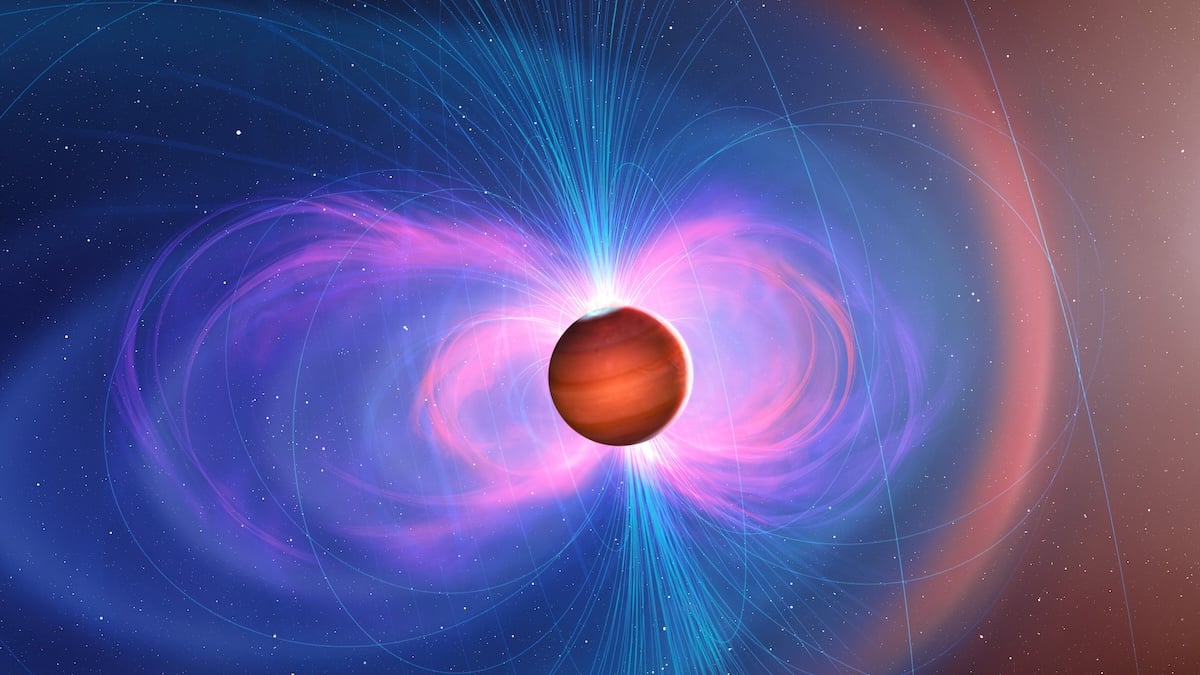
And the mechanism that could best explain that powerful braking effect is a magnetic field.
If the team’s findings are validated, these laggardly winds could be the best evidence we’ve seen yet of magnetic activity on a world outside the Solar System.
“This breakthrough opens a completely new window on exoplanet research,” Seidel says.
“It’s the first time we can compare the magnetic environments of other worlds – a key step toward ultimately understanding which planets can stay alive, keep their water, and perhaps even, one day, host life as we know it.”
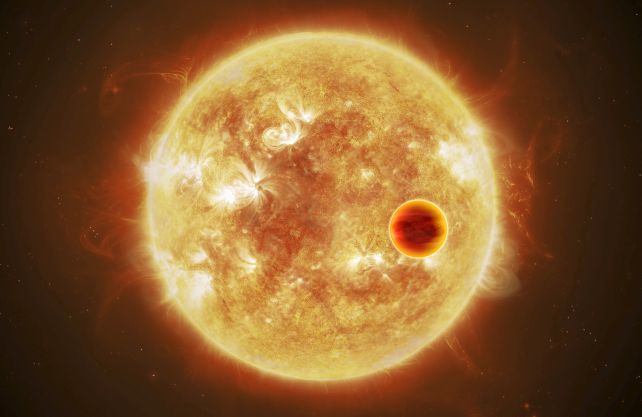
Hot Jupiters are already some of the most fascinating exoplanets in the Milky Way. These worlds are in such proximity to their stars that, in the most extreme cases, their orbits are less than a day.
This means that two things are usually true for hot Jupiters. The first is that they are tidally locked, with one side permanently in daylight facing the star, and the other in permanent darkness facing away.
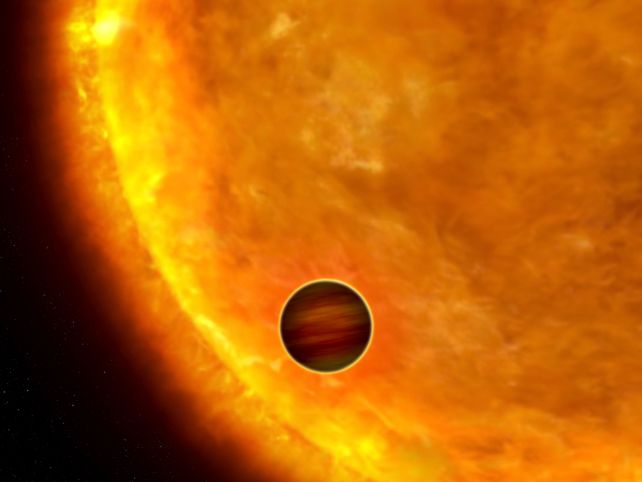
This produces a temperature contrast that should create some absolutely demented weather.
The second is that these worlds are usually heated to equilibrium temperatures of several thousand degrees, helping drive even stronger atmospheric circulation.
Now, we can’t directly measure magnetic fields on exoplanets, but previous studies of individual hot Jupiters have shown that, by tracing vaporized iron in the atmosphere, wind speeds can be established.
Because we know that magnetic fields can act as a brake on electrically charged gases, the researchers thought they might be able to use hot Jupiter wind speeds as a proxy for magnetic field activity.
They used the MAROON-X instrument on the Gemini North telescope and the ESPRESSO instrument on ESO’s Very Large Telescope to measure wind speeds across seven hot Jupiters.
Now, wind speeds on these worlds are still far beyond anything we might see in the Solar System. The researchers recorded howling gales at speeds between 2 and 7 kilometers (1.2 to 4.3 miles) per second. Jupiter’s wind speeds – the fastest in the Solar System – only get as high as about 0.4 kilometers per second.
However, what makes the hot Jupiters interesting is the clear relationship between wind speed and temperature.
The researchers found that the hotter the exoplanet, the slower its winds.
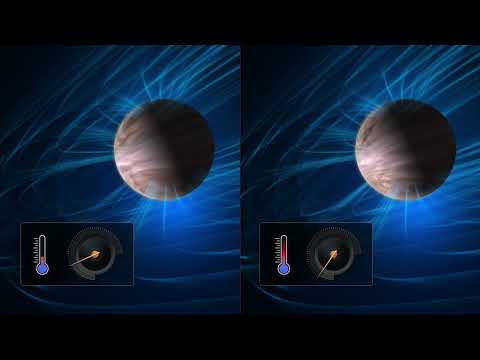
There are some other explanations for slower-than-expected winds on hot Jupiters; but, the researchers argue, the other possibilities would still show the opposite trend, with wind speed increasing with temperature.
“This is totally counterintuitive because, all things being equal, hot planets have more energy to accelerate the winds!” says astronomer Vivien Parmentier of Côte d’Azur Observatory. “Something must happen that slows down the wind speeds for hotter objects.”
This something, the researchers argue, is most likely to be magnetic fields… and, based on the trend in their observations, they were even able to infer the strength of the field producing the effect.
The hot Jupiters, they found, should have magnetic fields of only a few gauss, roughly comparable to Jupiter’s.

Because it’s a proxy measurement, further observations may be required to confirm the team’s findings.
Related: Ludicrous Lemon-Shaped World Is Like Nothing We’ve Ever Seen
However, it’s still a lovely result – one that shows just how far we’ve come in understanding alien worlds, moving away from the characteristics of individual planets to statistical-level analyses that start to reveal patterns.
“Here on Earth, we know the beauty of the northern and southern lights, where particles from the Sun hit our magnetic field and are guided toward the poles, colliding with gases in the atmosphere to produce colorful displays of green, pink, and purple,” says astronomer Bibiana Prinoth, formerly of Lund University, Sweden, now at the ESO.
“I like to imagine that some of these worlds have a sky filled not only with stars, but with vast curtains of colorful light dancing across a planet that’s half in perpetual day and half in endless night.”
The research has been published in Nature Astronomy.
What did you think of this news? Leave a comment below and/or share it on your social media. This way, we can inform more people about the hottest things in technology, science, innovation, and gaming!
This news was originally published in:
Original source
