
After 25 Years, Physicists Can Finally Measure The ‘Other’ Kind of Quantum Entanglement
Quantum entanglement is one of the most cognitively jarring disconnects between the quantum domain and the macroscopic world.
When fundamental particles such as electrons or photons are entangled, they share a quantum identity and cannot be described as individual entities; they exist in a superposition with no fixed state until at least one is measured.
This transcends physical distance, so a quantum-entangled coin flip on Earth would produce an instantaneous and commensurate result on Mars.
Of course, these results are random and transmit no information, squashing hopes for faster-than-light communication or an intricate terrestrial-Martian coin-flip cheating ring.
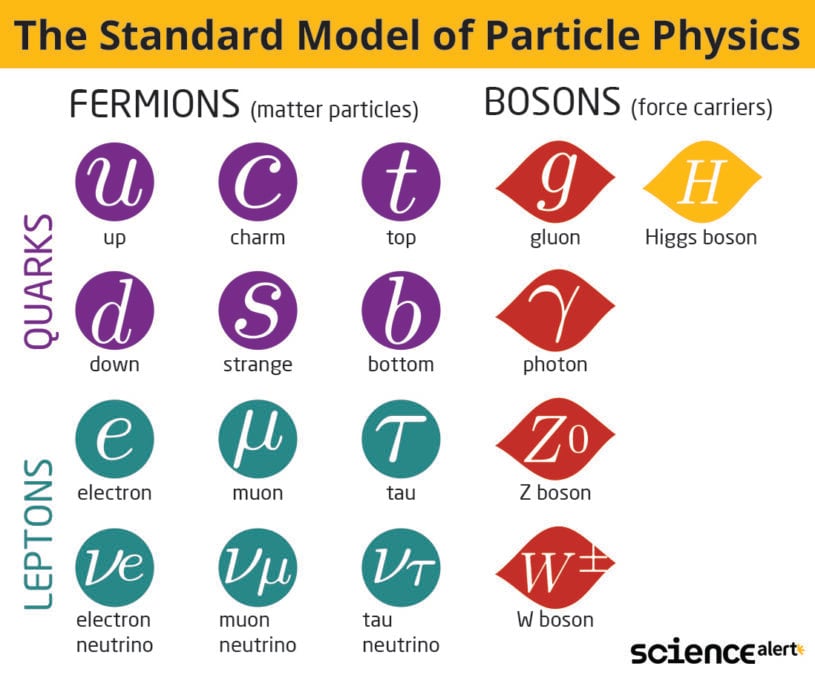
Still, entanglement is critical for quantum information technologies; we just need to increase how many particles we entangle and our ability to measure these systems.
To that end, physicists from Kyoto University and Hiroshima University have pulled us one or a few steps closer to our looming quantum future in a landmark study that determined the configuration of multi-particle entangled states, starting with three photons.
In their paper, published in Science Advances in September 2025, physicists finally reported a new technique to perform measurements of the so-called W-state entanglement types.
Previously, scientists measured Greenberger-Horne-Zeilinger (GHZ) states, the well-known and fundamental ‘vanilla ice cream’ of multi-particle entanglement systems.
“More than 25 years after the initial proposal concerning the entangled measurement for GHZ states, we have finally obtained the entangled measurement for the W state as well, with genuine experimental demonstration for 3-photon W states,” explains Shigeki Takeuchi, a quantum information researcher.
But the ‘chocolate chip cookie dough’ of W state entanglements exhibits greater complexity, and an interesting property that differs from the GHZ states. In W states, if you lose one of the entangled particles, the remaining ones retain their useful entangled state.
Importantly, particle entanglement is often measured using a technique known as quantum tomography. It works kind of like the X-ray computed tomography that reveals our bodies’ skeletal secrets.
It involves taking many measurements, and then putting these ‘slices’ together into a coherent image.
But this can be inefficient and tricky, introducing two practical bottlenecks.
First, scientists must create many identical entangled systems, because measuring (observing) their properties snaps them out of their entangled states.
Second, the measurements required to reconstruct an entangled state exponentially rise with the number of entangled particles.
The researchers managed to sidestep these issues with a one-shot measurement that determined the entire entangled system in a single step.
They did so using a discrete Fourier transform (DFT) optical circuit device of their own making, which acted as an advanced interferometer.
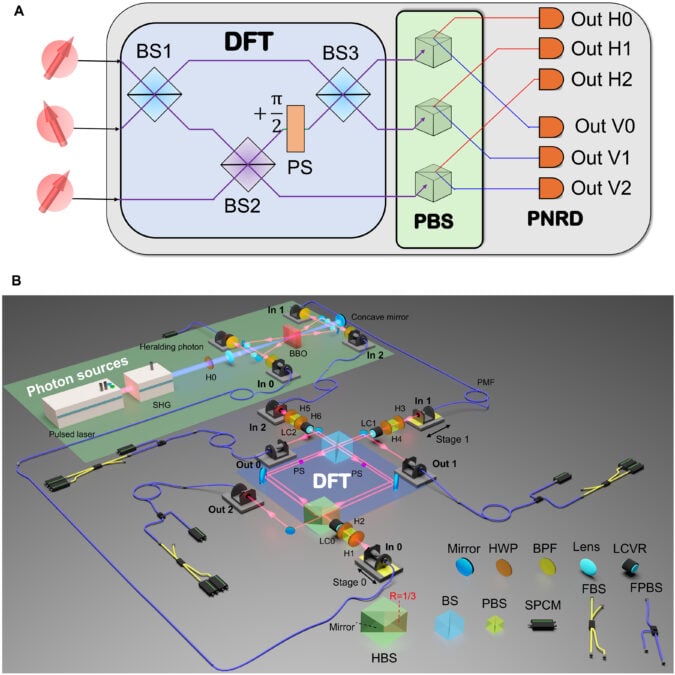
In other words, they injected three photons of known polarization into this device, which split them along different paths and then crashed them back into each other, to see how the peaks and valleys of their wave functions lined up, either combining or canceling out.
This allowed the researchers to explore the W state’s “cyclic shift symmetry,” which is a bit like a system’s fingerprint based on the symmetry of its quantum properties.
The “cyclic shift” part means that the entangled system’s structural description does not change when its individual photons are shifted in a cyclical fashion.
Imagine a group of people sitting in a circle around a campfire. Suddenly, each of them stands up and shifts over one seat to the left (who knows why, perhaps they’re part of an esoteric Borg-like hivemind that has not lost its ancestral fascination with flames).
As a result, the cyclically shifted Borg circle looks the same.
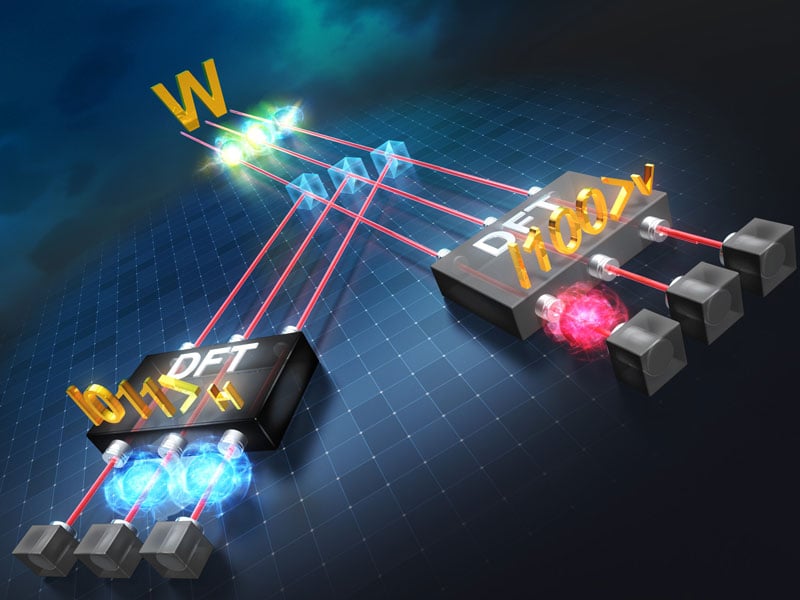
And thus, the researchers revealed an averaged measurement discrimination fidelity (MDF) of 0.871 ± 0.039.
They correctly identified the W state condition 87 percent of the time, comfortably exceeding the mathematical threshold of 66.7 percent (two-thirds) to demonstrate that three-particle entanglement measurement has been achieved, thereby proving the efficacy of their methodology.
Why not 100 percent?
The team attributes the shortfall to imperfections in photon preparation and the measurement setup itself.
“We believe that these results represent an important milestone toward a wider application of multi-qubit entangled measurements in photonic quantum computation, quantum communication, and sensing,” write the researchers.
Accordingly, this work helps open the door – hopefully not a quantum door that’s both open and closed at the same time, i.e., Schrödinger’s stubbed toe – for quantum applications in computing and cryptography.
The team now plans to develop on-chip photonic quantum circuits for these entangled measurements.
Given the gaping technological maw of quantum computing, these advances could come together to improve life-saving drug research or personalized healthcare strategies, for example.
They could also make our Pizza Hut rewards points accounts more secure than ever – unless a pepperoni-hungry hacker also has quantum computing access.
The research has been published in Science Advances.
This article was fact-checked by Rebecca Dyer and edited by Rebecca Dyer. While we pride ourselves on our process, we are only human. If you spot a mistake, please let us know.
What did you think of this news? Leave a comment below and/or share it on your social media. This way, we can inform more people about the hottest things in technology, science, innovation, and gaming!
This news was originally published in:
Original source
