
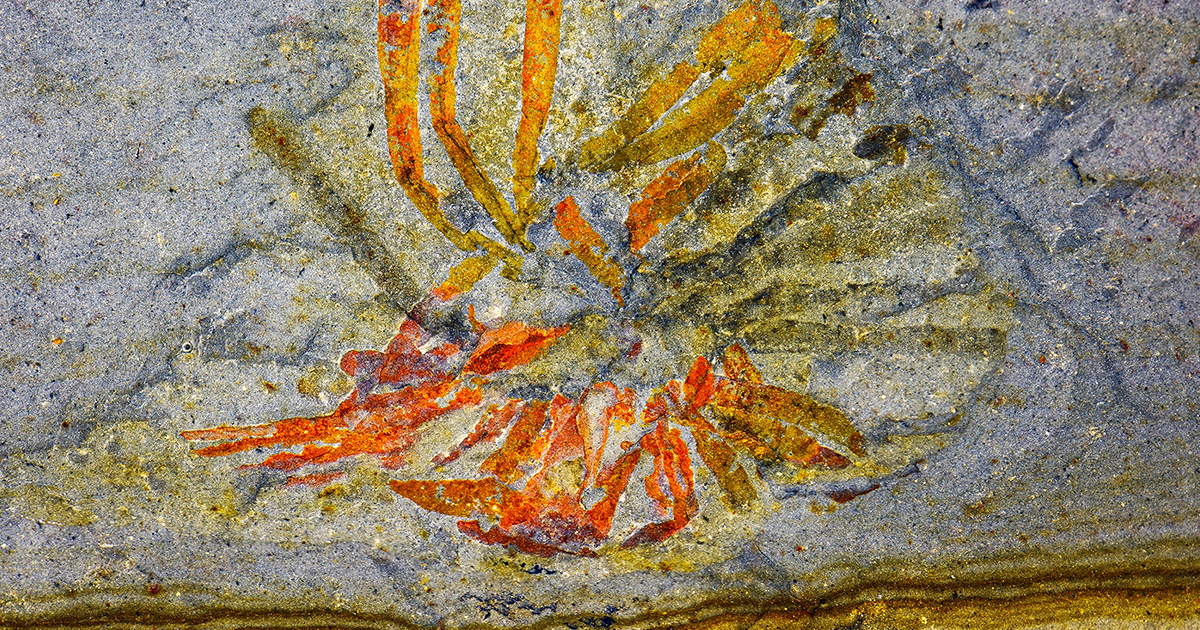
A Treasure Trove of Cambrian Fossils Rewrites the Story of Early Life
Roughly 540 million years ago, toward the start of the Cambrian Period, the planet was mostly ocean, and life was both alien and vaguely familiar. Small, phallic-looking worms rummaged through ocean-floor sediments while blind swimming beasts flung out whiplike tentacles to ensnare prey. Meanwhile, early versions of mollusks and sponges populated the seafloor as jellyfish floated above.
Shallow ocean waters and an increase in oxygen levels in Earth’s atmosphere triggered what we call the Cambrian explosion: the first major blossoming of modern biodiversity. Life forms of increasing complexity filled the seas, providing the evolutionary foundations for nearly every phylum alive today.
Then, around 513.5 million years ago, came the Sinsk event, the first known mass extinction of the Phanerozoic, our current geologic eon. As Earth’s tectonic plates shifted, huge volumes of volcanic gas and carbon dioxide transformed the atmosphere, sucking oxygen out of the oceans and devastating shallow-water environments.
Much of what scientists know about this period in Earth’s history comes from Charles Doolittle Walcott’s discovery of the Burgess Shale in British Columbia in 1909. The Burgess Shale is one of a small handful of Cambrian deposits that reach the level of Lagerstätten, a German term used to describe incredibly diverse and exceptionally preserved fossil sites. Sites that preserve soft-bodied organisms are even rarer because soft tissues decompose more easily, making these places especially useful for piecing together prehistoric ecosystems. Fossils from these most special locations not only show body outlines and external textures but also preserve details from appendages and internal organs, from eyes and gills to guts and nerve networks. Other notable Lagerstätten include the Chengjiang Fossil Site (China), Sirius Passet (Greenland), and Emu Bay Shale (Australia).
In 2026, a new Cambrian Lagerstätte entered the scene. Paleontologists in southern China uncovered a trove of some of the best-preserved Cambrian fossils to date — a massive collection of 8,681 fossils spanning 153 species — named the Huayuan biota. Many of the Huayuan fossils look similar, if not identical, to those in the Burgess Shale, indicating that these marine ecosystems were connected by global ocean currents. Crucially, because the Huayuan site postdates the Sinsk event and represents deeper parts of the ocean, the collection indicates that deep-water environments were a refuge for organisms during mass extinction.
To paleontologists’ delight, more than half of the species uncovered at the Huayuan site are new to science. “As we discovered more and more animal species in the field and in our lab, we were surprised by the extraordinary diversity of this soft-bodied biota,” said study author Han Zeng, head of the Chengjiang Paleontological Station and a paleontologist at the Chinese Academy of Sciences.
Zeng says that what’s been uncovered in the new deposit is only a fraction of the tens of thousands of other fossils there. They reveal a clearer picture of what life looked like in the early Cambrian’s deep marine environment after the Sinsk extinction.
Because this collection is so biodiverse and represents a part of the world that paleobiologists have understood little about — the deep seas — it can help them refine hypotheses about how all modern animal phyla on Earth evolved. These new fossils are yielding clues about the origins of oceanic carbon cycling, how ocean currents connected food webs on opposite sides of the globe, and the forces that drove ecosystems to become as complex as they are today.
“These are just exquisite fossils,” said Doug Erwin, a paleontologist and evolutionary biologist at the Santa Fe Institute who was not involved in the discovery but collaborates with Zeng. “They’re really beautiful specimens.”
All images courtesy of Han Zeng/Nanjing Institute of Geology and Palaeontology, Chinese Academy of Sciences.
What did you think of this news? Leave a comment below and/or share it on your social media. This way, we can inform more people about the hottest things in technology, science, innovation, and gaming!
This news was originally published in:
Original source
