
A Quiet Region of Italy Is Hiding a Vast Reservoir of Magma
Scientists have discovered a vast reservoir of magma bubbling beneath the Tuscan soil that may not yet have erupted.
With no obvious volcano to mark the spot, the immensity of the system and its extreme heat had gone unmeasured until now.
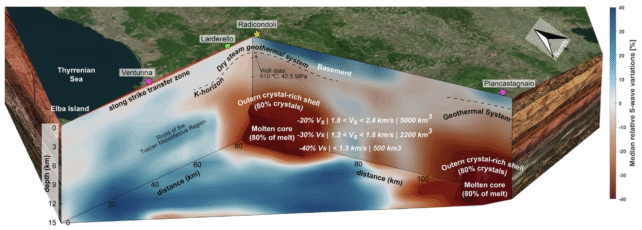
The Tuscany region is home to only sparse volcanic activity, and yet, 8 to 15 kilometers (5-9 miles) deep, scientists estimate that more than 5,000 km3 of magma and partial melt roils and churns.
That’s a volume of supercritical fluids roughly on par with the upper magma chambers of the famous Yellowstone supervolcano. But unlike in North America, there are no sulfur plumes or prismatic springs on the western coast of Italy to give away the presence of this quietly sleeping beast.
The discovery was made by an international team of geoscientists and volcanologists, led by researchers at the University of Geneva (UNIGE) in Switzerland, as well as Italy’s Institute of Geosciences and Earth Resources, and the Italian National Institute of Geophysics and Volcanology.
“We knew that this region, which extends from north to south across Tuscany, is geothermally active, but we did not realize it contained such a large volume of magma, comparable to that of supervolcanic systems such as Yellowstone,” explains lead author and geoscientist Matteo Lupi from UNIGE.
The size of the magma reservoir beneath Tuscany was measured using a network of seismometers, which can probe the subsurface sort of like an X-ray for the Earth. Using the resulting data, Lupi and his colleagues modeled the upper 15 kilometers of continental crust in Tuscany.
“These results are important both for fundamental research and for practical applications, such as locating geothermal reservoirs or deposits rich in lithium and rare earth elements, which are used, for example, in electric vehicle batteries,” explains Lupi.
“In addition to their great scientific interest, these studies show that tomography, by exploring the subsoil quickly and at low cost, can be a useful tool for the energy transition.”

The team’s interpretation of their data is that the middle crust of the Tuscany region is home to a large magmatic reservoir.
The sheer volume of the network, the authors write, is on par with “those of some of the largest eruptive systems worldwide, such as Taupō, Long Valley, and Yellowstone. All these volcanic systems featured super-eruptions.”
In Tuscany, however, there is no recognized eruption associated with this geothermal system.
With nowhere to go, scientists predict that in the shallow subsurface, supercritical fluids could exceed temperatures of 500 °C (932 °F).
Related: One of Earth’s Most Explosive Volcanoes Is Quietly Refilling With Magma
“The reason why this large amount of melt never gave rise to eruptions is enigmatic and debated,” the authors conclude.
“Such partial melts may help understand the long-term evolutionary processes taking place at volcanic systems that featured super-eruptions and in regional-scale high-enthalpy systems that have not (yet?) erupted.”
The study was published in Communications Earth & Environment.
What did you think of this news? Leave a comment below and/or share it on your social media. This way, we can inform more people about the hottest things in technology, science, innovation, and gaming!
This news was originally published in:
Original source
