
World’s Oldest Known ‘Octopus’ Turns Out to Be An Entirely Different Animal
A fossil that was fundamental to describing the evolution of octopuses turns out to have been an impostor, all along.
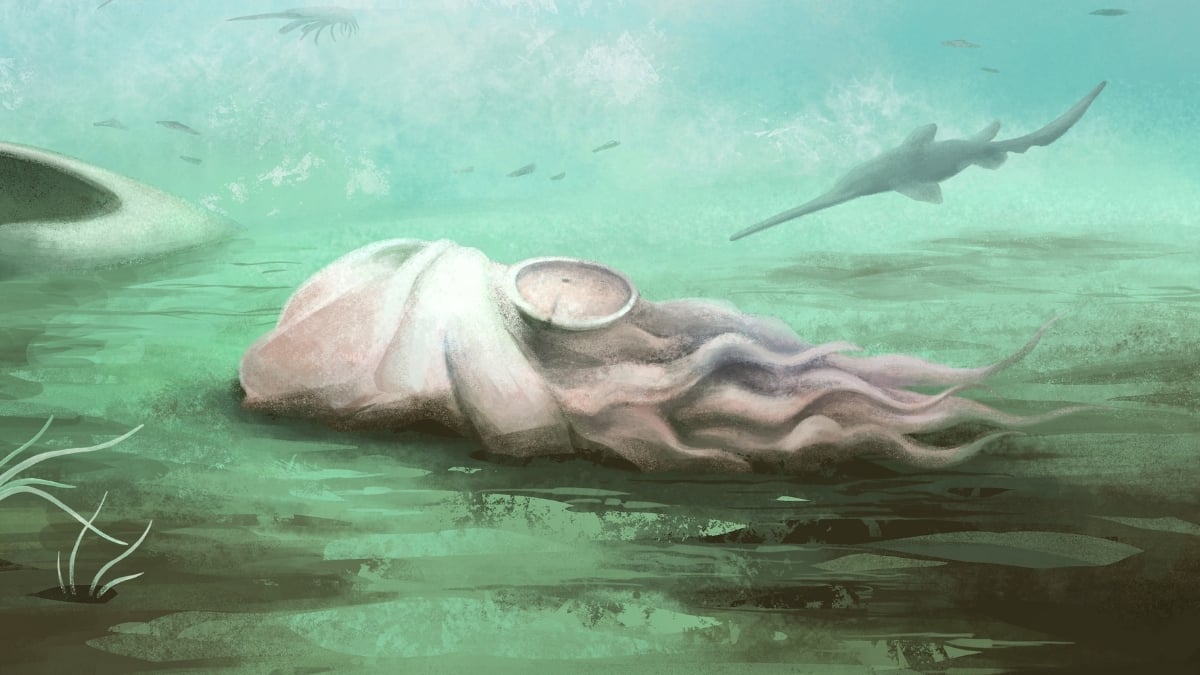
The famous 300-million-year-old Pohlsepia mazonensis, discovered in 2000 and later lauded in the Guinness Book of World Records as the oldest known octopus species, has been reclassified as a nautiloid – a shelled cephalopod closely related to the nautiluses living in the ocean today.
This means that scientists are going to have to redraw the cephalopod family tree – the discovery pushes the record of nautiloid soft tissue back by around 220 million years, and brings the earliest evidence for octopuses forward by around 150 million years.
“It turns out the world’s most famous octopus fossil was never an octopus at all. It was a nautilus relative that had been decomposing for weeks before it became buried and later preserved in rock, and that decomposition is what made it look so convincingly octopus-like,” says paleobiologist Thomas Clements of the University of Reading in the UK.
“Scientists identified Pohlsepia as an octopus 25 years ago, but using modern techniques showed us what was beneath the surface of the rock, which finally cracked the case. We now have the oldest soft tissue evidence of a nautiloid ever found, and a much clearer picture of when octopuses actually first appeared on Earth.”
Pohlsepia is known from a single fossil found in the Mazon Creek Lagerstätte in Illinois. When it was preserved in the soft mud 300 million years ago, its body was badly decomposed, so the paleontologists trying to interpret the squashed remains had their work cut out for them.
Nevertheless, they identified features that appeared to be eight limbs, two eyes, and an ink sac – all indicative, they said, of an octopodean identity. In the intervening years, other scientists queried the finding, but nothing definitive was published.
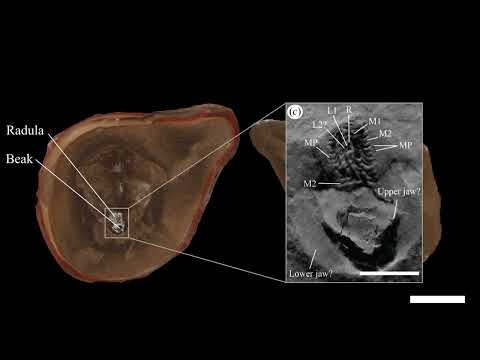
However, in the decades since Pohlsepia‘s identity was first established, technology has emerged that allows scientists to see inside fossils without having to destroy them. Clements and his team made use of cutting-edge synchrotron imaging, which uses X-rays produced by particle accelerators to see inside dense objects.
This X-radiation is billions to trillions of times brighter than the X-ray equipment you might see in a hospital, picking out high-resolution detail that other imaging technology, such as computed tomography, might miss.
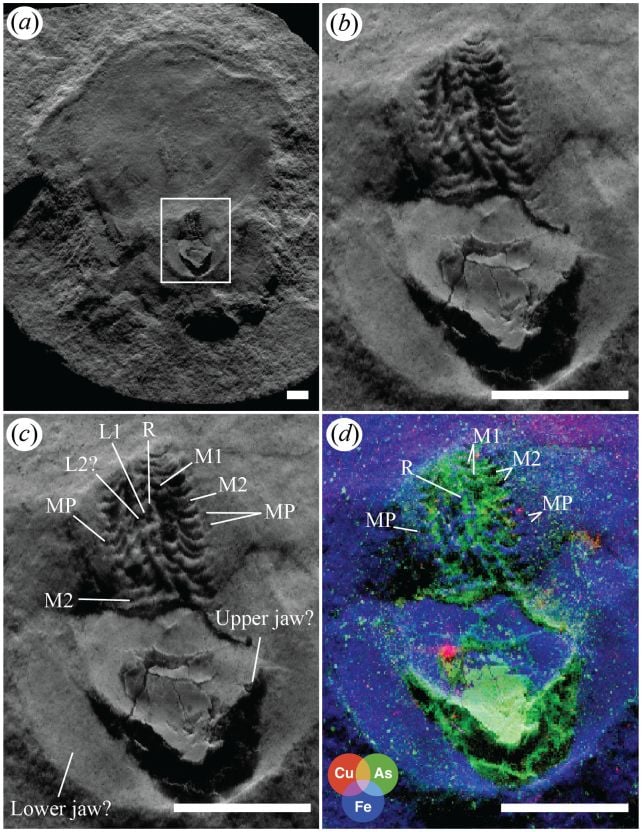
So, when the researchers examined Pohlsepia with this technique, they found an anatomical feature that no one had been able to see before: 11 tiny tooth-like structures, all in a row. This, they said, is likely a radula, a tongue-like ribbon covered in denticles, found only in mollusks.

It’s the number and shape of these denticle structures that was the dead giveaway that Pohlsepia is not an octopus, the researchers said. Octopuses typically have only seven or nine elements in each row of the radula. Nautiloids have 13. The number seen in Pohlsepia is between the two, but the shape clinches it: it’s closer to that of nautiloids than octopuses.
Moreover, they found little evidence that the structure previously interpreted as an ink sac was actually an ink sac. There was no sign of the pigment melanosomes that should accompany it.
When the researchers compared their findings with other cephalopod fossils in the Mazon Creek Lagerstätte, they found another surprise. The newly revealed radula matched that of Paleocadmus pohli, an ancient nautiloid already known from the site.
This suggests that Pohlsepia was never a distinct species – its unusual, decayed preservation made it difficult to interpret, and it was therefore miscategorized as a separate species. Instead, it is a specimen of P. pohli that has now been returned to its correct fold.
Related: The Famous Fossils Scientists Got Incredibly Wrong
In turn, this means that the octopus family tree isn’t what we thought. And that’s the beauty of science. Back in 2000, researchers did the best they could with the information they had. Now, with new technology and new techniques, we have new evidence that means we can move forward towards a better understanding of life on our planet.
“Sometimes, reexamining controversial fossils with new techniques reveals tiny clues that lead to really exciting discoveries,” Clements says.
“It’s amazing to think a row of tiny hidden teeth, hidden in the rock for 300 million years, have fundamentally changed what we know about when and how octopuses evolved.”
The research has been published in the Proceedings of the Royal Society B: Biological Sciences.
What did you think of this news? Leave a comment below and/or share it on your social media. This way, we can inform more people about the hottest things in technology, science, innovation, and gaming!
This news was originally published in:
Original source
