
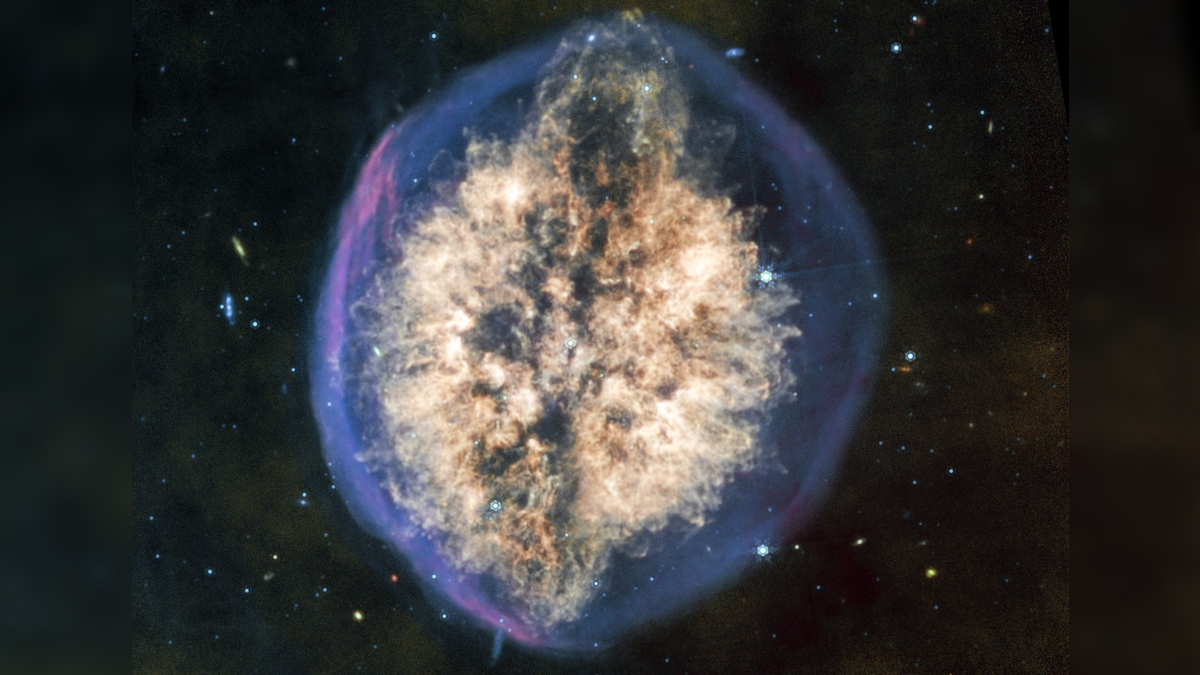
This Epic Nebula Looks Like a Giant Brain Floating in Space
JWST has captured one of its most eerily beautiful images yet: A glowing cloud of gas and dust that resembles a giant brain in a transparent skull, suspended in space.
Officially, its name is PMR 1 – a planetary nebula billowing outwards, the convulsive throes of a star in the final stages of its life. However, its resemblance to human anatomy has earned it a gruesome nickname: the Exposed Cranium nebula.
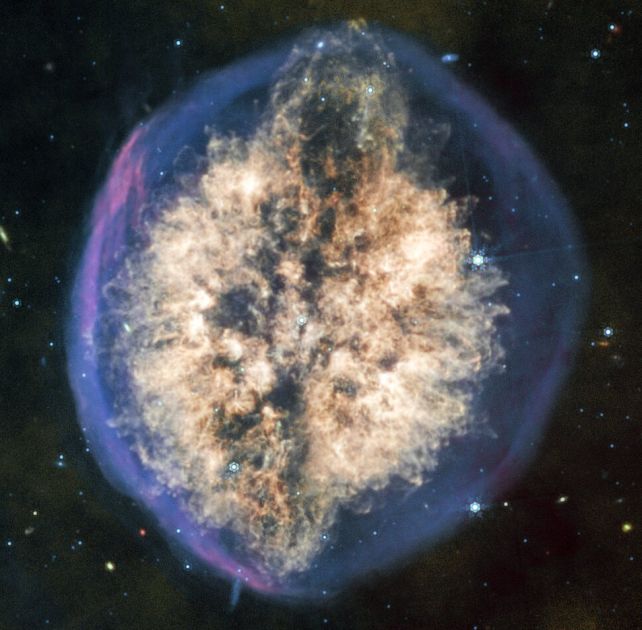
JWST’s unique infrared vision has captured intricate folds and filaments – as well as a dark, central lane running vertically across the object, creating the illusion of giant cerebral hemispheres.
Actually, PMR 1 is something of a mystery. We’ve known about its existence for nearly 30 years now; it’s about 5,000 light-years away, in the constellation of Vela, and it measures about 3.2 light-years across – similar in size to our Solar System as measured to the outer edge of the Oort Cloud.
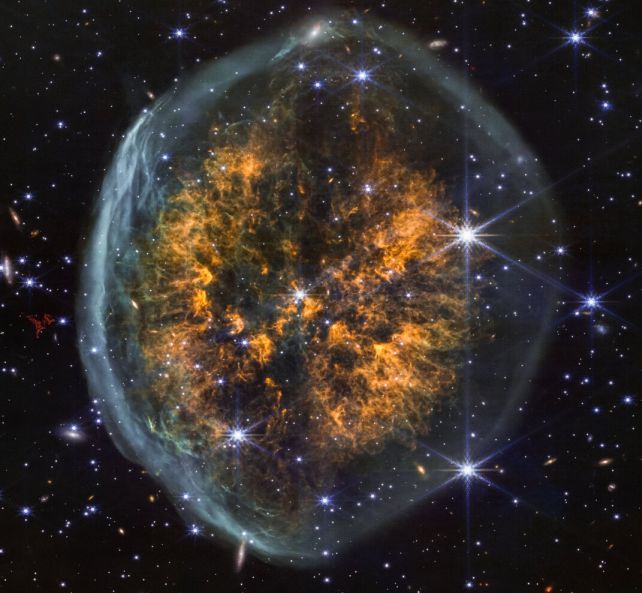
Astronomers have determined that the roiling material is being expelled by a star nearing the end of its life that is rapidly losing mass, spewing out what appear to be jets from opposite sides to create the vertical lane.
But we don’t know what sort of star it is. According to a 2001 paper, its spectrum matches that of a Wolf-Rayet star – very massive, very hot, and very luminous stars at the end of their main-sequence lifespans.

The Wolf-Rayet stage involves the loss of mass at a very high rate, transported by wild stellar winds and driven by radiation pressure. The result is some of the most spectacularly beautiful stellar death scenes in the Universe.
However, PMR 1’s star is unlikely to be one of these tempestuous titans. Other signs suggest a relatively small, Sun-like star, which means it’s just going to shake its outer layers off while the core settles into a white dwarf.
Related: We Just Got a Glimpse of What Will Happen When The Sun Finally Dies
If the spectrum truly matches a Wolf-Rayet type, it may belong to a rare class of planetary nebula central stars that resemble massive Wolf-Rayet stars, but are actually the exposed cores of Sun-like stars on their way to becoming white dwarfs.
Or maybe it’s just a lost Brain Spawn that can’t find its way back to the Infosphere.
What did you think of this news? Leave a comment below and/or share it on your social media. This way, we can inform more people about the hottest things in technology, science, innovation, and gaming!
This news was originally published in:
Original source
