
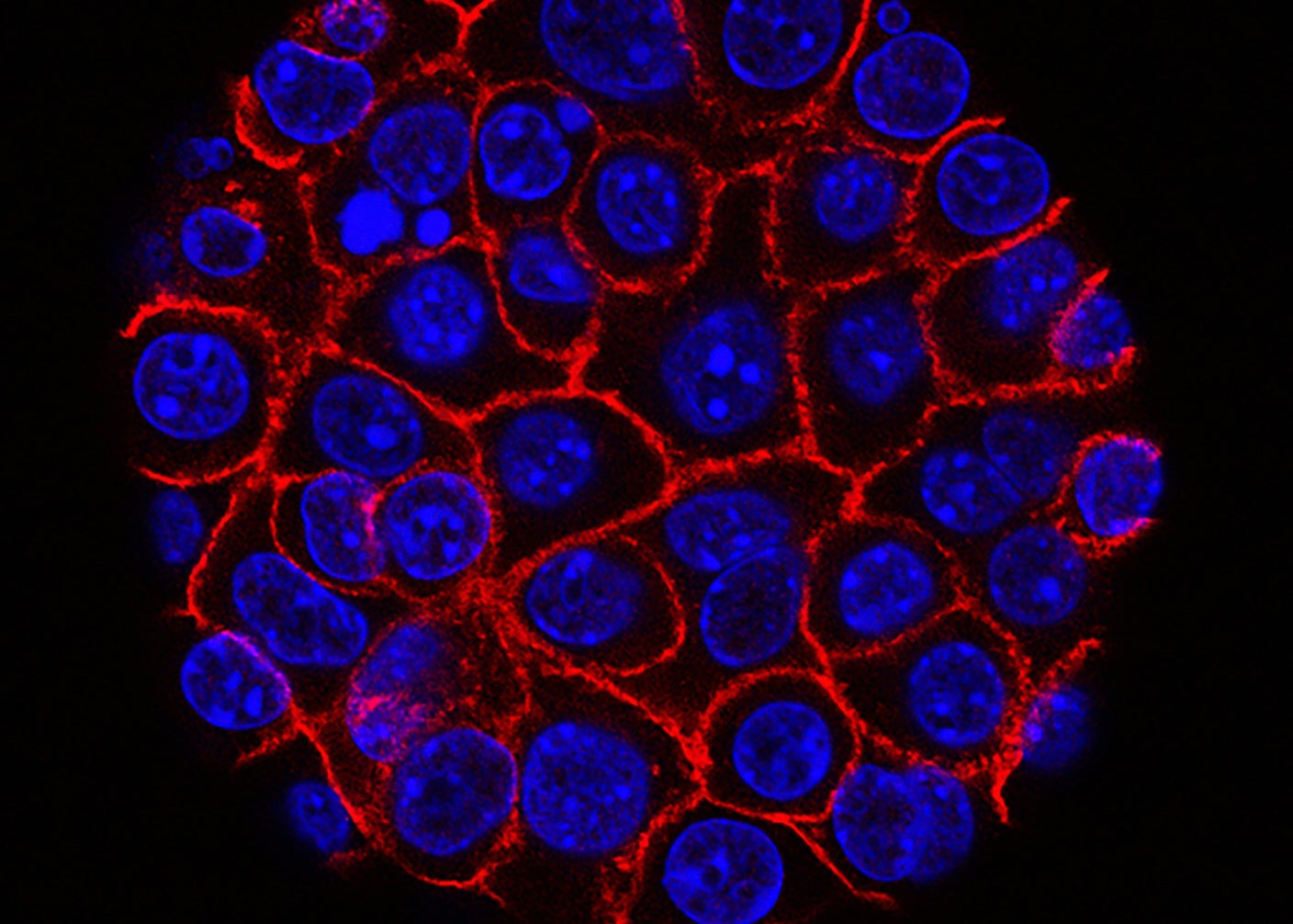
These Supercharged Immune Cells Completely Eliminated Solid Tumors in Mice
Few cancer treatments are as ferocious as CAR T cell therapy.
Often derived from a patient’s own immune cells, CAR T cells are genetically modified to hunt down and destroy cancer cells. The FDA has approved treatments for deadly blood cancers, and treatments tackling autoimmune diseases and preventing tissue scarring in the heart and kidneys have shown promise.
Yet CAR T has struggled against solid tumors. Over 85 percent of cancers fall into this category. Solid tumors have an arsenal of sneaky tactics to evade or deactivate CAR T cells, eventually undermining the treatment.
This month, a Columbia University team broke through one of the barriers with an upgraded design. They engineered a new, ultra-sensitive protein “hook” that seeks out CD70, a protein that dots the surfaces of multiple types of solid cancer cells—but at vastly different levels.
“Some molecules have been identified that are found in 25%, 50%, or 75% of tumor cells,” said study author Michel Sadelain in a press release. “Though a therapy directed at those targets might be successful…you can’t cure somebody if you just eliminate a small fraction or even 90% of their tumor.”
In tests, the supercharged cancer-killers, dubbed HIT cells, detected and wiped out cancer cells with extremely low levels of CD70—so low that the protein was undetectable using traditional methods. In kidney, ovarian, and pancreatic cancer grown from patients’ cells in petri dishes and in mouse models, HIT completely eliminated all signs of these tumors.
Like CAR T, the new approach is plug-and-play. The protein hook can be redesigned to target other faint cancer protein markers that have previously escaped detection.
“We hope our CD70-directed HIT cells help us find a way to eradicate the entire tumor,”
said study author Sophie Hanina.
A Mixed Bag
Our immune system naturally fights off cancer. T cells, for example, roam the body looking for threats. When they identify cancerous cells, they signal other immune cells to launch a coordinated effort to wipe out the cancer before it expands.
The identification process relies on antigens, proteins that dot the surfaces of cancer cells like beacons. But tumors are highly versatile and rapidly evolve their antigen signature, essentially cloaking themselves from immune attacks.
CAR T cells override the defense. Here, T cells are extracted from a patient’s body and genetically engineered with custom-designed protein hooks to grab onto cancer antigens.
Multiple blood cancers have a heavy coat of a single shared protein on their surfaces, making them a perfect target for CAR T therapy. Solid tumors, however, are different. Tumors are dotted with a wide range of antigens, many of which are present in normal tissues. This increases the chances CAR T might attack healthy cells and reduces its effectiveness.
Even for the same antigen, some cells in solid tumors express high levels, others very low. The latter escape CAR T detection and linger as a reservoir that can regrow the tumor.
For a persistent solid cancer cure, “you have to get down to the very last cell,” said Sadelain.
In Plain Sight
An ideal target antigen needs to check two boxes: It’s expressed across multiple tumor cell types, and at the same time, it’s absent in normal cells.
The antigen in the new study, CD70, fits the bill. It occurs in a variety of solid cancers, making it a valuable target beacon. But previous attempts targeting CD70 struggled to control cancer in clinical trials. This is partly because cancer cells within a single tumor have different levels of the antigen, and some seemingly lack the marker altogether, allowing them to escape detection.
But are these cancer cells truly devoid of the antigen, or is it just that scientists, and the CAR T cells they’ve engineered, can’t find them using current methods?
Researchers can see most proteins under the microscope but only if they’re at high enough levels. Rather than relying on conventional imaging, the team looked for CD70 gene expression in donated cancer patient samples. These lab models mimic the complexity of solid tumors.
CD70 antigens dotted each cell in multiple tumors, although at different levels of intensity. “We found that apparent CD70-negative tumor cells do in fact express low levels of CD70, though not at a level high enough to be eliminated by conventional CAR T cells,” wrote the team.
Taking aim at cancer cells with faint CD70 levels, the team tapped into their previous work genetically engineering cells to detect low-level antigens. The hooks on these HIT cells mimic those from a population of highly sensitive T cells naturally found in our bodies.
The team redesigned HIT cells to specifically target CD70. Because normal cells don’t use this molecular pathway, HIT cells largely ignored them, lowering the risk of collateral damage.
“HIT cells are the next generation of CAR T cells. They can be programmed like a CAR T cell, but they have the sensitivity of a natural T cell and can detect cancer cells that have only a vanishingly small number of target molecules,” said Hanina.
Sharp Shooter
Ovarian and pancreatic cancer cells have mixed levels of CD70. Several tests in highly aggressive models for these cancers found that HIT cells completely eradicated the tumors in petri dishes. The treatment also cleared cancer cells in different types of solid tumors in mice, even ones with low CD70 levels. Conventional CAR T only eliminated a fraction of the cancer.
A recent CAR T clinical trial targeting CD70 found CAR T cells could infiltrate and linger near kidney tumors, but their effectiveness was based on detection, which varied depending on the number of CD70 beacons. Because HIT cells are more sensitive, they could hunt down and kneecap more cancer cells.
But HIT cells may have side effects. Although CD70 isn’t expressed in most healthy tissues, its level skyrockets in immune cells during infections, which could trigger friendly fire. The team plans to investigate the treatment’s safety and efficacy in patients with ovarian cancer at the Columbia University Irving Medical Center.
If successful, the technology could benefit roughly 20 other types of solid cancer that express CD70, including deadly brain cancers such as glioblastoma.
“Curing solid tumors is not easy, but this work solves one piece of the puzzle,” said Sadelain.
What did you think of this news? Leave a comment below and/or share it on your social media. This way, we can inform more people about the hottest things in technology, science, innovation, and gaming!
This news was originally published in:
Original source
