

One Sleep Habit Could Boost Your Heart Health, Study Suggests
A new study of sleep and bedtime habits has a clear message for those wanting to lower their risk of major cardiovascular problems (such as a heart attack or a stroke): Stick to a regular bedtime.
While health studies often focus on the quality and duration of our sleep, here researchers from the University of Oulu in Finland found that getting to bed at the same time each night can be significant as well if you aren’t getting more than eight hours of sleep.
The researchers measured sleep behavior activity for 3,231 individuals at the age of 46. Sleep was tracked via wearables over the course of a week.
When participants getting under eight hours of sleep were split into regular, fairly regular, and irregular groups based on their sleep habits, the data showed that those in the irregular group showed double the risk of a serious cardiac event over the next decade, compared to the regular sleepers.
More variability in the sleep ‘midpoint’ (halfway between bedtime and waking up) was also linked to worse heart health.
“Our findings suggest that the regularity of bedtime, in particular, may be important for heart health,” says medical researcher Laura Nauha.
“It reflects the rhythms of everyday life – and how much they fluctuate.”
There is a caveat here, though, in that the risk association only showed up for those who got less than an average amount of sleep (just under eight hours) each night. It seems that banking enough shut-eye helps to protect against the dangers of an irregular bedtime.
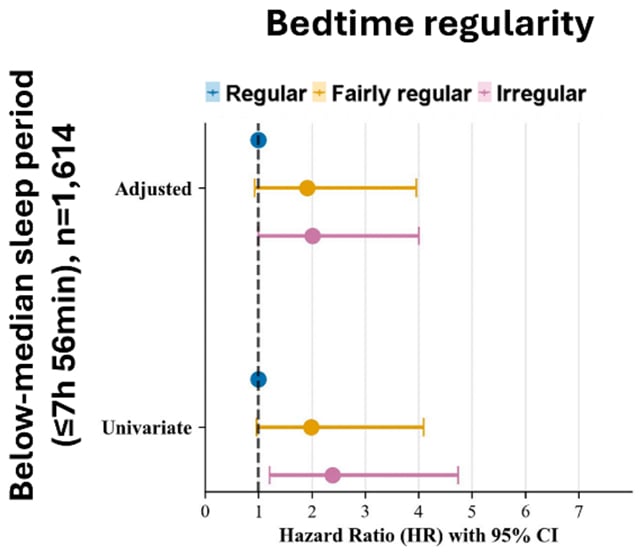
Wake-up times didn’t appear to matter either, the data showed. The connection was only there for large variations in getting to bed. In the irregular group, the average variability in bedtime over the week was 108 minutes, compared to 33 minutes for the regular group.
While the researchers controlled for factors including blood pressure, gender, and exercise, cause and effect can’t be proven here – only a notable association.
The researchers think that the natural 24-hour cycles that our bodies go through – our circadian rhythms – might help to explain some of this association. Changing bedtimes every night is likely to confuse and disrupt these rhythms, which in turn means the heart doesn’t have proper rest and recovery periods.
Real-world stress could also be playing a significant role, the new study acknowledges. Challenges in day-to-day life that affect sleep times – such as workload or mental health issues – will also often affect heart health too.

“Previous research has linked irregular sleep patterns to heart health risks, but this is the first time we’ve looked separately at variability in bedtime, wake-up time, and the midpoint of the sleep period – and their independent associations with major cardiac events,” says Nauha.
For this study, major cardiovascular events were defined as conditions that need specialized medical care, including myocardial infarctions (heart attacks) and strokes.
It’s also important to put the research in context. Out of the more than 3,000 participants, 128 suffered an event like this over the 10-year study period, so we’re talking about a relatively low number overall.
What’s more, sleep was only tracked for seven days, and routines may not necessarily have stayed the same for all participants.
That said, cardiovascular diseases remain the leading cause of death globally, responsible for almost 18 million fatalities a year at the last count. This is clearly a health issue where interventions are badly needed.
Related: Magnetic Fluid Injected Into The Heart May Prevent Strokes, Scientists Think
The researchers are keen to see further studies looking at this bedtime relationship in more detail, and across larger and more diverse groups of people, not least because bedtime is something that many of us have some degree of control over.
There’s a growing pile of evidence linking sleep quality and routine to a whole host of health consequences, and we also know that a lot of these connections – like sleep and exercise – work both ways. The findings here give us another goal to aim at in terms of optimizing our overall sleep health.
“Maintaining a regular sleep schedule is one factor that most of us can influence,” says Nauha.
The research was published in BMC Cardiovascular Disorders.
What did you think of this news? Leave a comment below and/or share it on your social media. This way, we can inform more people about the hottest things in technology, science, innovation, and gaming!
This news was originally published in:
Original source
