
New Simulations Reveal How Earth’s Strongest Ocean Current Got Started
New simulations show that the world’s strongest ocean current didn’t start flowing overnight – several major factors needed to align before it could begin exerting its powerful influence on Earth’s climate.
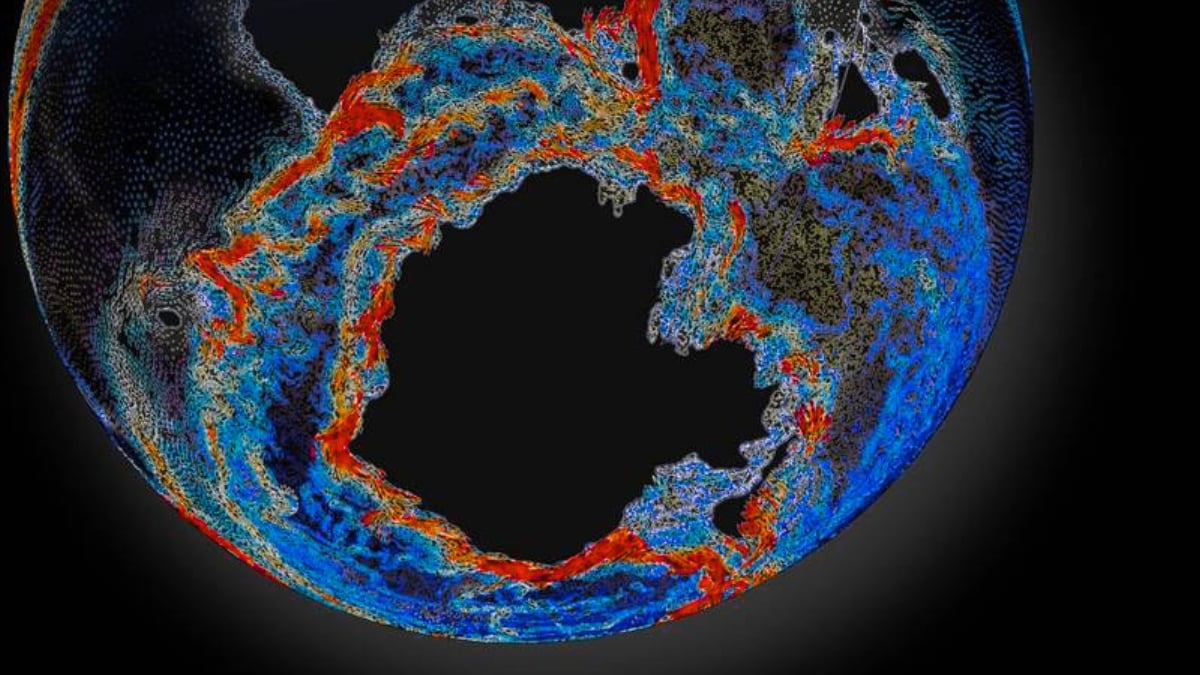
Five times stronger than the Gulf Stream, the Antarctic Circumpolar Current (ACC) snakes around Antarctica in a clockwise direction, feeding into other major ‘conveyor belts’ that move water and nutrients around the planet’s oceans.
The ACC is thought to have formed roughly 34 million years ago, after new ocean passageways opened up as Australia and South America drifted northwards, away from Antarctica. But the new study finds that this alone wouldn’t have been enough to kickstart the current.
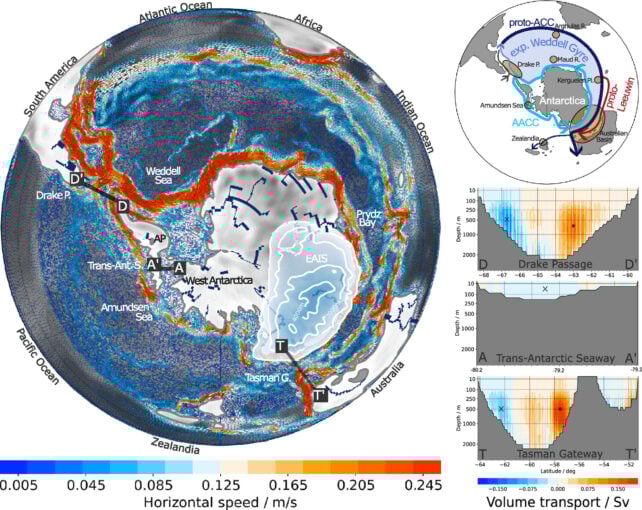
It turns out, a strong westerly wind needed to kick up first. These winds, which are still blowing today, rush through the Tasman Gateway – the open expanse of ocean between Antarctica and the southern coast of Australia.
“There were already indications that the wind in the Tasman Gateway played an important role in the formation of the ACC,” says Hanna Knahl, climate modeler at the Alfred Wegener Institute (AWI) in Germany.
“Our simulations can clearly confirm this: Only when Australia had moved further away from Antarctica and the strong westerly winds blew directly through the Tasman Gateway, the current could fully develop.”
Despite its important role in the global climate, the ACC remains relatively understudied because it churns around the most remote parts of Earth. To better understand its present-day and future movements, a team led by scientists at AWI investigated its past.
The researchers produced climate simulations of Earth as it was about 33.5 million years ago, when the ACC is thought to have first started up. This included details on ocean depth and circulation, atmospheric carbon dioxide levels, wind speeds and directions, and land mass locations.
These models were then paired with data on the evolution of the Antarctic ice sheet, to investigate how its formation may have influenced, and been influenced by, the ocean currents and overall climate.
That period was a tumultuous time in Earth’s history: The planet was transitioning from a greenhouse climate to a cooler icehouse climate, characterized by permanent ice caps on the poles.
In under a million years, the CO2 concentration dropped from around 1,000 parts per million (ppm) to around 600 ppm.
This wasn’t the only major change the planet was going through. As Australia and South America drifted northwards, Antarctica became completely isolated from other landmasses, allowing water to circulate around the continent.
However, that still wasn’t enough for the ACC as we know it to get going. The simulations showed that a ‘proto-ACC’ was starting to form, but it couldn’t yet complete a full circuit. Instead, the current splits and heads north, traveling off the east coasts of Australia and New Zealand, where it eventually dissipates.
The problem, it seems, is that the winds blowing off the East Antarctic Ice Sheet meet the westerly winds in the Tasman Gateway, and the current can’t keep up its strength. The circuit can only be completed after Australia shifts farther north.
“Our model results support previous findings indicating that the onset of a complete ACC is only possible once Australia migrates further north to a position where the westerly wind belt and the Tasman Gateway become latitudinally aligned,” the researchers write.

Once the ACC really got going, it played a key role in stabilizing Earth’s climate. It connects with currents in other oceans to form a kind of global conveyor belt that transports nutrients and water of different temperatures. Crucially, this fast-moving boundary around Antarctica keeps warmer waters away from the ice sheets, which helped keep them intact for millions of years.
However, our current warming phase could be disrupting the ACC. The current is migrating southward, bringing warmer waters closer to the Antarctic shorelines, which accelerates ice loss.
In turn, this influx of fresh meltwater is diluting the salinity of the ocean around it. Recent research suggests that this could slow the ACC by 20 percent by 2050, which would weaken biodiversity in the oceans, and allow even more warm water to reach the ice sheets, in a vicious cycle.
Related: A Cycle Deep Within Earth’s Crust May Affect Climate More Than We Thought
“In order to predict the possible future climate, it is necessary to look into the past with simulations and data to understand our Earth in warmer and more CO2-rich climate states than today,” says Knahl.
“But careful, the climate of the past can of course not be projected 1:1 onto the future. Our study shows that the circumpolar current in its ‘infancy’ influenced the climate very differently than today’s fully developed ACC does.”
The research was published in the Proceedings of the National Academy of Sciences.
What did you think of this news? Leave a comment below and/or share it on your social media. This way, we can inform more people about the hottest things in technology, science, innovation, and gaming!
This news was originally published in:
Original source
