

Lifting Weights Changes Your Fat Long Before You Lose Weight – at Least in Mice
A lot of biological changes happen in the body once someone starts losing weight.
For researchers looking at the impact of diet, exercise, or any other factor, it can be difficult to untangle these weight loss effects from whatever it is they’re trying to measure.
To get some clarity on the effects of strength training on fat cells before weight loss kicks in, researchers from the University of Campinas in Brazil ran experiments with obese mice over the course of a week.
They studied the visceral fat around the organs before the animals had started to shed the pounds.
Compared to sedentary obese mice, the mice on the strength training regimen had less fat around their intestines and smaller fat cells (which typically indicates healthier fat tissue).
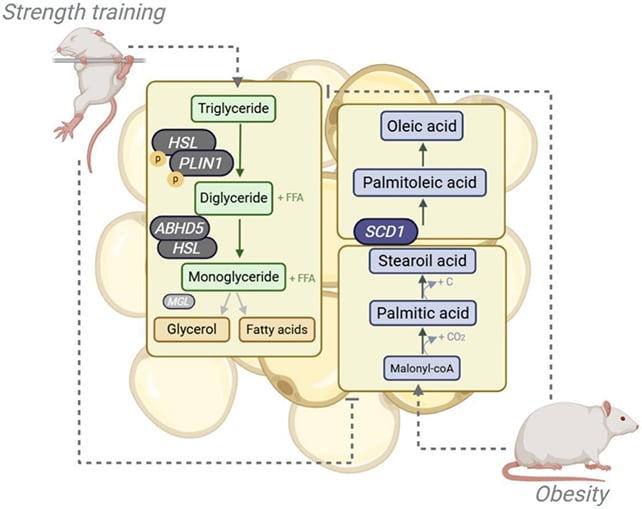
There were also signs of positive changes in fat storage and fat breakdown signals.
The study results, published in Life Sciences, suggest that strength training improves metabolic health before any associated weight loss – though the findings still need to be replicated in human trials.
“People tend to think that if they’ve been strength training for two months and haven’t lost weight, it hasn’t done any good,” says physician Leandro Moura.
“But what we saw in this study is that after just seven days of strength training – even when there was still no weight loss – the molecular pathways that promote fat accumulation were less active, while those that stimulate fat breakdown were more active.”
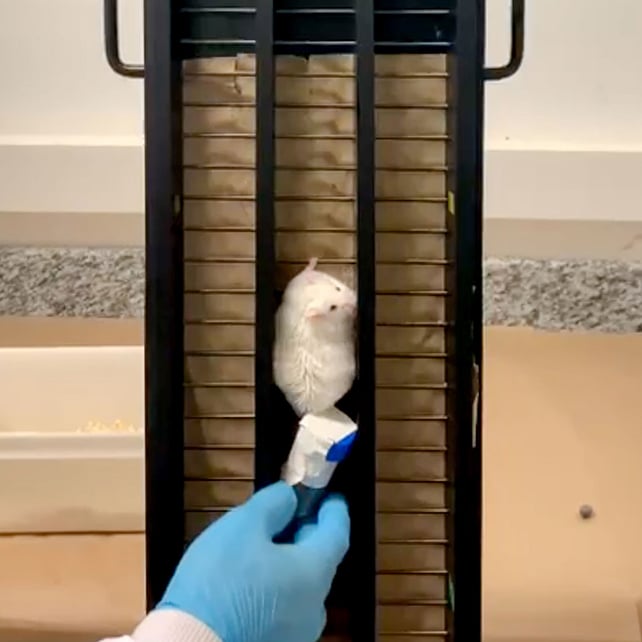
To simulate the effects of weight training on the study animals, the researchers directed the obese mice to climb a 70-centimeter (27.6-inch) staircase with a weight attached to their tails. Sessions included 20 climbs, with rest periods of 60–90 seconds, at 70 percent of the maximum capacity of the rodents, and there were seven sessions in all.
“We calculated how much weight each mouse could carry while climbing a staircase,” says Moura.
“Obviously, it isn’t possible to replicate the exact strength training exercises performed by a person, but we were able to induce a similar effort in the body, with more intense contractions, effectively mimicking a strength training session for humans.”
Fat tissue samples from these strength training mice were then compared with tissue from obese mice who hadn’t done any exercise.
As well as the benefits mentioned above, the team also looked at two proteins, ABHD5 and ATGL. ABHD5 is one of the drivers for breaking down fats: It was at a reduced level in the obese, sedentary mice, but in the strength training group, ABHD5 levels were normal – and interactions with ATGL, a fat-dismantling enzyme, increased too.
Add in a dialing down of the Scd1 gene in the exercised mice – which is involved in producing fat – and the researchers say there’s evidence that strength training can work alongside aerobic exercise for reducing weight.
“Both types of exercise activate similar pathways – at different intensities – as well as different pathways,” says Moura.
“Therefore, combining the two remains the best recommendation and the best strategy for those who want to lose weight.”
The next steps, besides working towards the long-term goal of clinical trials, are to look at the longer-term effects of strength training in mice, and to assess how the impacts might vary when it comes to different types of fat, in different places in the body.
That exercise is good for the body has been established for a long time – but by filling in some of the details, researchers can figure out which types of exercise are best for which people, and how they can be optimized.
“We’ve always heard that physical exercise burns fat and helps you lose weight, but we rarely stop to think about how that happens, how much exercise is needed, and what that fat burning actually means,” says Moura.
The research has been published in Life Sciences.
This article was fact-checked by Fiona MacDonald and edited by Fiona MacDonald. While we pride ourselves on our process, we are only human. If you spot a mistake, please let us know.
What did you think of this news? Leave a comment below and/or share it on your social media. This way, we can inform more people about the hottest things in technology, science, innovation, and gaming!
This news was originally published in:
Original source
