
Scientists Create a New Form of Ice at More Than 2,000 °C
Water is one of the most commonplace, essential substances in the human world.
We literally can’t function without its properties as a near-universal solvent. It falls from the sky. We bathe in it, drink it, and immerse ourselves in it for fun.
But if just considered as a liquid, water is extremely weird, behaving in ways completely at odds with other liquids. It becomes less dense when it freezes. Its surface tension is bizarrely high. So is its boiling point. And, based on its molecular weight, it should be a gas at room temperature.
And that’s all at normal, ambient Earth conditions.
Tweak the pressure and the temperature a few notches, and water’s outlandish behavior gets even more out of hand.
Scientists have now demonstrated one of the weirdest forms of ice yet – under preposterous pressures up to 2.3 million atmospheres, and tremendous temperatures up to 2,630 kelvins (2,357 degrees Celsius, or 4,274 degrees Fahrenheit).
At those temperatures, you’d normally expect water to emphatically be a gas – even partially sundered into its constituent oxygen and hydrogen atoms. But something interesting happens at the astronomical pressures found deep inside planets.
When water transitions from a liquid to a gas, or vapor, it expands. Under crushing pressures of millions of atmospheres, this expansion is stymied. Instead, water can remain extraordinarily dense, taking on exotic forms unlike any ice we encounter at Earth’s surface.
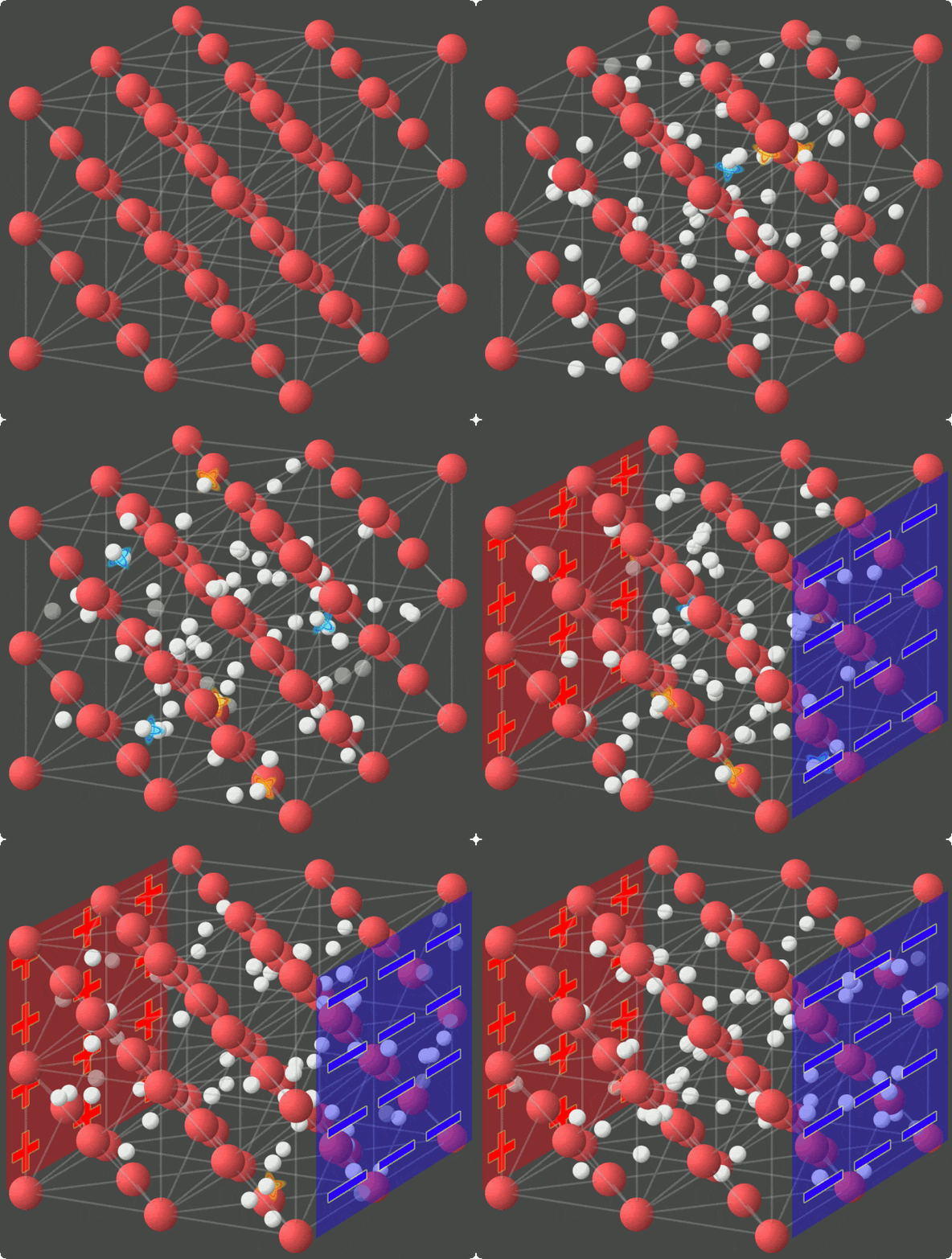
One of these is superionic ice – a deeply odd state of matter that’s neither entirely solid nor entirely liquid. Its oxygen atoms remain fixed in a rigid crystal lattice, as they would in a solid. But the hydrogen nuclei are mobile, diffusing through that lattice more like particles in a liquid.
At slightly different sets of conditions, the arrangement of the oxygen atoms shifts into different configurations known as phases. There are some twenty-something known phases of water ice, a few of which become superionic under extreme conditions. Scientists are always looking for more.
And it’s not just weirdness for weirdness’s sake. Superionic ice is thought to exist deep inside Uranus and Neptune, where its unusual properties may play a role in generating the planets’ equally unusual magnetic fields.
In their new experiments, a team led by physicist Alexis Forestier of the French Alternative Energies and Atomic Energy Commission subjected tiny samples of water to the sorts of extreme conditions expected in the interiors of ice giant planets.
They squeezed the samples between the tips of diamonds to pressures as high as 230 gigapascals, while using lasers to heat them to thousands of degrees. That’s 2.3 million times Earth’s atmospheric pressure at sea level – the pressure at the center of Earth, for context, is around 360 gigapascals.
Then, using an extremely narrow beam of synchrotron X-rays, they probed for changes in the crystal structure of the ice.
What emerged was a configuration predicted theoretically but never unambiguously observed in experiments: hexagonal close-packed, or hcp, ice. As the hcp crystal was heated, its expansion also showed a signature of superionic behavior, suggesting it entered the superionic state at around 1,700 kelvins.
The name refers to the arrangement of the oxygen atoms. Imagine you’re packing identical balls in layers; there are a number of different ways those layers can be stacked while packing the balls as tightly as possible.
One previously identified form of superionic ice has a face-centered cubic, or fcc, structure. In the newly identified hcp ice, the layers are stacked in a different sequence. The researchers found evidence that one can transform into the other as the layers shift position.
This transformation seems to occur as conditions grow more extreme.
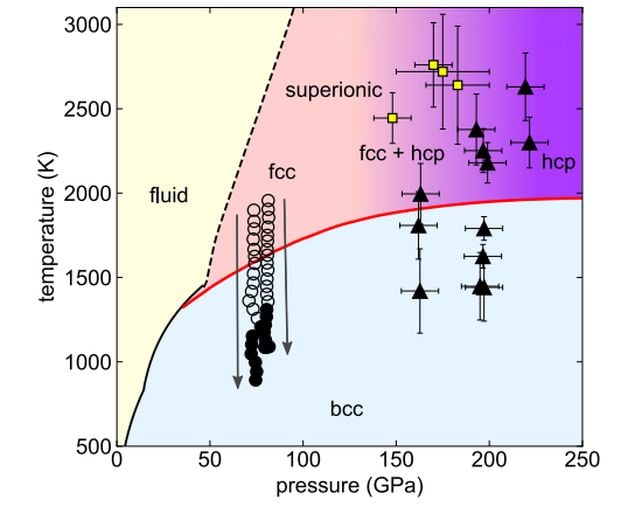
At 155 gigapascals and 2,000 kelvins, the signal observed from the X-ray probe was a mix of fcc and hcp.
Dialing up to 197 gigapascals and 2,250 kelvins, the hcp signature became stronger relative to fcc.
By the final set of conditions – 219 gigapascals and 2,630 kelvins – the fcc signature had almost vanished, and hcp clearly dominated.
Intriguingly, this may not have been the first time the researchers had produced hcp ice.
Looking back at data from an earlier experiment, they realized that a previously unidentified X-ray diffraction peak observed above 130 gigapascals was likely the signature of hcp ice – they just hadn’t recognized it at the time.
Their results suggest that, at pressures above around 200 gigapascals, hcp may become the more stable arrangement of superionic ice.
It seems like a relatively small change – literally on the atomic scale – but the difference could mean big things for the Solar System.

If hcp ice conducts electricity differently from fcc ice, its presence deep inside Uranus and Neptune could change models of how material and electrical charge move through their interiors – processes thought to be involved in generating the planets’ strange, messy, lopsided magnetic fields.
Related: Scientists Just Made ‘Superionic Ice’ That’s Solid And Liquid at The Same Time
We don’t actually know about the properties of hcp ice yet, though. The stuff has only just been discovered. The researchers invite further theoretical work to tease apart those properties – especially its mechanical plasticity and electrical conductivity.
Further experiments will also be needed to pin down exactly where, across the extremes of pressure and temperature, hcp ice is stable relative to its fcc counterpart.
Water is really weird, and superionic ice is even weirder. Scientists have only just scratched the surface of what this strange molecule can do; in a way, it feels fitting that we need to rely on it to stay alive.
Stay frosty, water. Or hot. You do you.
The findings have been published in Physical Review Letters.
This article was fact-checked by Rachel Garner and edited by Rebecca Dyer. While we pride ourselves on our process, we are only human. If you spot a mistake, please let us know.
What did you think of this news? Leave a comment below and/or share it on your social media. This way, we can inform more people about the hottest things in technology, science, innovation, and gaming!
This news was originally published in:
Original source

