
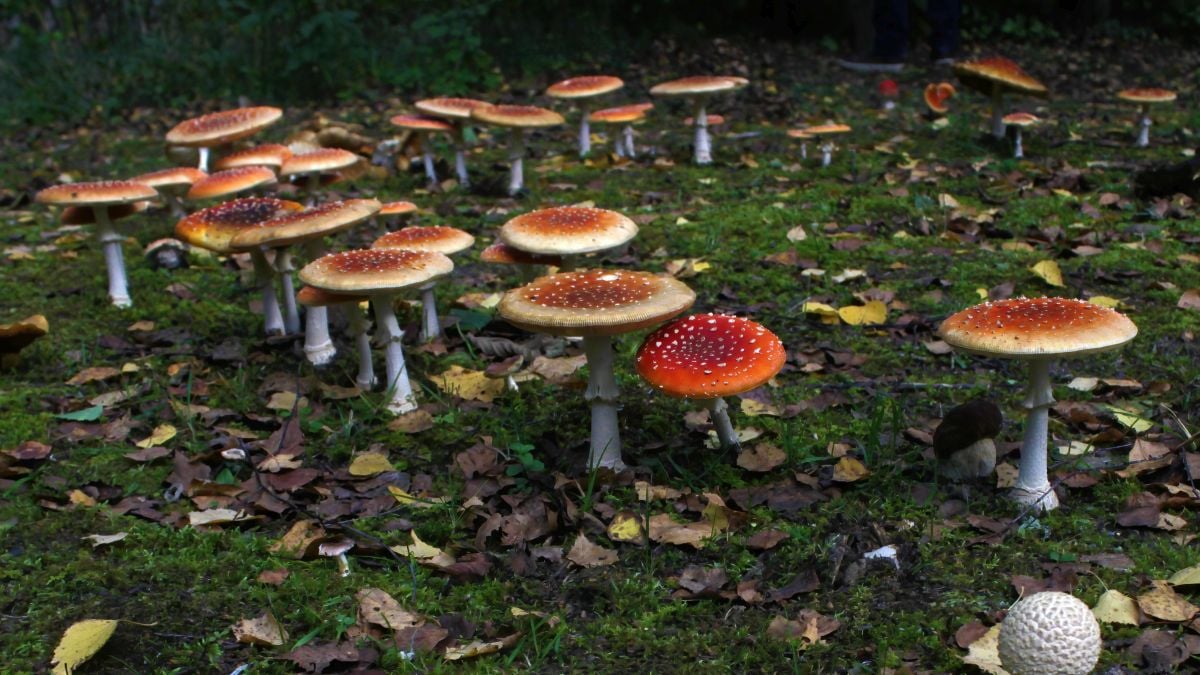
We May Finally Know Why Mysterious Mushroom Fairy Rings Grow in Circles
If you’re ever in a patch of woods or meadow at just the right time of year, you may stumble across something that seems like an act of otherworldly trickery.
In the right circumstances, you might encounter an almost perfect ring of mushrooms, arrayed almost as though halted in a circle dance.
For centuries, these so-called fairy rings have inspired myth – some legends say they’re the work of the devil, others of fairies, witches, or elves.
For all their ubiquity in folklore, though, it may surprise you to learn that scientists still don’t know exactly why the fungus hidden beneath these mushrooms grows as a ring, rather than a solid disk, or why that ring radiates outward to form such neat circles.
Now, researchers led by mycologist Hanna Johannesson of Stockholm University in Sweden have peered under the grass, using DNA analysis and an unusual fungal transplantation experiment to look for answers.
What they have found – while preliminary – does not do much to dispel the fairy ring mythos. The results suggest that the fungi that form fairy rings may be trying to ‘flee’ something in their own wake.
“The results were most consistent with a transient-escape hypothesis,” the researchers write in Royal Society Open Science, “and suggest that the mycelium avoids inhibitory factors present at the back edge of the mycelial growth front.”
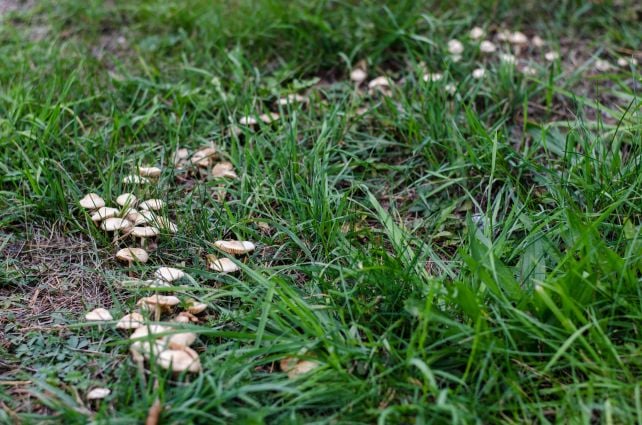
Fairy rings are not limited to a single species of mushroom. More than 100 different taxa have been observed forming them, but the basic principle is broadly similar.
Basically, the mushroom you see above ground is just a small part of a much larger organism. The mushroom is the fruiting body; the main body of the fungus is a branching network of thread-like structures, called mycelium, growing hidden in the darkness underneath.
As the fungus grows outward from its starting point, mushrooms can spring up along its advancing edge, tracing the subterranean growth in a circle. Over time, that circle can continue expanding.
Well, that’s the general idea, anyway. But since the vast bulk of the fungus lives hidden in a complex ecosystem beneath our feet, the underground structure of a fairy ring has been surprisingly difficult to map.
To find out, the researchers investigated a species called Marasmius oreades – also known as the fairy ring mushroom or Scotch bonnet, growing in two separate fairy rings in a cemetery in Uppsala.
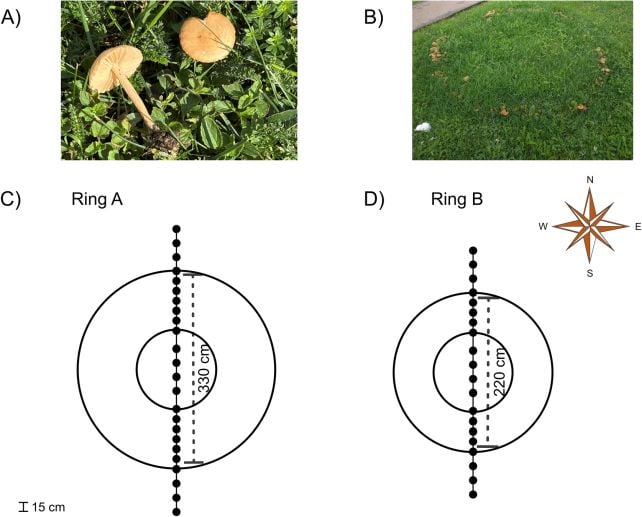
The researchers took soil samples along lines crossing each of the two rings, covering the mushroom-bare middle and the bristling-with-mushrooms edges of the circles, as well as the soil outside the circle, to serve as a background control.
Then, they sequenced the DNA they found therein, searching the resulting sequences for those that matched the M. oreades genome.
They found high concentrations of the mushroom’s DNA in the soil from the circle rim – particularly the outer edge of the rim.
But in the middle of the circle, the DNA levels dropped to background levels similar to what was outside the circle – suggesting that not just the fruiting bodies, but the mycelium itself, assumes a ring-shaped architecture.
That’s a pretty cool result, but it raised another question: Why, though?
The researchers identified several possibilities. Perhaps, once it gets going, the fungus simply continues in the same direction of travel at the same pace. Perhaps the ring’s growth is oriented like a compass. Maybe the fungus even communicates with itself to tell all the sections how to form a ring.
Or maybe it’s trying to get away from something.
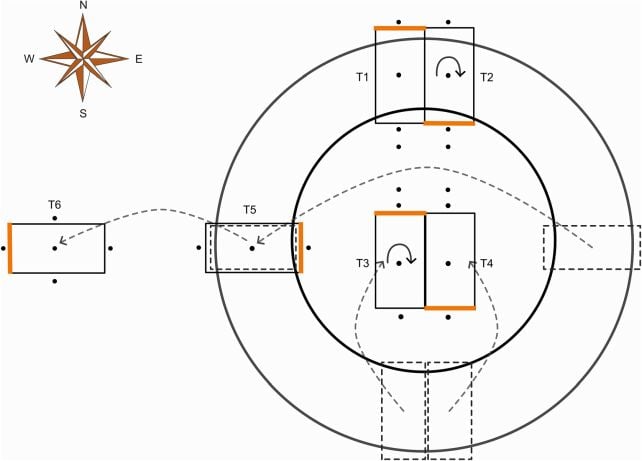
To find out, the researchers dug up parts of each mushroom ring and either rotated or transplanted them in different spots. Then, they left the fungus alone to do its thing, coming back 14 months later to see what – if anything – had changed.
Their results were most consistent with what the researchers called the transient-escape hypothesis.
Under this scenario, the soil just behind the advancing front becomes temporarily unfavorable for growth. The fungus therefore keeps advancing into the soil ahead, away from the temporarily inhospitable conditions in its wake.
What the results couldn’t tell the researchers was why. One reasonable explanation could be that the fungus temporarily depletes nutrients as it passes through and continues to move in the direction where the food is.
Another possibility is that it releases toxins that temporarily render the soil unattractive.
But whatever the explanation is, the effect doesn’t last forever. Fungi planted back into the center of the circle were able to continue growing.

Meanwhile, a fungal section that was moved completely outside one ring continued in its previous direction, while the equivalent experiment on the second ring produced growth in an additional direction.
Related: Hidden Web of Fungus Inside Earth Could Reach The Sun a Billion Times
Further investigation will be needed to see if any of these ideas can be validated.
“Though additional studies with data from more rings, complemented with laboratory experiments, are needed to unveil the causal mechanism behind the observed patterns here, we show that it is possible to gain detailed information about fungal genomes directly from soil samples, which enables us to study vegetative growth of fungi in their natural environment,” the researchers write.
“This will provide new insight and ignite new questions regarding the processes behind the fairy ring structure and growth pattern.”
It would be remiss not to point out, though, that it’s hard to make a portal to fairyland with a solid disk.
The findings have been published in Royal Society Open Science.
This article was fact-checked by Fiona MacDonald and edited by Peter Dockrill. While we pride ourselves on our process, we are only human. If you spot a mistake, please let us know.
What did you think of this news? Leave a comment below and/or share it on your social media. This way, we can inform more people about the hottest things in technology, science, innovation, and gaming!
This news was originally published in:
Original source
