

Never-Before-Seen Type of Amyloid May Explain a Devastating Form of Alzheimer’s
Alzheimer’s disease is an incredibly challenging condition to study, because of both its complexity, and the many different ways it can vary between patients.
There’s one type of Alzheimer’s that’s only ever been found in two families and two other individuals, caused by what’s known as the Flemish amyloid-beta precursor protein (APP) mutation.
This is a genetic anomaly that impacts the amyloid-beta (Aβ) protein plaques that congregate in the brains of Alzheimer’s patients.
This mutation causes unusually prominent Aβ accumulation in and around blood vessels in the brain.
In those affected, these deposits cause a condition called cerebral amyloid angiopathy (CAA), associated with brain hemorrhages and typically death by the late 50s.
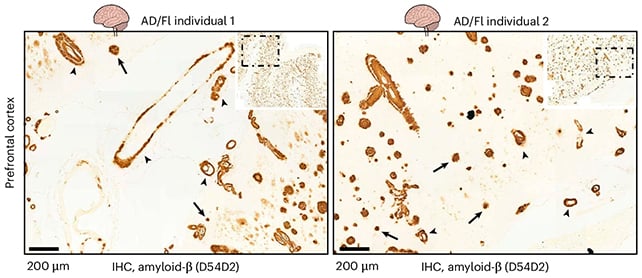
An international team of researchers, publishing their work in Nature Structural & Molecular Biology, has now identified the unique way that Aβ filaments fold in people with this type of Alzheimer’s.
They also discovered how these folding shapes affect the disease, which could provide new opportunities for targeted treatments.
“Together, our structural and cellular data define a familial Alzheimer-disease-associated amyloid fold and provide insight into the molecular basis of Flemish-type dementia and cerebral hemorrhage,” write the researchers in their published paper.
The researchers studied postmortem brain tissue samples from two individuals who had died with Alzheimer’s, one from each of the Flemish families known to be affected by this type of dementia.
Through an imaging technique called cryogenic electron microscopy (cryo-EM), providing a level of resolution close to being able to see individual atoms, the type of fold that happens in the Flemish APP mutation was revealed.
The fold in this case was a specific Z-shape that scientists have never seen before, helping to explain why the Aβ filaments it produces collect around blood vessels: it exposes a specific amino acid, known as the F20 residue, which the researchers think helps the filaments interact with components of blood vessel walls.
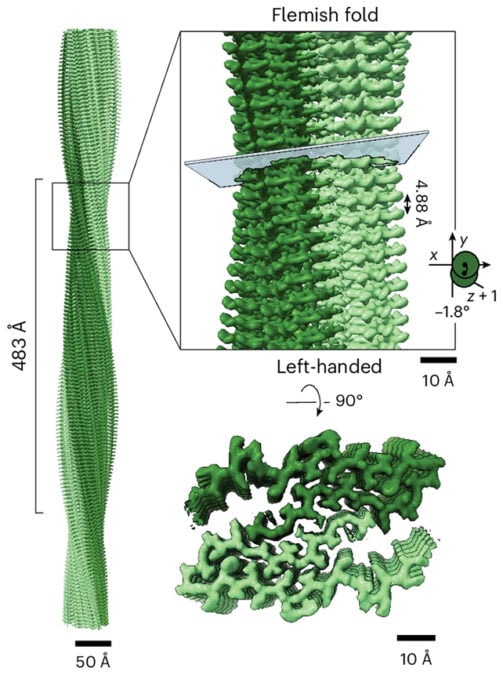
The team also worked out how the fold takes shape. The mutation removes a single methyl group from Aβ, which appears to encourage this fold to form.
“Our results reveal how loss of a methyl group at residue 21 gives rise to an Aβ fold with vascular tropism and provide structural insight into the mechanisms underlying Flemish-type progressive dementia and cerebral hemorrhage,” write the researchers.

Previous work has shown that the Aβ protein shapes created by the mutation are actually less likely to clump than other types, and yet when they do start to accumulate, they cause just as much damage as can be seen in standard Alzheimer’s – perhaps due to the way they interact with blood vessels.
“Despite its reduced aggregation propensity in vitro, the Flemish (A21G) mutation produces Aβ assemblies that are as neurotoxic as those formed by wild-type Aβ and, in vivo, leads to the largest and most stable plaque cores observed in Alzheimer’s disease,” write the researchers.
There’s a lot to take in here, but these are big steps forward for understanding this rare form of Alzheimer’s – how the genetic variant it’s associated with changes the way Aβ proteins accumulate and then attack the brain in this very specific way.
These findings can be expanded out too. Making sense of the protein clumps so characteristic of Alzheimer’s – their shapes and how they work – is crucial to developing treatments for all versions of the disease.
The next steps are to establish exactly how this newly discovered fold type may contribute to brain damage that leads to dementia, and what kind of biological mechanisms are involved – as well as how they might relate to Alzheimer’s disease more generally.
Related: The Tragic Case of The Youngest Person Ever Diagnosed With Alzheimer’s
“Future studies should address whether the Flemish fold alters seeding, propagation or neurotoxicity in cellular or animal models, and whether similar structural principles underlie other hereditary and sporadic forms of Alzheimer’s disease,” write the researchers.
The research has been published in Nature Structural & Molecular Biology.
This article was fact-checked by Peter Dockrill and edited by Peter Dockrill. While we pride ourselves on our process, we are only human. If you spot a mistake, please let us know.
What did you think of this news? Leave a comment below and/or share it on your social media. This way, we can inform more people about the hottest things in technology, science, innovation, and gaming!
This news was originally published in:
Original source
