
Massive Study of 10 Million Siblings Links Birth Order To Risk of ADHD, Autism
Whenever a new sibling arrives in a family, the dynamic changes in all sorts of ways.
There’s an extra seat at the dining table, less room on the couch, and another opinion to consider at family meetings (at least when they reach a certain age).
In a study published in Nature Health, researchers from the University of Chicago and Columbia University have explained how the number of children in a family, and the order they’re born in, appears to be linked to potential impacts in terms of health and disease, too.
First-born children are more likely to have allergies, and conditions including autism, attention deficit hyperactivity disorder ( ADHD), Tourette’s, and obsessive-compulsive disorder (OCD), the study found.
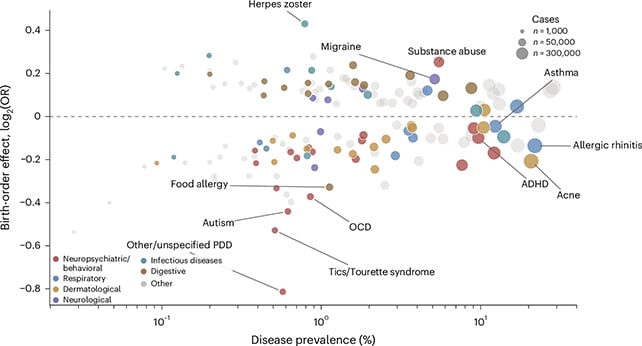
Meanwhile, kids who are born second are statistically more likely to have stomach problems, migraines, shingles, and issues with substance abuse.
“The birth order, defined as the ordinal position of a child among siblings, has fascinated researchers for more than a century,” write the researchers in their published paper.
“Theorists in the early years proposed that first-borns receive greater parental investment and face higher expectations, while later-borns develop in the immunological and social wake of their older siblings.
“These ideas have generated a rich but fragmented empirical literature, with individual studies examining birth order in relation to specific diseases or developmental outcomes.”

The researchers looked at US health insurance data covering more than 10.3 million kids with one sibling. This data was mined for correlations between being a first-born or second-born child, and a total of 569 different diseases in a ‘disease atlas’.
For completeness, comparisons were run between siblings in the same family, and first-born and second-born children from different families. This helps to minimize interference from other factors, such as the presence of pets or family income.
Of the 569 diseases analyzed, 150 showed different associations for first-born and second-born children, including those mentioned above.

“The disease atlas view reveals that birth-order effects are not confined to a few well-studied conditions but instead pervade nearly every clinical domain tested, with a striking concentration of first-born excess in neuropsychiatric conditions and second-born excess in digestive and musculoskeletal diseases,” write the researchers.
For some of the conditions, the age gap made a difference. A bigger age gap increased the likelihood of the first-born child having autism, for instance, but reduced the likelihood of first-borns having allergies their siblings didn’t have.
“The consistency of results between designs, the performance of validation controls, and the robustness to geographical confounding collectively support the conclusion that birth order is associated with widespread, albeit modest in size, differences in disease risk,” write the researchers.
The next question is why there are these patterns, but further research will be needed to find some answers – and to separate out other factors, such as parental age (first-born kids will obviously always have younger parents than their siblings).
There have been a host of interesting studies on the impact of birth order amongst children. Research has shown that it can potentially influence your IQ level, for example, but not your career choices.
Being an only child, meanwhile, has its own set of possible consequences.
Now there’s evidence that the risk of hundreds of diseases, disorders, and conditions are at least to some extent dependent on whether you joined the family unit first or second – way beyond the well-established idea that a second sibling benefits from being exposed to, and building up immunity to, microbes brought home by an older brother or sister.
Related: Sharing The Womb With a Twin Brother Seems to Have a Huge Detrimental Effect on Girls
“Birth order is associated with disease risk more broadly than previously appreciated,” write the researchers.
“The convergence of evidence from between-family and within-family designs, combined with validation controls and robustness analyses, is consistent with a mixture of physiological, immunological and social mechanisms operating throughout the human disease phenome.”
The research has been published in Nature Health.
This article was fact-checked by Rachel Garner and edited by Peter Dockrill. While we pride ourselves on our process, we are only human. If you spot a mistake, please let us know.
What did you think of this news? Leave a comment below and/or share it on your social media. This way, we can inform more people about the hottest things in technology, science, innovation, and gaming!
This news was originally published in:
Original source
