
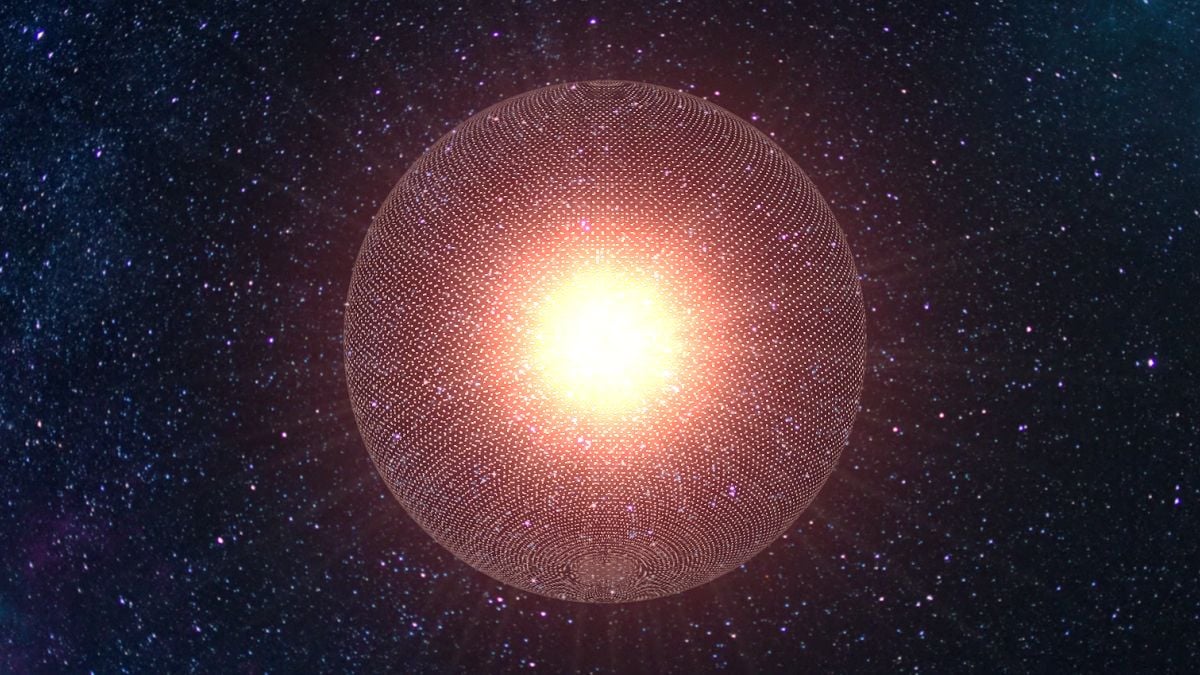
JWST Just Examined Two Stars Suspected of Harboring Dyson Spheres. Here’s What It Found…
Somewhere in the Universe, an alien culture may have developed the technology to build giant megastructures around stars, harnessing their energy on an unimaginable scale.
First proposed in 1960 by theoretical physicist Freeman Dyson, the Dyson sphere has become one of the most enduring symbols of the search for extraterrestrial intelligence.
This is because such structures should change starlight in ways we can detect from Earth – telltale technosignatures that could finally reveal an advanced alien civilization.
Now, astronomers have used the JWST‘s golden infrared eye to put two of the strongest Dyson sphere candidates to the test.
“Waste heat. That is the whole game,” astrophysicist Olivia Curtis of Pennsylvania State University, co-author of a preprint describing the analysis, told ScienceAlert.
“A civilization can hide its star behind a shell of solar collectors, but thermodynamics always collects its tax, and all that captured starlight has to come back out as a warm mid-infrared glow.”
That glow would be unavoidable. Just as a laptop or lightbulb gives off waste heat, so too would any machine that harvests a star’s energy. The larger the hypothetical megastructure, the brighter that excess infrared radiation should become.
That excess is exactly what Project Hephaistos, led by astrophysicist Erik Zackrisson of Uppsala University in Sweden, set out to find. Even false positives could teach us how to better search for alien tech – by revealing the many ways the Universe can mimic it.
The search sifted through roughly five million Milky Way stars looking for exactly this kind of infrared excess – more mid-infrared light than an ordinary star should produce.
Seven stars survived the team’s increasingly stringent tests, with the two studied here emerging as the search’s most compelling candidates.
JWST quickly exposed the two candidates as Dyson sphere impostors – and the explanation was brilliantly simple. The light from both stars was being boosted by a distant galaxy almost perfectly lined up behind them.
“The first images did it,” Curtis said.
“At the shortest wavelength you mostly see the star, and as you step out to 10 and then 15 microns the star fades away while a second source right next door lights up. The moment you see two sources where WISE saw one, you know the star was never the thing glowing, and the spectra only confirmed what the pictures had already given away.”
These weren’t just any background galaxies. Both are exceptionally bright in infrared light, exactly the wavelengths astronomers search when hunting for the waste heat of a hypothetical Dyson sphere.
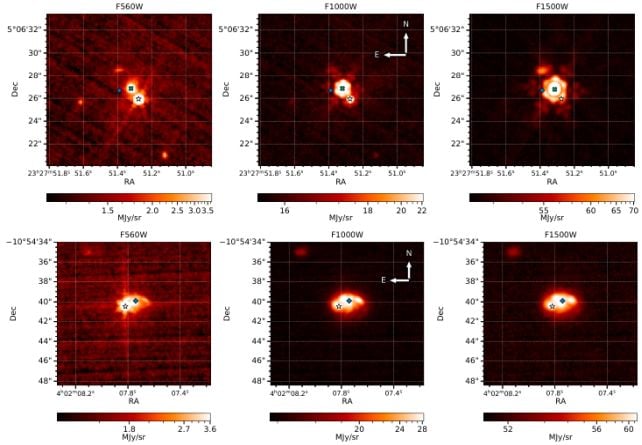
One, sitting behind Candidate D, appears to be a Hot Dust-Obscured Galaxy, or Hot DOG, whose central supermassive black hole is heating vast clouds of dust.
The other, behind Candidate E, is likely a dusty starburst galaxy, where stars are forming at a furious rate.
Both galaxies naturally produce the kind of warm infrared glow astronomers were searching for.
From Earth’s perspective, each galaxy lay almost perfectly behind a much closer star. The blur created by the Wide-field Infrared Survey Explorer (WISE) telescope that identified them made each of the two objects appear to be a single source with an inexplicable infrared excess.
“Candidate D passed every archival test thrown at it … so it went into the JWST observations as the most promising Dyson sphere candidate on the board,” Curtis said.
“It came out hiding a galaxy tucked almost perfectly behind it, offset by about one arcsecond, which on the sky is like a coin seen from three miles away. The Universe hid that galaxy about as well as it possibly could have, and I respect it a little for that.”
Candidate E proved even trickier. Its galaxy was an extended, clumpy system, with the foreground star landing almost exactly on one of its brightest infrared knots – the worst possible place it could have been, Curtis said.
“That coincidence made the measurements genuinely painful, because at the wavelengths where the galaxy blazes the star simply vanishes into it, and in the end the only clean handle I had on the star was its diffraction spikes, the long rays that give JWST stars their famous spiky look, which let me measure it the way you might spot a friend in a crowd by their hat,” she said.
“I spent more hours on those spikes than I care to admit, and I am still a little offended by that galaxy.”
The result, however, extends far beyond ruling out two Dyson sphere candidates that didn’t make the grade.
The search gave astronomers two galaxies that are genuinely scientifically interesting in their own right that otherwise might never have been spotted.
It yielded one of the most convincing impersonations of a Dyson sphere that our Universe may be capable of producing.
In order to find the answers, the researchers had to develop some new techniques for untangling light and working around some of JWST’s quirks.

And the two star-galaxy alignments are a gift falling straight into the lap of the next generation of giant telescopes, which will be able to use the much closer star as an adaptive optics guide while taking observations of the more distant galaxy.
“The chase paid off in ways that have nothing to do with aliens,” Curtis said.
Ruling out a compelling candidate, the research shows, is in no way the same as drawing a blank.
Discovering that two of the best Dyson sphere candidates were actually galaxies photobombing stars is exactly the kind of result that makes the next search more reliable.
“Young fields grow up by hunting their false positives all the way to the ground, and every one of these teaches the next survey what to cut. We now know the most dangerous impostor in this game, a rare breed of dust-shrouded galaxy that hides in ordinary light and blazes in the mid-infrared,” Curtis said.
“Nobody had ever marched Dyson sphere candidates through a gauntlet like this before, all the way from an all-sky flag to radio imaging to JWST, so future searches inherit the whole recipe, and whatever survives it next time will have earned real attention.”
The paper is available on preprint server arXiv.
What did you think of this news? Leave a comment below and/or share it on your social media. This way, we can inform more people about the hottest things in technology, science, innovation, and gaming!
This news was originally published in:
Original source
