
MIT engineers find a precise way to grow artificial blood vessels
Tissue engineers are finding ways to grow living organs and tissues from cells, with the aim of replacing diseased and damaged counterparts in the body. Scientists have successfully grown artificial muscles, livers, kidneys, skin, and other tissues. But there’s been no reliable way to engineer precisely patterned networks of blood vessels, some of which can be finer than a human hair.
Without a vascular network to deliver nutrients, any artificial tissues, no matter how life-like, can’t function.
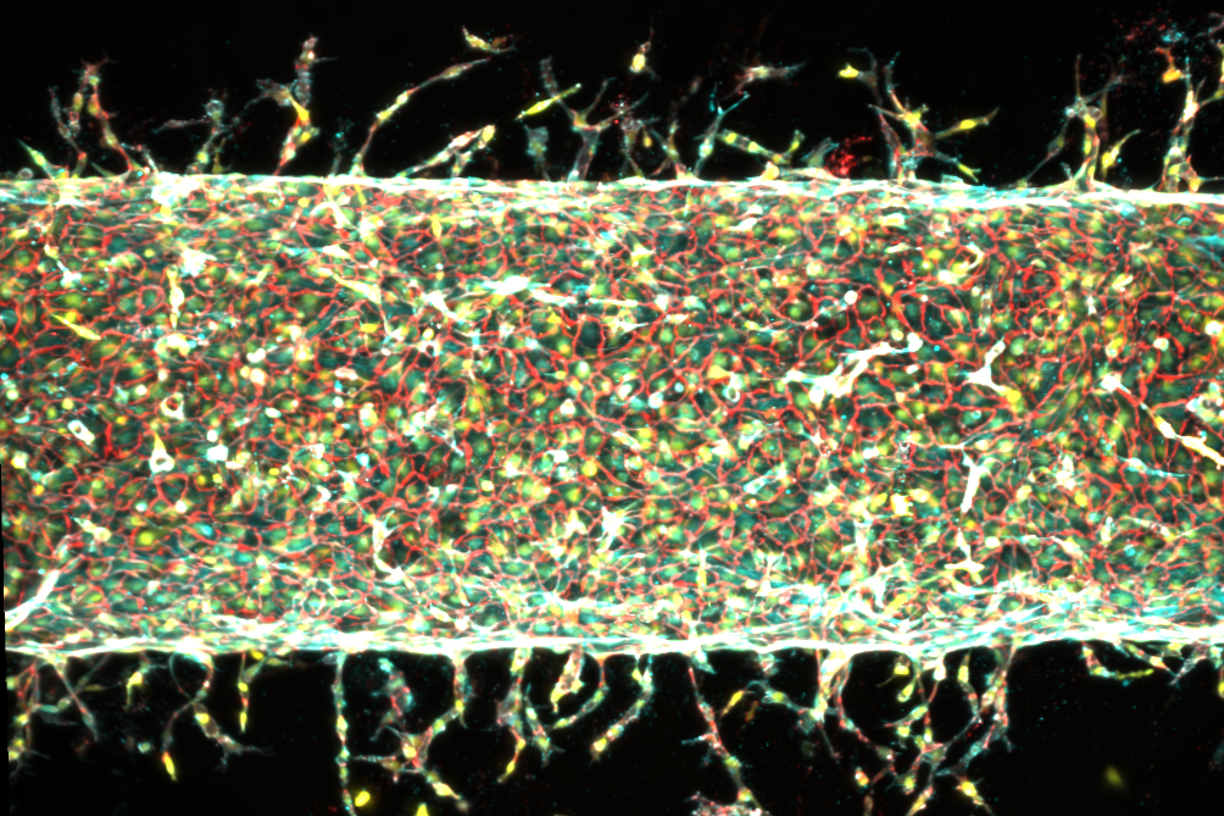
Now MIT engineers have found they can engineer and control the growth of blood vessels by mechanically stretching them.
The team has built a human “blood vessel on a chip,” composed of a central artery made from human endothelial cells, that is embedded in a gel that also contains a small magnet. The researchers studied how the main artery responded as they jostled the gel back and forth using an external magnet to move the magnet embedded within the gel.
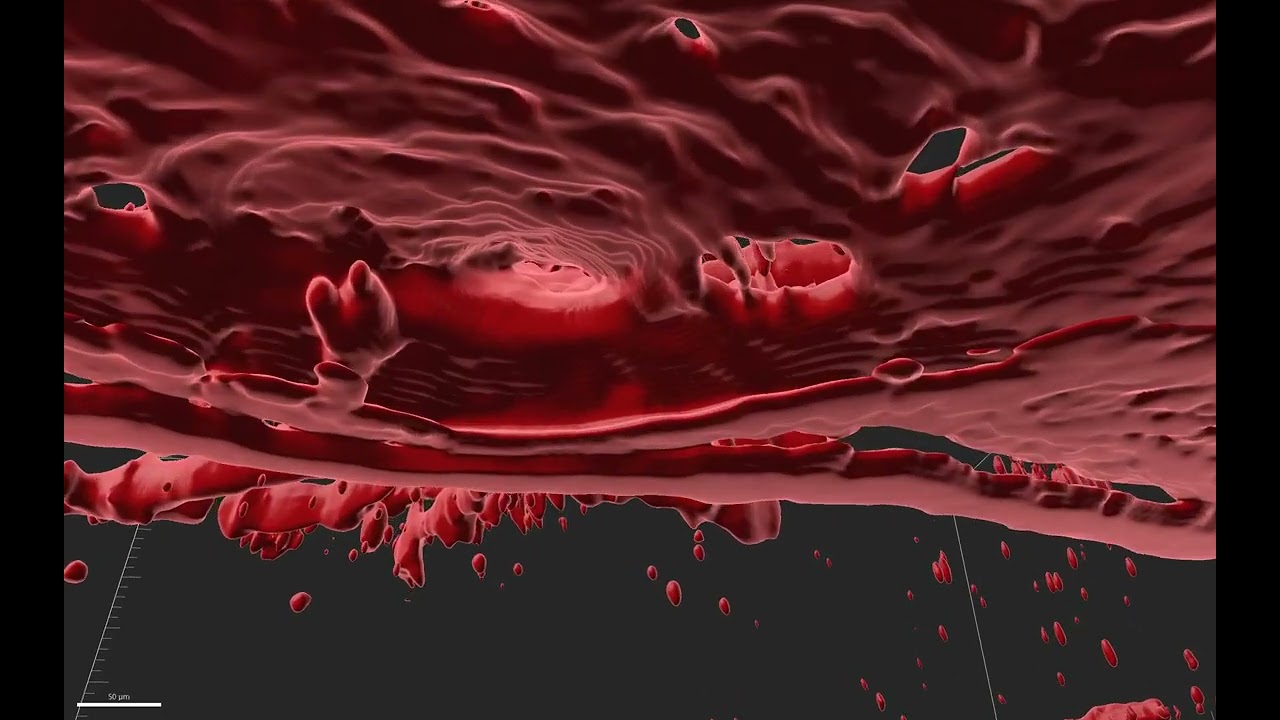
They found that the simple mechanical action of repeatedly jostling the artery stimulated the artery to sprout other, smaller capillaries. By changing the direction in which the artery is jostled or stretched, the researchers could redirect the growing new vessels. And stretching the artery by various degrees influenced how many more new vessels sprouted.
Their results, reported in the Proceedings of the National Academy of Sciences, offer scientists a new way to engineer artificial blood vessels and program the patterns in which they grow.
“Healthy tissues depend on organized blood vessel networks, but state-of-the-art protocols don’t enable fabricating such networks within engineered tissues,” says Ritu Raman, associate professor of mechanical engineering at MIT and the study’s co-lead author. “The ability to program blood vessel growth with physical cues may enable reproducible and scalable fabrication of engineered tissues that can be implanted in the body to restore function after debilitating disease or injury.”
The study’s MIT co-authors include Sina Kheiri, Jessica Shah, Shashaank Venkatesh, and Roger Kamm, along with Peiyuan Chai and Ryan Flynn at Harvard University.
“Moving is good”
Blood vessels are tricky to grow and control using conventional fabrication techniques. While 3D printers can produce vessels at the scale of major arteries and veins, the technology is not precise enough to print intricate networks of much finer, thread-like capillaries. Scientists have had some success with growing blood vessels from individual cells, by cultivating them in Petri dishes filled with nutrients and growth factors. But controlling how and where they grow remains a challenge.
“You can try to pattern chemical cues, like growth factors, to direct where vessels grow, but you can’t do this very precisely,” Raman says. “We thus need other types of patternable cues that can help us build tissues with organized vessels.”
She and her students wondered whether they could grow and control new blood vessels using a protocol they previously developed to grow artificial muscles and nerves. In their previous works, the team engineered a small chip filled with a gel that they infused with nutrients and growth factors. They embedded a small magnet within the gel, and then carpeted the surface of the gel with live muscle or neuron cells. They then manipulated an external magnet to pull the embedded magnet, and the cell-covered gel, back and forth. This work revealed that mechanical “exercise,” pulling the cells back and forth, directly influenced how the cells grew.
In their new work, the team used a similar setup to see if they could grow and control new blood vessels.
The researchers built a “blood-vessel-on-a-chip,” smaller than a postage stamp, and filled it with a similar nutrient-rich gel containing a small magnet. They poked a thin tube lengthwise through the gel to create a hollow channel, and coated the channel with live endothelial cells, which naturally grow and fuse to form blood vessels in the body. Once the cells took on the channel’s shape, they started sprouting new, capillary-like vessels in the gel.

Placing the device under a motorized stage fitted with small, suspended magnets, the researchers moved the magnets back and forth in different directions, and by various degrees, and observed whether and how blood vessels sprouted from the central artery in response.
“The main takeaway is: Stretching the blood vessel back and forth seems to enhance the number of new capillaries that grow,” Raman says.
If the main artery were simply left alone in the gel, it would grow some new vessels in random locations along its length. But when the artery was jostled, significantly more vessels sprouted. When the team used the magnets to stretch the gel back and forth, by 5 percent of the gel’s total width, many new vessels grew out from the main artery. When they stretched by 15 percent, fewer vessels sprouted, but those that did grew longer. And when the team changed the direction of stretching, the new vessels followed in response, taking turns and following the pattern of the team’s mechanical stimulation.
“We’re finding that moving is good, which is always the takeaway of everything we do in our lab,” Raman says. “Mechanical forces play an important role in our bodies. That means that if you want to grow more or less vessels, or shorter or longer vessels, or vessels in certain directions, we now know how to do that.”
A gatekeeping gene
The researchers went a step further to investigate why blood vessels grow in response to mechanical forces. To do so, they looked to gene editing, and the role of one particular gene: Piezo1.
Raman had recently attended a talk by molecular biologist Ardem Patapoutian. In 2021, Patapoutian received the Nobel Prize in Physiology or Medicine for his discovery of ion channels in cell membranes that open and close in response to mechanical pressure. These channels, named PIEZO1 and PIEZO2, act as a cell’s gatekeepers, controlling what goes in and what comes out of a cell. Both types of channels, Patapoutian found, are regulated by their respective genes, also named PIEZO1 and PIEZO2.
After his talk, Raman showed Patapoutian her group’s experimental results, which showed a connection between blood vessel growth and mechanical stimulation. Patapoutian in turn proposed that the explanation could be the PIEZO1 channel; by mechanically exercising the central artery, Raman may have been stimulating ion channels in the artery’s cells to open, triggering new blood vessels to grow.
To test this hypothesis, Raman looked to knock down the PIEZO1 gene. If this gene were less active, and fewer blood vessels grew as a result, then it would mean that blood vessels do indeed grow in response to mechanical stimulation, and specifically, through the activation of PIEZO1 ion channels.
The team repeated their experiments, this time with endothelial cells that were genetically edited to suppress the PIEZO1 gene. Sure enough, they observed that significantly fewer new blood vessels sprouted, even as they mechanically exercised the central artery.
Now that the team has found a way to grow and control blood vessel growth, they plan to apply the protocol to grow organized networks of vessels to supply artificial organs and tissues. “We are now investigating how precisely patterning blood vessel growth can help improve muscle function,” says co-author Jessica Shah.
This work was supported, in part, by the U.S. Department of War Army Research Office Early Career Program and PECASE Grant, and a Department of War DURIP Program Grant.
What did you think of this news? Leave a comment below and/or share it on your social media. This way, we can inform more people about the hottest things in technology, science, innovation, and gaming!
This news was originally published in:
Original source
