
It’s Official: This Is The World’s Fastest Spider, And It Can Outrun a Human
If you already find spiders creepy enough, you might want to stop reading here.
A new study analyzes the sprinting pace of 258 different spider species, and the fastest of the bunch can easily catch a person walking.
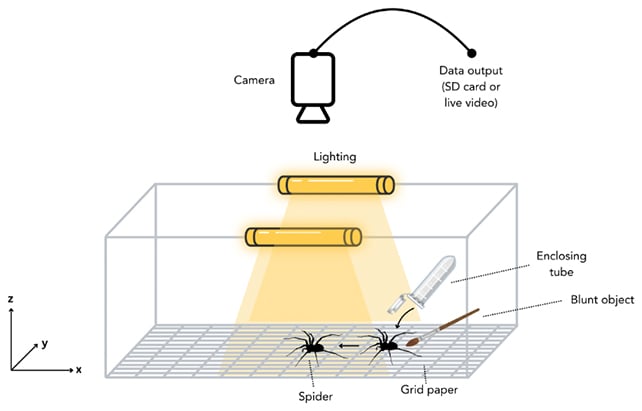
The researchers behind the study used a lab setup involving a camera and grid paper mounted on a plastic tray or metal sheet to see which spider species scampered between two points the quickest.
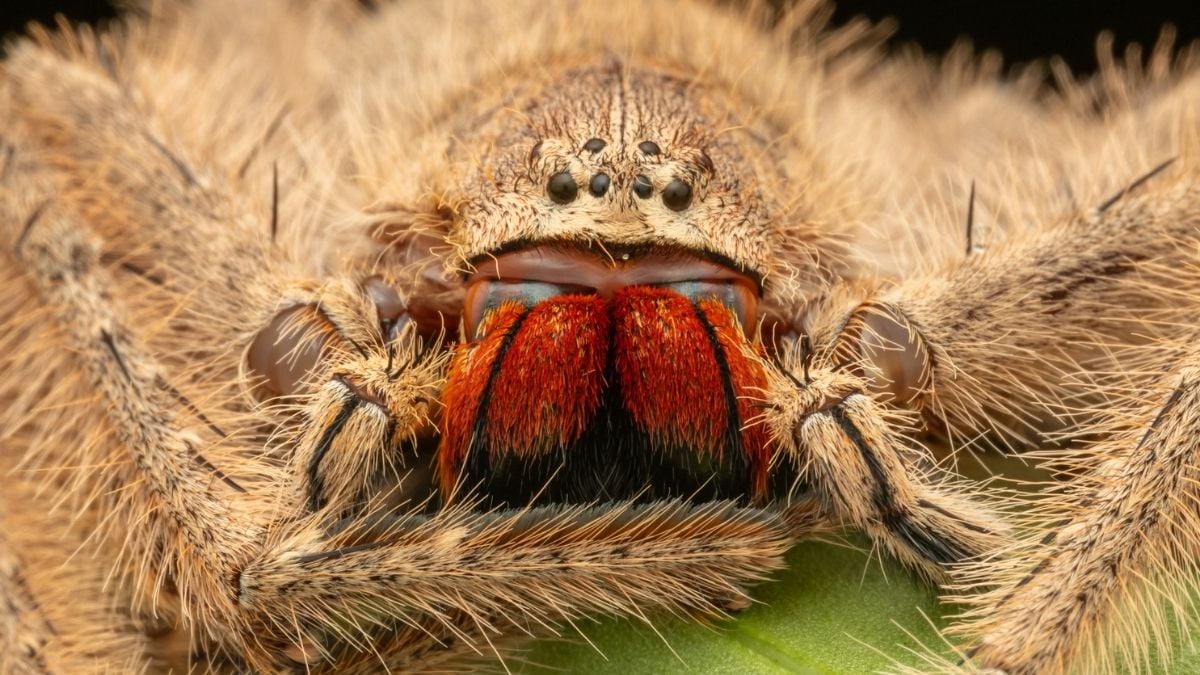
It was a type of huntsman spider (genus Heteropoda), native to Queensland, Australia, that came out on top: It reached speeds of almost 3.6 meters per second. That’s a little over 8 miles per hour, and comfortably ahead of the average human jogging speed of 4-6 miles per hour.
This study wasn’t just a straightforward speed test, though – the researchers wanted to see how spider evolution and anatomy affected running pace.
In other words, what spider shapes and traits are most conducive to speedy scuttling?
“Strong running performance, after accounting for both body size and shared ancestry, was associated with relatively longer legs and, to a lesser extent, ecological guild, but not with leg slenderness or a preference for inverted versus upright locomotion,” the researchers write in their preprint, which is awaiting peer review.
While the official world record for the fastest spider is held by the Moroccan flic-flac spider (Cebrennus rechenbergi), the cart-wheeling routine that C. rechenbergi uses when startled isn’t technically the same as running the way the spiders did in this study.
And the average top speed of the flic-flac spider is 1.7 meters per second – showing the gap in our appreciation of spider speeds that this latest study has filled.
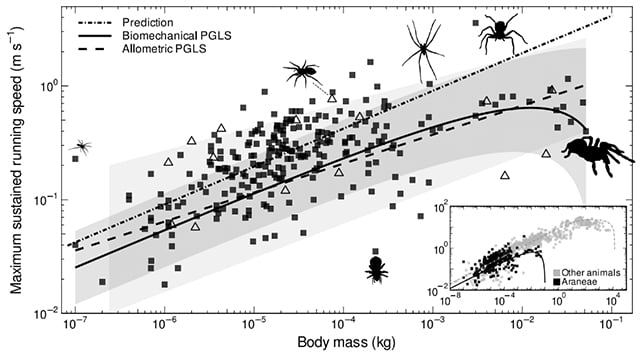
The team found that larger spiders tended to be faster, but certain species were exceptions. The tiny orange goblin spider (Oonops pulcher) weighs about 30,00 times less than the record-breaking huntsman, yet was only 18 times slower.
It feeds into previous research showing that the fastest animals often aren’t the smallest or largest creatures. Rather, it’s the limits that body size and anatomy put on muscle energy that matter most.
“A cheetah, say, comfortably outruns most similarly sized dogs,” animal biomechanist David Labonte, from Imperial College London, told New Scientist journalist James Woodford.
“This is, of course, because its lifestyle has made this speed beneficial, but it is still dictated by physics.”
In addition to larger spiders generally being faster, longer legs were also important when it came to speed – more so than how slender the legs were.

After measuring or finding published data on the scuttling speeds of 258 arachnid species, the researchers then compared those speeds across the arachnid family tree to see how different spider lineages fared.
It was ground-hunting spiders that ran the fastest for their size, likely because they spend a lot of time actively chasing prey. It was also newer species, evolutionary speaking, that showed the most variation in speed.
“Macroevolutionary patterns of running performance thus reflect not only variation in body size, but also size-specific leg morphology, ecological differentiation and phylogenetic history,” write the researchers.
It’s the most comprehensive cataloging of spider speed to date, and while it may make some of us a little more wary when coming across a spider, it’s an important look at how physical capacity and genetic history combine to determine the traits of a species.
Related: Scientists Discover a Fungus Turning Spiders Into Zombies
The study ends with a note that, “in an age in which machine learning and artificial intelligence are coming to dominate research across the sciences”, it’s important that real-world experiments and data continue to be prioritized.
“Only with such data at hand will we be able to eventually drive major advances in our understanding of the factors that shape locomotor performance in spiders, other arthropods, and animals more generally,” the researchers conclude.
The research is available on the bioRxiv preprint server ahead of peer review.
This article was fact-checked by Rachel Garner and edited by Clare Watson. While we pride ourselves on our process, we are only human. If you spot a mistake, please let us know.
What did you think of this news? Leave a comment below and/or share it on your social media. This way, we can inform more people about the hottest things in technology, science, innovation, and gaming!
This news was originally published in:
Original source
