
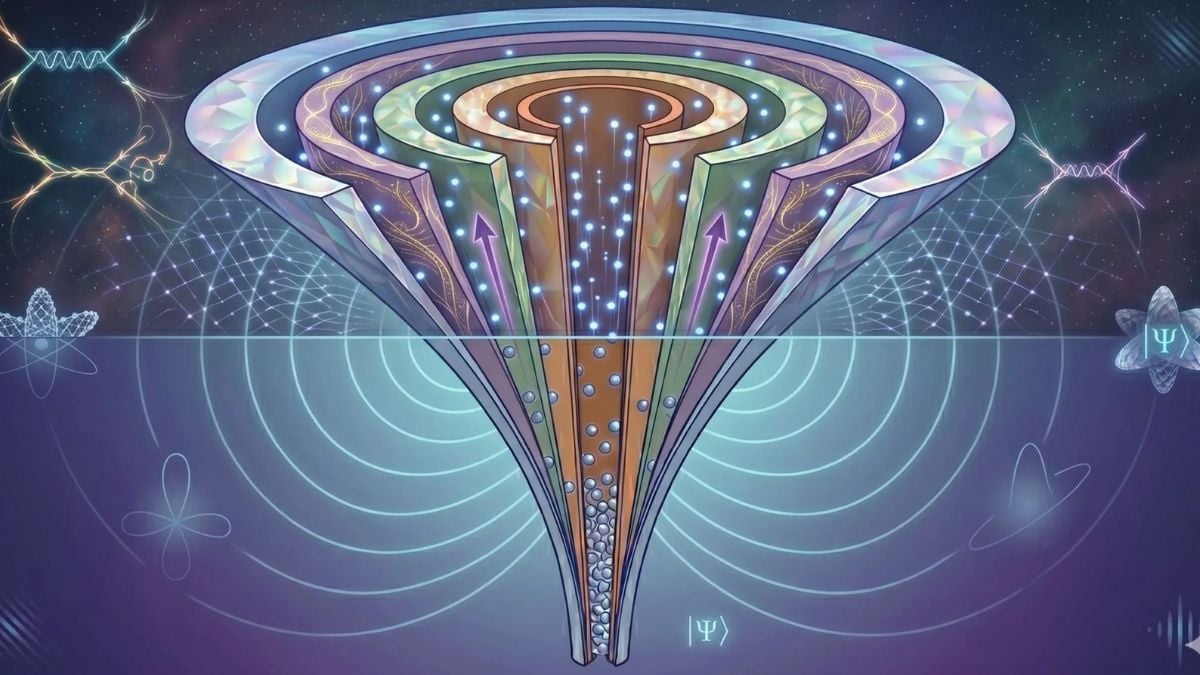
A Sea of Quantum Weirdness: Experimental Physicists Have Created an Exotic New Form Of Matter
At the lowest temperatures in the Universe, physics gets funky.
When atoms are cooled to just above absolute zero (-459.67 degrees Fahrenheit, or -273.15 degrees Celsius), they can conduct electricity without resistance, become ‘super-particle’ clouds, or flow without friction and climb up the walls of their containers.
Existence at the smallest, coldest scales is ruled by quantum statistics, which determine the behavior of bosons and fermions: the two families of fundamental particles thought to comprise every thing in the Universe.
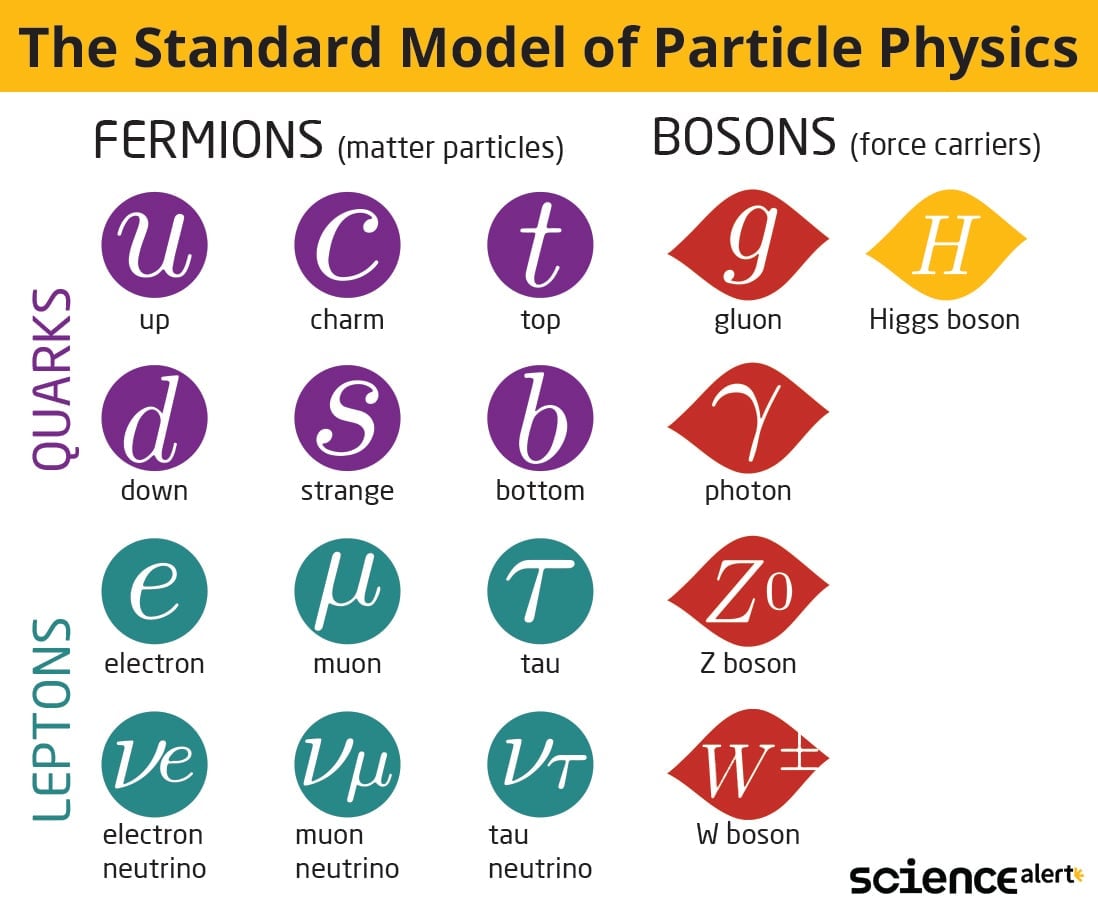
Bosons are force-carrying particles, like photons or the famous Higgs boson. These can occupy the same quantum state, meaning that limitless bosons can ‘overlap’ on top of each other and act like coherent waves.
Fermions are particles like electrons and the quarks that make up protons and neutrons. They cannot ‘overlap’ because only a single fermion may occupy a quantum state, as per the famous Pauli exclusion principle – which also explains why stellar zombies, like neutron stars and white dwarfs, don’t collapse into infinitely small black holes.
Recently, physicists have plied these principles to experimentally and theoretically describe a strange new phase of quantum matter likened to a sea of self-organized particles.
“Fermions, for instance, stack neatly into the available energy states to form the so-called ‘Fermi sea’,” says Alvise Bastianello, a theoretical physicist at the French National Centre for Scientific Research (CNRS) and the Université Paris-Dauphine.
“But what happens if one forces interacting atoms to continuously cycle through extreme conditions, smoothly shifting them from strongly repelling each other to strongly attracting each other?”
To find out, the researchers first created an exotic state of matter called a Bose gas. This comprised a collection of approximately 70,000 cesium atoms cooled to an otherworldly temperature of just a few nanoKelvin, equivalent to billionths of a degree above absolute zero.
In such extreme conditions, atoms lose their individuality and begin acting as a nebulously unified entity.
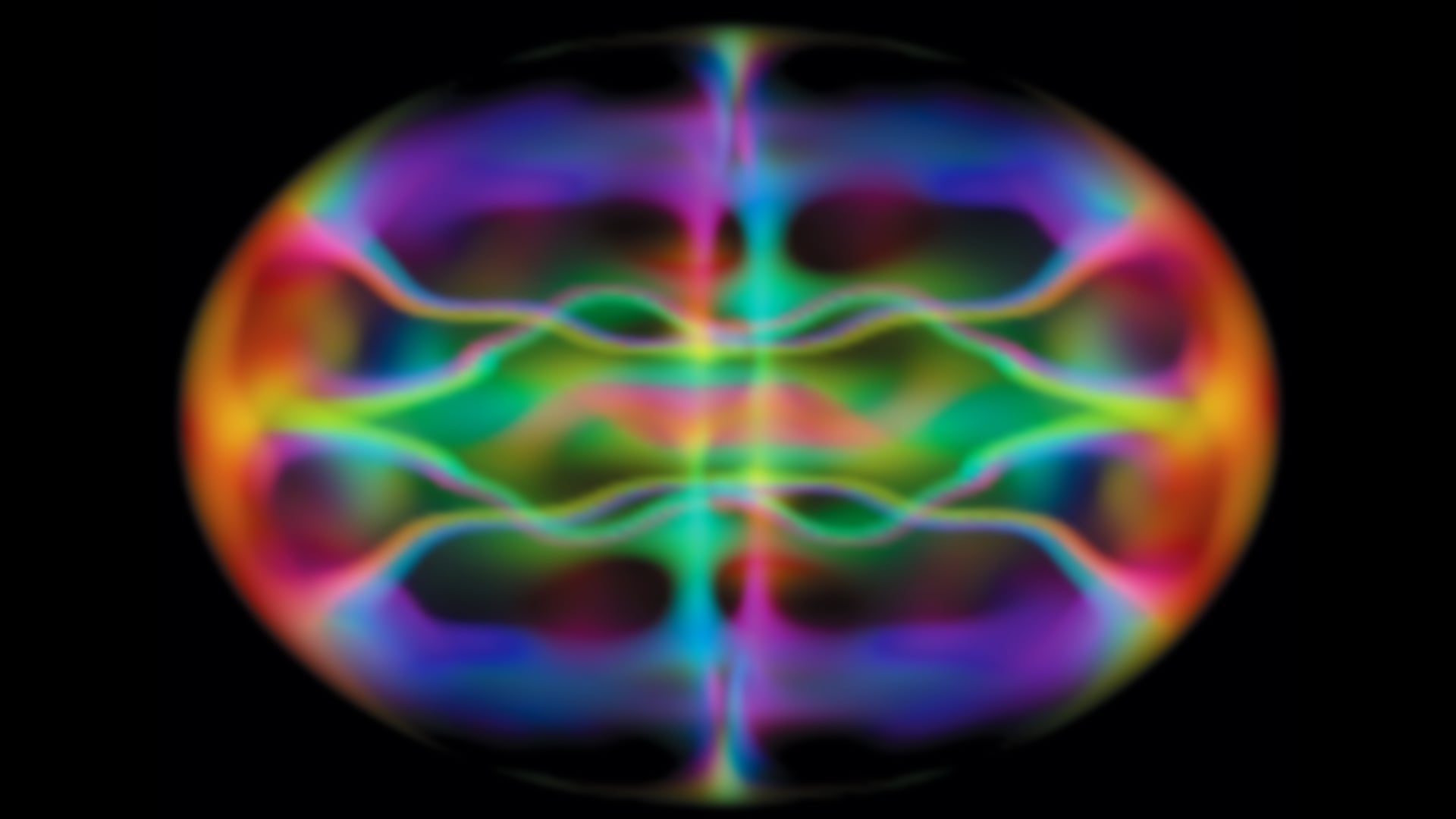
The researchers then confined this singular substance within one-dimensional tubes, generated by a two-dimensional optical lattice, a webwork of lasers that traps atoms so they can be observed.
Finally, researchers subjected this matter to repeated interaction cycles, in which they induced its constituent atoms to strongly repulse then attract each other.
In doing so, they birthed an entirely new, unexpectedly exotic phase of quantum matter, a fractional Fermi sea.
As mentioned, bosons can occupy quantum states without restriction, but fermions cannot. Therefore, the ‘fractionality’ of this sea represents a sort-of in-between, in which quantum states can be only partially occupied – a mechanism that may only manifest in lower-dimensional experiments.

The cyclical attraction and repulsion pulses also yield a counter-intuitive result. Rather than firing up or randomly dispersing the particles, they do the opposite.
“Instead of simply heating the system, the interaction cycle reorganizes the atoms into a new many-body state,” says Yi Zeng, condensed matter physicist at the University of Innsbruck in Austria and the study’s lead author.
Research leader Hanns-Christoph Nägerl, a professor at the University of Innsbruck who specializes in experimental quantum physics, explains:
“This state is highly excited, but it is not random. It has a hidden order that becomes visible in its correlations.”
Given its oddly complex interactions, including apparent ripples called Friedel oscillations – the “smoking gun” evidence of a fractional Fermi sea – the researchers are unsure of how to label their labile matter.
“We are not yet sure how we should name these new quasiparticles. Perhaps ‘super-Fermions’?” suggests Nägerl.
This novel experiment offers a unique pathway for exploring the interactions of cold-atom quantum systems, to probe how our macro-reality emerges from the weirdness occurring at the most foundational scales.
“The discovery of fractional Fermi seas shows how far we can push quantum simulation: not only reproducing known models, but creating and probing states that go beyond established paradigms,” Nägerl says.
Related: Scientists Discover a New Quantum State of Matter Once Considered Impossible
As a result, this work may help improve quantum information and sensing capabilities, allowing high-precision data processing and measurements to link the world – with untold potential for improving material science, biomedicine, and encryption technologies, among many others.
This research was published in Physical Review Letters and is available at the pre-print server arXiv.
This article was fact-checked by Jess Cockerill and edited by Michael Irving. While we pride ourselves on our process, we are only human. If you spot a mistake, please let us know.
What did you think of this news? Leave a comment below and/or share it on your social media. This way, we can inform more people about the hottest things in technology, science, innovation, and gaming!
This news was originally published in:
Original source
