
Brain Implant Lets Man With Severe Paralysis Speak in His Own Voice Again
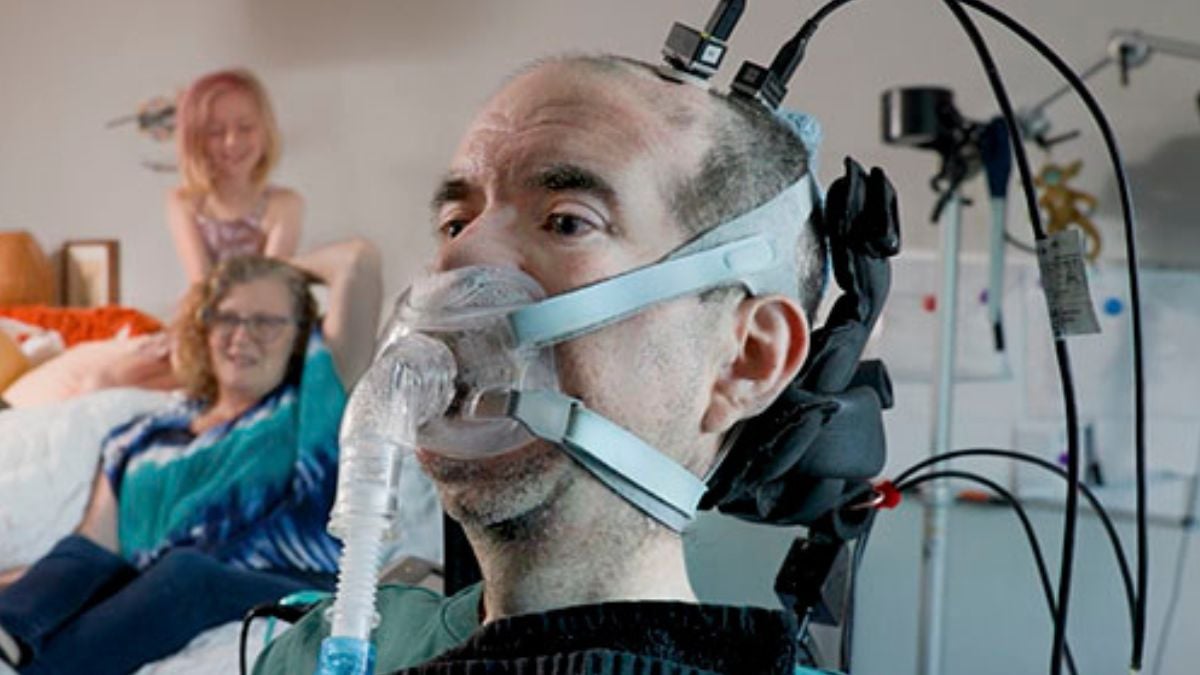
A man with severe paralysis, who can no longer move almost any part of his body, can now ‘speak’ on his own terms, using an experimental brain implant.
His family can finally hear his voice again, as a digital version reads his thoughts aloud.
Casey Harrell has an advanced form of amyotrophic lateral sclerosis (ALS), which makes his natural speech very difficult for others to understand.
But he has a lot to say when given the opportunity.
For nearly two years, the 47-year-old’s brain has been hooked up to a continuously running brain-to-text decoder using an experimental neuroprosthetic.
This cutting-edge interface has allowed Harrell to express more than 183,000 sentences and close to 2 million words.
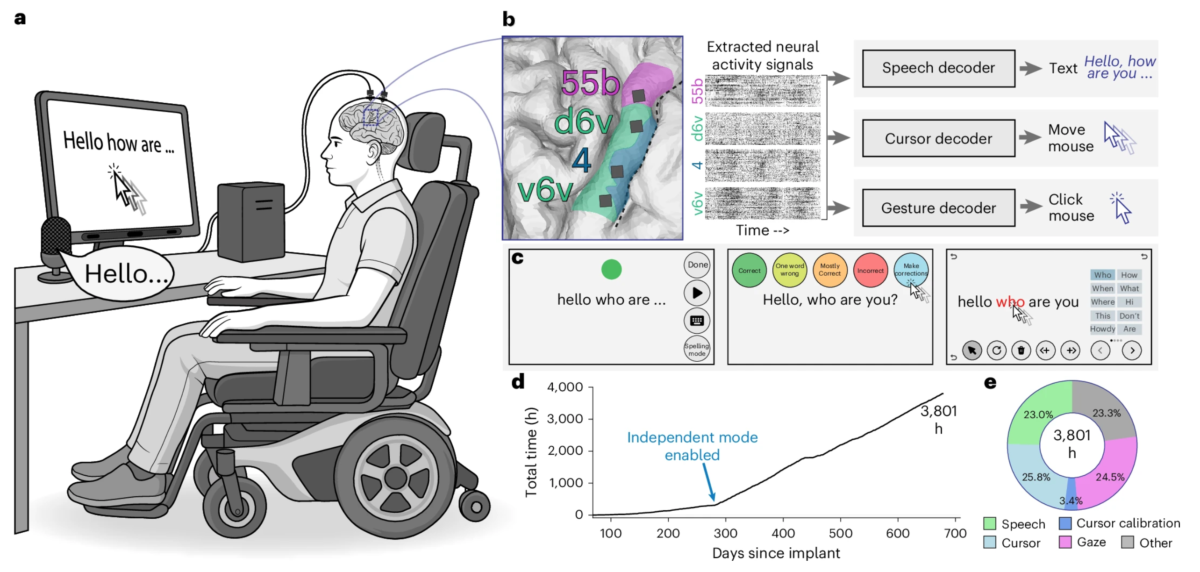
The futuristic technology requires a surgical implant in a specific part of the brain. The electrode arrays placed therein can detect neurological activity when someone attempts to speak, even if that person does not move their mouth.
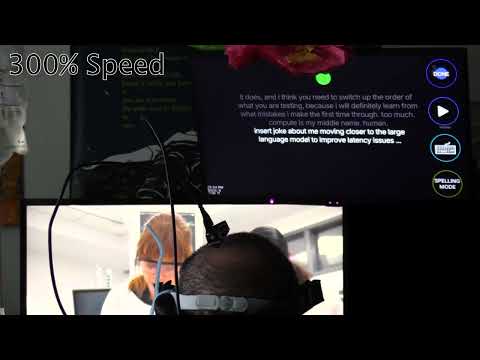
This data is then automatically detected by an external speech decoder and displayed on a computer screen in real time.
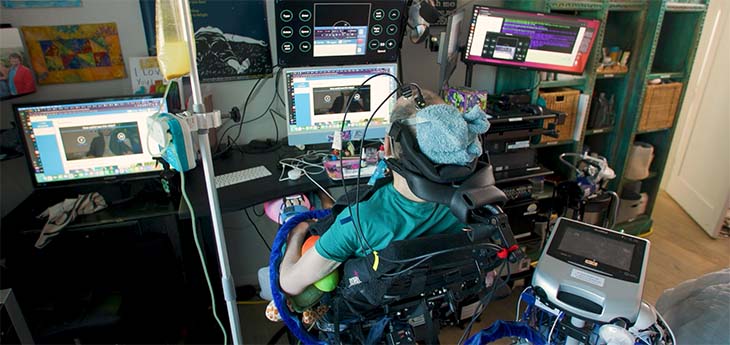
Harrell navigates the screen with his eye gaze. His focus is represented as a white circular ‘cursor’, and he can ‘click’ using the mere thought.
It takes a bit of time to connect the device in the morning, with some help from a carer, but mounted on a mobile cart, the decoder can follow Harrell throughout his day.
Using it, he can independently send emails and messages, browse the internet, and maintain full-time employment, despite his condition.
Perhaps most importantly, he can communicate with loved ones.
The digital voice that verbalizes his thoughts was made to sound similar to Harrell’s pre-ALS voice.
“It is very sweet to have the ability to look at my wife’s eyes when she hears my voice,” Harrell has shared through the system, “and conjures up a sweet memory and to explain to my daughter who does not really remember anything about when I was still talking to them and remind them of what I used to sound like.”
The outcome has been life-changing, and we know that because Harrell has told us so.
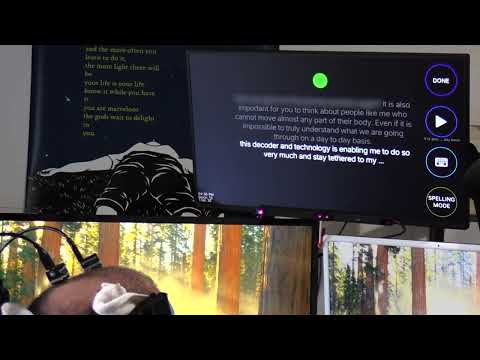
In the video below, Harrell explains via text that the technology is enabling him “to do so very much and stay tethered to my life as a human being.”
His story has scientists hopeful that these experimental devices may actually work in the wider world and in the long term.
“For years, BCIs have been proof-of-concept devices that lived in highly controlled research labs,” says neurosurgeon David Brandman, a co-principal investigator and co-senior author of the study from the University of California, Davis (UCD).
“This work shows that we may have crossed a threshold by empowering a person with paralysis to speak on his own terms.”
Harrell is enrolled in Brandman and his team’s ongoing pilot clinical trial in the US, called BrainGate 2.
This preliminary study is designed to investigate the safety and feasibility of a novel brain-computer interface in people with paraplegia who have severe speech impairments or who are unable to use their hands.
The technology was developed at UCD, in collaboration with experts at Brown University and Mass General Brigham Neuroscience Institute.
At the start, Harrell could only use the system with researcher support. But now, with several important tweaks, he can use it practically all on his own, from the comfort of his home.
According to researchers at UCD, who have varying degrees of investment in the technology, Harrell has accumulated the trial’s largest brain recording dataset so far.
For more than 400 days, he has practiced using the device, totaling more than 3,800 hours. Harrell’s average communication speed is about 56 words per minute, which is much faster than when he first attempted to turn his thoughts into text, way back in 2023.

“Casey can use the system to communicate his own thoughts, not only while we’re there in a controlled environment, but whenever he wants,” says Nicholas Card, postdoctoral scholar, UC Davis Neuroprosthetics Lab
“Sometimes, he would do that over 12 straight hours.”
Importantly, Harrell is also in control of his silence. He can enable a ‘privacy mode’ if he wants to keep some thoughts to himself.
Only data from sessions where this ‘privacy mode’ wasn’t activated were saved and used to train future speech-decoding models.
When he does speak through the system, the program is correct or at least mostly accurate about 92 percent of the time, Harrell reports, according to recently published results.
The independence this has given Harrell has been transformative, similar to others’ recent experience with brain-computer interface technology.
Related: Experts Discuss The Dark Likelihood of ‘Abandoned’ Brain Implant Technology
“It is a life that is more full of dynamic action and with friends and family, with colleagues,” Harrell shared through the device, “and it is something that allows me to communicate more in my natural way of communicating than any other technology that I have experienced.”
Researchers hope that Harrell’s experience and the 26 other participants currently enrolled in the clinical trial will help them refine the technology for future users.
The study is published in Nature Medicine.
What did you think of this news? Leave a comment below and/or share it on your social media. This way, we can inform more people about the hottest things in technology, science, innovation, and gaming!
This news was originally published in:
Original source
