
New propulsion system could make tiny satellites both fast and fuel-efficient
MIT engineers are testing a new propulsion system that combines the power and speed of conventional chemical thrusters with the precision and fuel-efficiency of electrical thrusters.
The system could enable the design of nimbler, more flexible small satellites, which could perform both fast, powerful maneuvers and slower, precise adjustments, depending on the mission and moment at hand.
The key to the new system is a special propellant that can power both chemical and electrical thrusters, which traditionally have required separate, bulky fuel sources.
“If you can have chemical and electrical propulsion in one small package, it’s the best of both worlds,” says Amelia Bruno, a former postdoc in MIT’s Department of Aeronautics and Astronautics (AeroAstro). “This opens the door for small satellites to do even more science, more observations, and more interesting missions, all on a smaller and cheaper platform.”
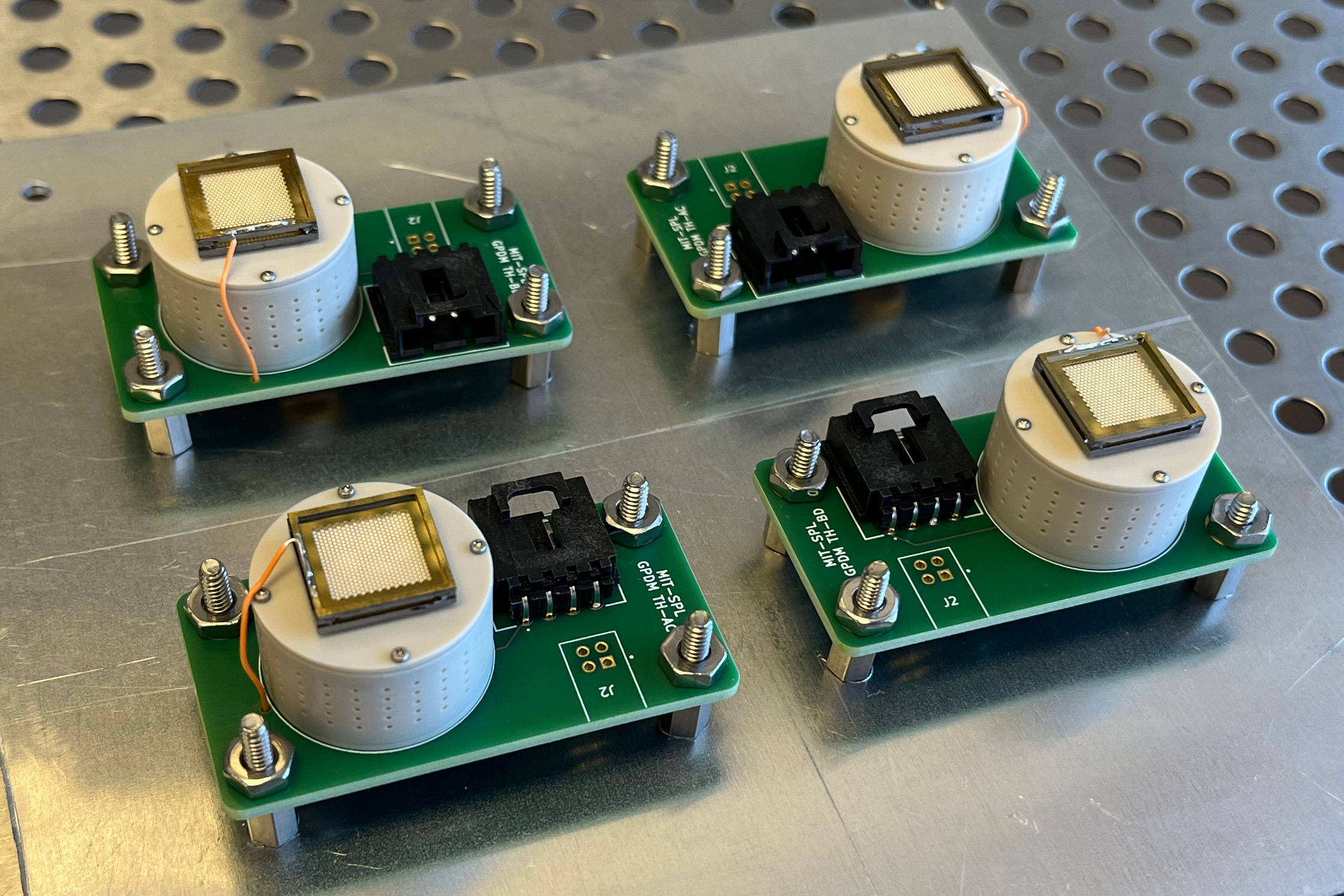
Bruno is the lead author of a study appearing this week in the Journal of Propulsion and Power showing that a type of “green monopropellant” originally developed by the U.S. Air Force for use in chemical propulsion in space can also effectively power tiny “electrospray” thrusters. Electrospray thrusters are dime-sized rockets that use electric fields to charge up a liquid propellant’s particles, which are then shot into space as a thrust-generating spray.
Electrospray thrusters are extremely fuel-efficient and can perform slow and precise maneuvers, such as pushing a small spacecraft bit by bit through a long, interplanetary journey. Chemical thrusters, in contrast, require a large fuel supply to perform short and fast bursts, for instance to quickly ascend and descend, or speed up and slow down.
Now that the MIT group has found a propellant that can fuel both chemical and electrospray thrusters, they see big potential for small spacecraft. The team is working with NASA to launch the Green Propulsion Dual Mode mission — a briefcase-sized CubeSat that will carry a chemical thruster and four electrospray thrusters, all fueled by a single propellant tank. The mission will be the first to test such a two-in-one propulsion system for small spacecraft. If it is successful, Bruno says the mission could pave the way for small satellites to explore beyond Earth’s orbit.
“We could send CubeSats to Mars, or the asteroid belt, where they could make the journey slowly, using electrospray thrusters,” says study co-author Paulo Lozano, the Miguel Alemán Velasco Professor of Aeronautics and Astronautics at MIT. “You could then use your chemical thrusters to quickly move to look at interesting features. You could have a lot more flexibility to do a lot more things.”
The study’s co-authors also include Matthew Corrado SM ’22, PhD ’26.
A sea of ions
Lozano’s group at MIT designs, fabricates, and tests electrospray thrusters for use in satellites that range from the size of a lunchbox to a small carry-on suitcase. Compared to conventional satellites, these microsatellites are significantly smaller and cheaper to launch into space.
But smaller spacecraft require smaller everything else, including propulsion systems. In that respect, electrospray thrusters are a good fit. The thrusters Lozano develops are about the size of a thumbnail. Each thruster sits atop a small reservoir of ionic liquid propellant. When the reservoir is connected to a battery, the battery supplies some amount of voltage that electrically charges a corresponding amount of ions in the liquid. The charged particles are then channeled out of the reservoir, through the thruster’s tips and into space as a thrust-inducing spray.
Over the past decade, Lozano has tested many thruster designs, under varying conditions, and with various types of ionic liquid propellant — a fuel that is essentially made from salts that can remain in liquid form.
“Ionic liquids are very stable and can even remain a liquid in space, which not a lot of materials can do,” Bruno says. “And it’s basically a sea of ions, which is why we base our technology around it, so we can pull those ions out into an electrospray.”
Bruno and Lozano have collaborated with the U.S. Air Force, which synthesized a new kind of ionic liquid propellant — the Advanced SpaceCraft Energetic Non-Toxic propellant (ASCENT) — which was being tested in chemical thrusters. Chemical thrusters are high-force propulsion systems typically associated with launching rockets and performing hard and fast maneuvers once in space. ASCENT was designed as a “green,” less toxic alternative to hydrazine, which has been the traditional fuel source for chemical propulsion and is extremely hazardous to handle.
“ASCENT happens to be an ionic liquid mixture,” Bruno says. “And we said, hey, that’s the stuff we typically use. Theoretically, this should work. Let’s go figure out how.”
Spray and spin
In their new study, Bruno, Lozano, and Corrado tested the performance of electrospray thrusters that they fueled with ASCENT. Each thruster they used was attached to a small cube-shaped reservoir about the size of a Lego brick. They filled each reservoir with 1 gram of ASCENT, a liquid that has a viscosity similar to baby oil. They then attached a thruster to opposite sides of a CubeSat, which they set on a MagLev stand — a custom testbed that is designed to magnetically levitate a sample or device. The MagLev in Lozano’s lab is installed inside a large vacuum chamber, which the researchers can tune to mimic the conditions in space.
Over multiple experiments, the team remotely applied varying levels of voltage to activate the thrusters, which in turn produced a spray that spun the CubeSat around, like a floating, spinning top. The researchers measured the amount of thrust produced with each trial, and calculated ASCENT’s fuel efficiency as they ran the thrusters continuously over periods lasting up to 100 hours.
In the end, they found that ASCENT was able to successfully fuel each electrospray thruster. What’s more, the propellant, which was originally intended for chemical propulsion, was just as efficient as other, conventional ionic liquids at propelling electric thrusters.
“Compared to our normal electrospray propellants, ASCENT can provide similar performance in terms of thrust,” Bruno says. “Now that we know our thrusters work with ASCENT, we can start thinking of all the ways we can make them even better.”
Now that ASCENT has been proven to work in both chemical and electrical propulsion, she and Lozano say that a single tank of the fuel can be used to power both types of thrusters, all in a compact, two-in-one system that could fit within a small CubeSat. The team will test the idea with NASA’s Green Propulsion Dual Mode mission, which is scheduled to launch in November.
“This will be the first time that a satellite will have a shared propellant tank,” says Lozano, who notes that in addition to long, exploratory interplanetary missions, small satellites equipped with both chemical and electrical propulsion could also be useful for missions closer to Earth, such as for weather and climate observations.
“Say there’s a storm coming, and you’d want to deploy your constellation of small satellites to observe over one location,” he says. “You could choose to send them quickly or slowly depending on the nature of the observation. And the only way to do that is if you have two propulsion systems, which is now possible.”
This research is supported, in part, by NASA.
What did you think of this news? Leave a comment below and/or share it on your social media. This way, we can inform more people about the hottest things in technology, science, innovation, and gaming!
This news was originally published in:
Original source
