

Scientists Discover New Giant Virus That Replicates in a Totally Unique Way
Researchers have discovered a new type of giant virus, which replicates in a way we’ve never seen before.
Stranger still, this entity could give us clues to the very origins of complex life.
Viruses sit outside the standard tree of life, as they’re made of segments of genetic material rather than cells.
That makes it challenging to figure out how they originally evolved, and how they relate to living organisms.
Giant viruses – so called for their huge and complex genomes, compared to that of standard viruses – could help unravel that mystery.
In this new research, microbiologists from the Tokyo University of Science (TUS) discovered the new giant virus, furtivovirus, in the Inasegawa River in Kamakura City, Japan.
Its name comes from the Latin word furtivus, which means ‘hidden’ or ‘stealthy’, because of the initial difficulty the team had in picking it out from their sample.
This follows on from the recent identification of other giant viruses, including the discovery of ushikuvirus earlier this year by some of the same researchers.
While these giants all follow the standard virus practice of hijacking host cells to spread, there are some crucial variations too.
“Although these viruses belong to the same group, they use the cell nucleus in different ways,” says Masaharu Takemura, a virologist at TUS.
“If we can understand how giant viruses and host cells interact and evolve together, we may gain new insights into the significance of viruses as living organisms and how we can coexist with them.”
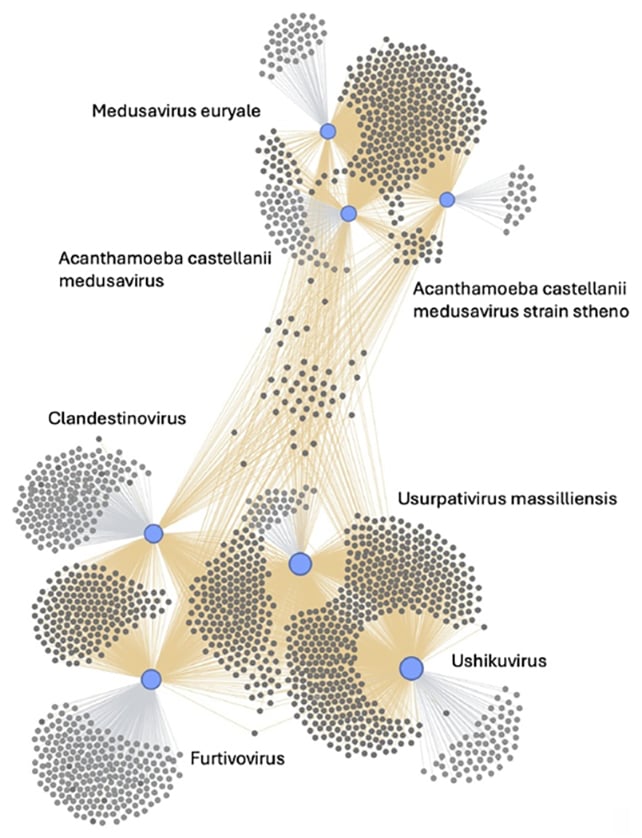
Two characteristics of furtivovirus make this latest discovery special. First, the new analysis suggests it bridges the gap between two related groups of giant viruses, which have genomes that are significantly different in size.
As such, the researchers propose furtivovirus should get its own viral family. This would be called Manesviridae, and would include other similar giant viruses.
There are differences in genome size and host selection compared with other giant viruses, as well as consistencies in DNA that, the researchers say, justify the new classification.
As the researchers explain, furtivovirus and its proposed new family have a lot to teach us about how viruses can evolve over vast time periods – into different sizes, and with different methods of replication.
That brings us to the second special characteristic: its replication strategy. Other giant viruses either keep the host cell’s nucleus intact and replicate inside it, or bust down the nuclear membrane and replicate in the fluid outside the nucleus.
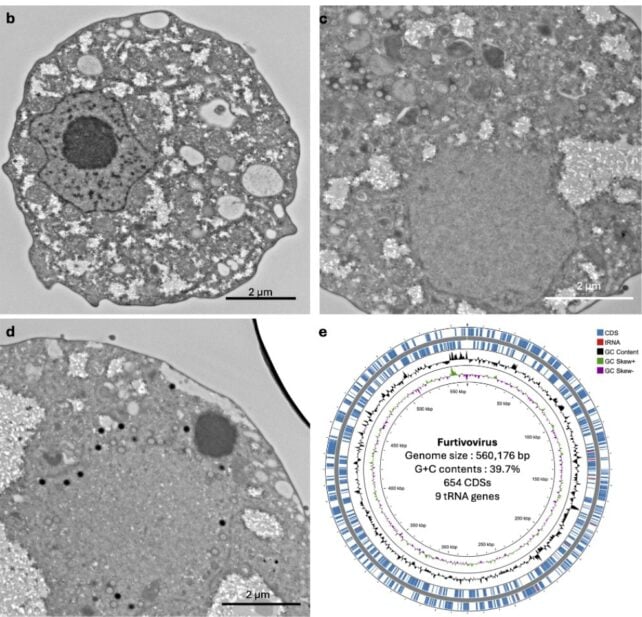
Furtivovirus takes an in-between tactic. After infecting a cell, it breaks down the cell’s nucleus, coopting the cell’s machinery and replicating in what remains of the nucleus’s fluid. This is something that hasn’t previously been observed in other giant viruses.
“This finding highlights the complexity of genome evolution, demonstrating that giant viruses can expand their overall genome size to adapt to uncertain environments while reducing their core essential genes, thereby providing new insights into the evolutionary pressures that shape the diversity of the virosphere,” write the researchers in their published paper.

When it comes to how all of this relates to complex life, the thinking is that viruses may have been responsible for originally forming the nucleus inside cells.
The cell nucleus distinguishes us and other eukaryotes from organisms like bacteria and archaea, and a hypothesis previously proposed by Takemura and others posits that invading giant viruses may have developed the nucleus as a protection mechanism.
So how does furtivovirus fit in? It shows the evolutionary pathway for how this might have come about – from viruses that replicate inside an intact nucleus to viruses that entirely destroy the nucleus, with furtivovirus sitting somewhere in between.
It’s not yet proof of the theory, but it’s more evidence that viruses can adapt and change in how they make use of the host nucleus. And as our understanding of giant viruses and the different types grows, there will no doubt be more discoveries to come.
Related: Ancient Viruses May Have Given Our Ancestors The Edge to Evolve
“The discovery of furtivovirus and its unique nucleoplasm-dependent replication cycle provides a critical biological context for this genomic disparity,” write the researchers.
“Through deep comparative genomic analysis, we demonstrated that these seemingly disparate lineages share a cohesive evolutionary origin that is distinct from other established orders.”
The research has been published in the Journal of Virology.
What did you think of this news? Leave a comment below and/or share it on your social media. This way, we can inform more people about the hottest things in technology, science, innovation, and gaming!
This news was originally published in:
Original source
