

A Radical Innovation Helped Archaic Humans Survive a Harsh Ice Age
A brainy human relative who lived during an ice age nearly 150,000 years ago adapted to the bitter cold by developing a sophisticated stone-tool industry, according to a new study of a crystal-studded rib bone found in China.
This surprising discovery, described in a recent paper, shows that creativity doesn’t only flourish during peaceful periods, but also when conditions are trying, and innovation may be most needed.
“Finding out that these stone tools were made during a harsh ice age tells a different story,” says anthropological archaeologist Yuchao Zhao, from Shandong University in China.
“Hard times can force us to adapt.”
The stone tools were previously found across the Lingjing archaeological site in central China. Researchers think ancient people used the venue to butcher animals, rather than as a residential base, thanks to its strategic access to a spring.
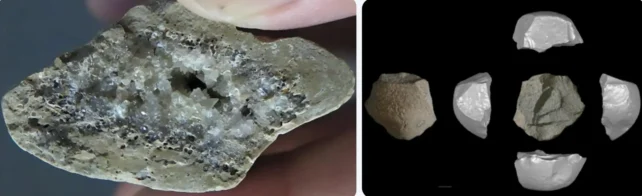
This fruitful site has yielded nearly 15,000 stone artifacts, mainly quartz, unearthed across numerous strata.
It’s believed that at least some of these items were crafted by Homo juluensis, a recently proposed archaic human relative with a large brain and a mix of hominin features, who lived in eastern Asia from around 300,000 to 100,000 years ago.
At a passing glance, the stone tools found at Lingjing may seem like randomly chipped rocks. But they’re exceptionally sophisticated, demonstrating advances in cognitive abilities and craftsmanship.
“This was not casual flake production, but a technology that required planning, precision, and a deep understanding of stone properties and fracture mechanics,” explains Zhao.
For example, the crafters in question deliberately preserved angles on the stones from which they could flintknap flakes capable of performing functions such as cutting meat from bones.
Beyond intricately worked stones, these tools represent a bridge between worlds and people:
“The underlying logic of this system – and the cognitive abilities it reflects – shows important similarities to Middle Paleolithic technologies often associated with Neanderthals in Europe and with human ancestors in Africa, suggesting that advanced technological thinking was not limited to western Eurasia,” Zhao adds.
This finding helps overturn the long-held assumption that populations in this region stagnated in technological advancement for tens of thousands of years.
Researchers previously estimated that the tools were made during a balmy era when life was relatively easy.
“People often imagine creativity as something that flourishes in good times,” Zhao says.

In this study, the team reassessed the age of the tools by dating a rib from a deer-like animal that was butchered at the site.
They were able to do so because the rib contained calcite, an incredibly common mineral that contains uranium, an element that slowly decays into thorium.
After measuring the ratio of uranium to thorium in the calcite crystals, the researchers experienced a eureka effect:
“We used to think these tools were made 126,000 years ago, during a warm interglacial period, but based on the new dates suggested by the crystals, some of these tools were actually produced 146,000 years ago, during a harsh, cold glacial period,” Zhao says.
This presents a slight paradox: Is creativity a luxury reserved for leisurely times, or is it a child of necessity, as suggested by a purportedly Platonic ideal?
Further research is needed to determine whether Lingjing represents a localized center for innovation or perhaps a site where techniques were shared across generations or demographics.
But the stone tools found here represent a cognitive leap compared with the more ancient Homo erectus populations that inhabited the same site.
“Even though these tools are just a little bit older than we’d previously thought, the entire story is changed,” says Zhao.
More broadly, a comparative analysis comprising 100 Paleolithic sites in China provided evidence that this type of toolmaking became a more widespread adaptation to a shifting environment and culture.
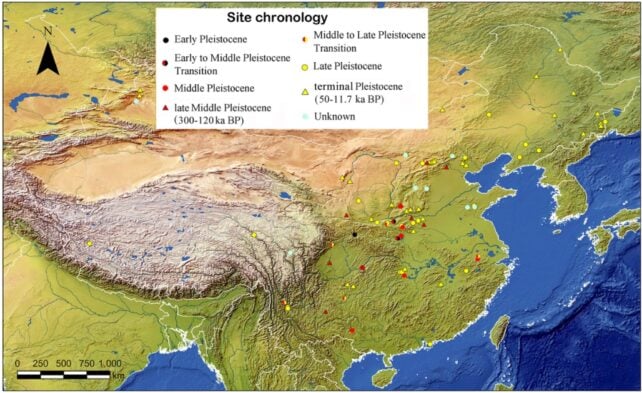
The advent of this toolmaking complexity also coincides with the emergence of morphological mosaicism, linking technological advances to the evolution or even hybridization of archaic human relatives.
Related: The Earliest Known Dentistry Wasn’t Done By Our Species
“Altogether, this research reveals a much richer story of innovation, intelligence, and human evolution in East Asia,” Zhao concludes.
This research was published in the Journal of Human Evolution.
What did you think of this news? Leave a comment below and/or share it on your social media. This way, we can inform more people about the hottest things in technology, science, innovation, and gaming!
This news was originally published in:
Original source
