
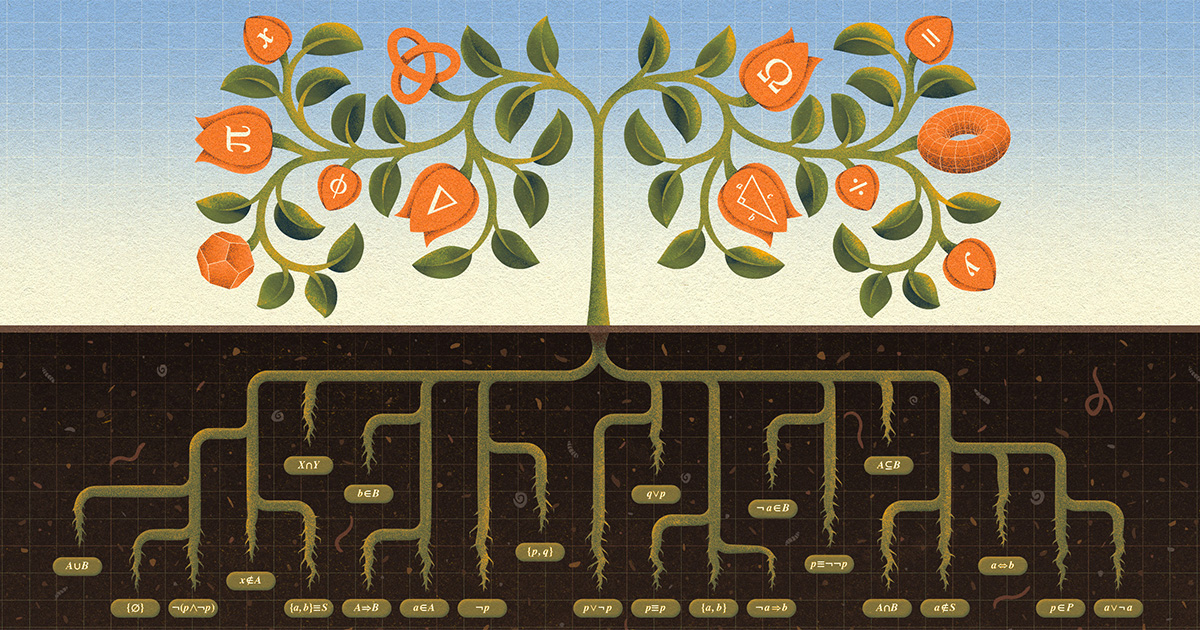
Why Math’s Final Axiom Proved So Controversial
How do mathematicians decide that something is true? They write a proof.
Often they start with proofs that already exist, building on or drawing connections between proven claims. Each of these proofs, in turn, has relied on other proofs to make its point, and so on. Proofs upon proofs. Truths upon truths. But eventually this process must come to an end. At some point, things are true simply because they are.
These truths are the axioms, the ground rules. And it is tempting to stop there — to declare, as Penelope Maddy, a philosopher of mathematics at the University of California, Irvine, put it, “that axioms are obvious or intuitive or conceptual truths.”
After all, most mathematicians simply accept that their work relies on an axiomatic system — namely, “Zermelo-Fraenkel set theory with the axiom of choice,” or ZFC — if they bother to acknowledge the axioms at all. ZFC is a list of 10 basic principles that together form the foundation on which nearly all of modern mathematics is built.
But a closer inspection reveals a more unsettled, human process of establishing truth. “Any honest, clear-eyed examination of how the axioms of ZFC came to be adopted would have to acknowledge that a wide range of mathematical considerations went into these decisions,” Maddy said.
That process, which began over a century ago, is still very much in progress.
Paradoxes and Doubt
The late 1800s were a time of paradoxes and doubt, the result of mathematicians beginning to search for cohesive ideas about what rules the mathematical universe obeyed. There were axiomatic systems out there, but they tended to be for specific areas of math: Euclid’s postulates for geometry; various schemes for standardizing arithmetic. But how did they all fit together? Could all of math be derived from one common set of rules?
Mathematicians found a potential solution — and more doubts — in the work of Georg Cantor.
At the time, Cantor was studying the real numbers — that is, all the numbers that appear on the number line — and what they could say about the nature of infinity. He had found that there were more real numbers than whole numbers, giving rise to the profound realization that not all infinities are the same size.
To make this comparison, Cantor had used a seemingly simple tool: the set. A set is a collection of objects, or elements. It might be a collection of numbers, like the real numbers, or a collection of shapes, or even a collection of other sets. Over time, it became clear that complex and disparate mathematical ideas — nearly all of them — could be represented with these same elementary entities. As a result, the set emerged as a potential tool for ironing out any inconsistencies between different areas of math.
But early set theory lacked canonical rules. It was possible to define sets with any property, which led to exactly the sorts of paradoxes that were bothering mathematicians at the time. Consider, for example, the set of all sets that are not members of themselves. Does this set contain itself? Whether you answer yes or no, you get a contradiction now known as Russell’s paradox.
As mathematicians obsessed over these dilemmas, ZFC emerged out of a struggle with another idea of Cantor’s.
In 1883, Cantor introduced his “well-ordering principle.” He claimed that it should be possible to arrange any set so that all of its (non-empty) subsets would have a smallest element. For finite sets, this is intuitive. You can always put the lesser items first. But for infinite sets, it is less obvious. Take the set of integers {…, −2, −1, 0, 1, 2, …}. The negative numbers form a subset, but they also get lower and lower for eternity. It seems as if there can be no least element.
But what if you arrange the original set of integers like this: {0, −1, 1, −2, 2, …}? Now you can say that the smallest element is the one that comes first in any subset. In this way, −1 becomes the smallest element of the subset of negative numbers.
Cantor’s “law” was that this should be possible for all sets, even if you can’t explicitly construct the proper ordering. It was one way of arguing that infinite sets behave like finite ones.
In 1904, the German mathematician Ernst Zermelo proved it. He did so by showing that Cantor’s law was equivalent to a principle he had developed while exploring the properties of sets. This principle, the so-called axiom of choice, said that if you start with multiple (or even infinitely many) non-empty sets, you can choose one element from each of those sets to create a new set.
Zermelo developed his other axioms to prove this equivalence. “He was just listing all the assumptions that he needed to get the proof through,” said Joan Bagaria, a set theorist at the University of Barcelona. That list included the basic idea that there is such a thing as a set, which is defined by its elements. Other axioms dealt with the formation of sets from other sets, or with the existence of infinite sets.
Zermelo’s list of axioms emerged at a time when many mathematicians, such as Abraham Fraenkel, were also tinkering with set theory’s foundations. Many of them found themselves arriving at different formulations of similar ideas — and some new ones, too, that resolved problems arising from newer theories having to do with larger forms of infinity. In 1930, Zermelo released a “final” list that included revisions to his own axioms as well as a handful of additions — but not, at first, the axiom of choice. Mathematicians were more hesitant to include it, because unlike the other axioms, it defined sets without giving an explicit way to construct them.
Zermelo was pleased that his list of principles, known as ZF, appeared to cleanse the set-theoretic universe of many major paradoxes such as Russell’s. But he lamented that he was unable to prove that his axiomatic system was “consistent” — that it didn’t yield contradictions.
He need not have worried. Just a few years after the arrival of ZF, Kurt Gödel showed that no axiomatic system capable of basic arithmetic can be used to prove its own consistency. Moreover, any consistent system must also be incomplete, meaning that there are true mathematical statements that cannot be proved using the system’s axioms.
In fact, in the 1960s, the Stanford mathematician Paul Cohen proved that the axiom of choice is “independent” of the other axioms — that is, under the rules of ZF, the axiom of choice cannot be proved true or false.
Once it was clear that logic could not validate the axiom of choice one way or the other, the question became: Is it useful? And it was. It makes a great deal of other math possible — especially math related to infinite objects. After that, the axiom of choice gained much more widespread acceptance. “Without choice, your tools are very limited,” Bagaria said. “It’s like doing math with your hands tied behind your back.” And so the C (for “choice”) came to be affixed to the list of axioms that were originally developed to support it.
The axiom of choice demonstrates the folly of believing that mathematical axioms are self-evident or obvious. An axiom can also be accepted for plenty of other reasons, as Maddy put it — such as for its power to generate interesting theorems.
The ZFC axioms are often regarded as perhaps the most universal truths that humanity has managed to articulate — for while it may be possible for physicists to imagine universes in which physical laws are turned inside out, mathematical laws will remain constant.
It is a paradox without resolution: The foundations of mathematics are as universal, as solid as anything humanity knows, a core part of nearly every mathematical truth. And yet they remain simply what we choose to believe.
What did you think of this news? Leave a comment below and/or share it on your social media. This way, we can inform more people about the hottest things in technology, science, innovation, and gaming!
This news was originally published in:
Original source
