
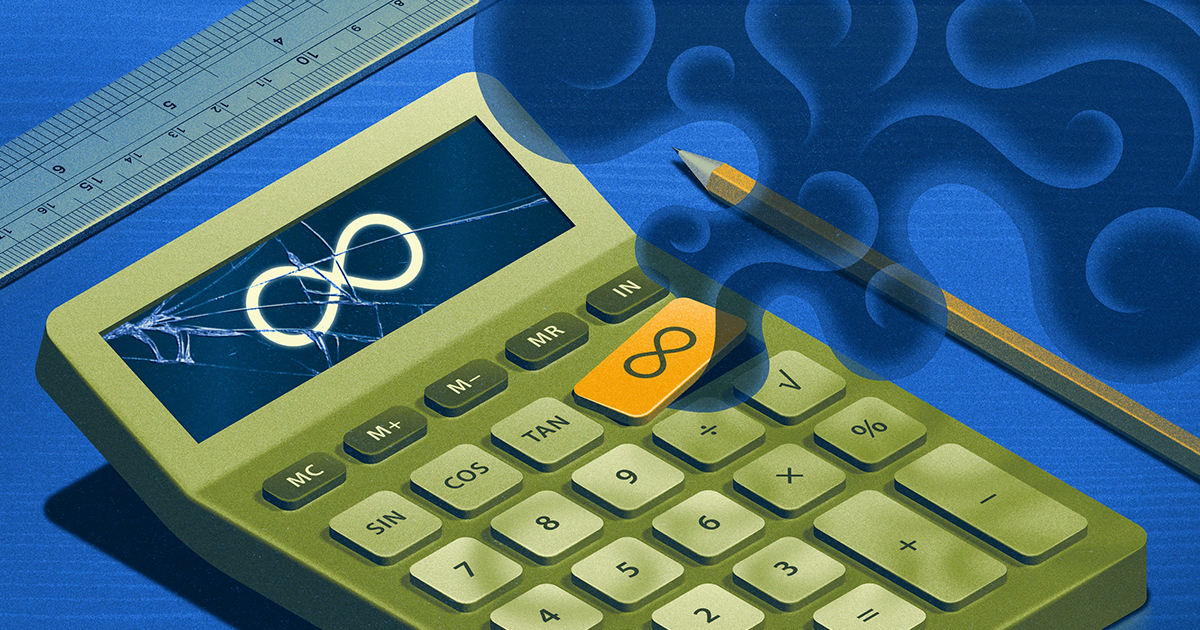
What Can We Gain by Losing Infinity?
Doron Zeilberger is a mathematician who believes that all things come to an end. That just as we are limited beings, so too does nature have boundaries — and therefore so do numbers. Look out the window, and where others see reality as a continuous expanse, flowing inexorably forward from moment to moment, Zeilberger sees a universe that ticks. It is a discrete machine. In the smooth motion of the world around him, he catches the subtle blur of a flip-book.
To Zeilberger, believing in infinity is like believing in God. It’s an alluring idea that flatters our intuitions and helps us make sense of all sorts of phenomena. But the problem is that we cannot truly observe infinity, and so we cannot truly say what it is. Equations define lines that carry on off the chalkboard, but to where? Proofs are littered with suggestive ellipses. These equations and proofs are, according to Zeilberger — a longtime professor at Rutgers University and a famed figure in combinatorics — both “very ugly” and false. It is “completely nonsense,” he said, huffing out each syllable in a husky voice that seemed worn out from making his point.
As a matter of practicality, infinity can be scrubbed out, he contends. “You don’t really need it.” Mathematicians can construct a form of calculus without infinity, for instance, cutting infinitesimal limits out of the picture entirely. Curves might look smooth, but they hide a fine-grit roughness; computers handle math just fine with a finite allowance of digits. (Zeilberger lists his own computer, which he named “Shalosh B. Ekhad,” as a collaborator on his papers.) With infinity eliminated, the only thing lost is mathematics that was “not worth doing at all,” Zeilberger said.
Most mathematicians would say just the opposite — that it’s Zeilberger who spews complete nonsense. Not just because infinity is so useful and so natural to our descriptions of the universe, but because treating sets of numbers (like the integers) as actual, infinite objects is at the very core of mathematics, embedded in its most fundamental rules and assumptions.
At the very least, even if mathematicians don’t want to think about infinity as an actual entity, they acknowledge that sequences, shapes, and other mathematical objects have the potential to grow indefinitely. Two parallel lines can in theory go on forever; another number can always be added to the end of the number line.
Zeilberger disagrees. To him, what matters is not whether something is possible in principle, but whether it is actually feasible. What this means, in practice, is that not only is infinity suspect, but extremely large numbers are as well. Consider “Skewes’ number,” $latex e^{e^{e^{79}}}$. This is an exceptionally large number, and no one has ever been able to write it out in decimal form. So what can we really say about it? Is it an integer? Is it prime? Can we find such a number anywhere in nature? Could we ever write it down? Perhaps, then, it is not a number at all.
This raises obvious questions, such as where, exactly, we will find the end point. Zeilberger can’t say. Nobody can. Which is the first reason that many dismiss his philosophy, known as ultrafinitism. “When you first pitch the idea of ultrafinitism to somebody, it sounds like quackery — like ‘I think there’s a largest number’ or something,” said Justin Clarke-Doane, a philosopher at Columbia University.
“A lot of mathematicians just find the whole proposal preposterous,” said Joel David Hamkins, a set theorist at the University of Notre Dame. Ultrafinitism is not polite talk at a mathematical society dinner. Few (one might say an ultrafinite number) work on it. Fewer still are card-carrying members, like Zeilberger, willing to shout their views out into the void. That’s not just because ultrafinitism is contrarian, but because it advocates for a mathematics that is fundamentally smaller, one where certain important questions can no longer be asked.
And yet it gives Hamkins and others a good deal to think about. From one angle, ultrafinitism can be seen as a more realistic mathematics. It is math that better reflects the limits of what people can create and verify; it may even better reflect the physical universe. While we might be inclined to think of space and time as eternally expansive and divisible, the ultrafinitist would argue that these are assumptions that science has increasingly brought into question — much as, Zeilberger might say, science brought doubt to God’s doorstep.
“The world that we’re describing needs to be honest through and through,” said Clarke-Doane, who in April 2025 convened a rare gathering of experts to explore ultrafinitist ideas. “If there might only be finitely many things, then we’d better also be using a math that doesn’t just assume that there are infinitely many things at the get-go.” To him, “it sure seems like that should be part of the menu in the philosophy of math.”
For mathematicians to take it seriously, though, ultrafinitists first need to agree on what they’re talking about — to turn arguments that sound like “bluster,” as Hamkins puts it, into an official theory. Mathematics is steeped in formal systems and common frameworks. Ultrafinitism, meanwhile, lacks such structure.
It is one thing to tackle problems piecemeal. It is quite another to rewrite the logical foundations of mathematics itself. “I don’t think the reason ultrafinitism has been dismissed is that people have good arguments against it,” Clarke-Doane said. “The feeling is that, oh, well, it’s hopeless.”
That’s a problem that some ultrafinitists are still trying to address.
Zeilberger, meanwhile, is prepared to abandon mathematical ideals in favor of a mathematics that’s inherently messy — just like the world is. He is less a man of foundational theories than a man of opinions, of which he lists 195 on his website. “I cannot be a tenured professor without doing this crackpot stuff,” he said. But one day, he added, mathematicians will look back and see that this crackpot, like those of yore who questioned gods and superstitions, was right. “Luckily, heretics are no longer burned at the stake.”
Dissident Mathematics
Aristotle saw infinity as something that you could move toward but never reach. “The fact that the process of dividing never comes to an end ensures that this activity exists potentially,” he wrote. “But not that the infinite exists separately.” For millennia, this “potential” version of infinity reigned supreme.
But in the late 1800s, Georg Cantor and other mathematicians showed that the infinite really can exist. Cantor’s approach was to treat a series of numbers, such as the integers, as a complete infinite set. This approach would become essential in the creation of the foundational theory of mathematics, known as Zermelo-Fraenkel set theory, that mathematicians still use today. Infinity, he showed, is an actual object. Moreover, it can come in many different sizes; by manipulating and comparing these different infinities, mathematicians can prove surprising truths that on their face seem to have nothing to do with infinity at all. While few mathematicians spend much time in the realm of the higher infinite, “nowadays, almost every mathematician is an actualist,” Hamkins said. Infinity is assumed by default.
But this foundation of modern math has inspired fierce arguments since it was first proposed. One reason is that accepting a core assumption about infinity allows you to construct strange paradoxes: It becomes possible, for instance, to carve a ball into five parts and use them to create five new balls, each with a volume equal to that of the first.
Another objection is more philosophical. In the decades after Cantor’s revelations, some mathematicians argued that you cannot simply assert the existence of a mathematical structure — you must prove that it exists through a process of mental construction. In this “intuitionist” philosophy, for example, pi is less a number with an infinite non-repeating decimal expansion, and more a symbol that represents an algorithmic process for generating digits.
But intuitionism only requires that a given mental construction be possible in theory: It prohibits actual infinity but permits potential infinity. Some mathematicians still weren’t satisfied with this. They remained troubled by Skewes’ number and other values so large they could never be written down. And so they sought to take intuitionist ideas to an extreme.
“If you’re thinking, which numbers are going to exist in this view, those are going to have to be numbers that we can in practice construct,” not just theoretically construct, said Ofra Magidor, a philosopher at the University of Oxford.
A new version of intuitionism — one that took these practical constraints to heart — crystallized in the 1960s and ’70s, with the work of Alexander Esenin-Volpin, a Soviet mathematician and poet.
Esenin-Volpin was known first and foremost as a political dissident. For leading protests and spreading anti-Soviet rhetoric and poetry, he was institutionalized. “He said, ‘I’m a human being. I have fundamental rights,’” said Rohit Parikh, a logician at the City University of New York who hosted Esenin-Volpin in his home after the Soviets forced him to emigrate in the 1970s. Esenin-Volpin was a strange houseguest, who would pace around Parikh’s attic all night and use his wife’s beloved ceramics as an ashtray while working on a strange theory that rejected not only potential infinity but even extremely large numbers — those that couldn’t be constructed in a person’s mind.

Alexander Esenin-Volpin was a Soviet dissident, mathematician, and poet who was imprisoned several times for his human rights activism.
Irene Caesar
The logician Harvey Friedman once asked Esenin-Volpin to pinpoint a cutoff for what makes a number too large. Given an expression like 2n, at what value of n do numbers stop? Was 20 actually a number? What about 21, 22, and so on, up to 2100? Esenin-Volpin responded to each number in turn. Yes, 21 existed. Yes, 22 did. But each time, he waited longer to reply. The dialogue soon grew interminable.
Esenin-Volpin had made his point. As Parikh and others would later put it, the limits of numbers were rooted in the limited resources needed to demonstrate their existence, like time. Or available computer memory, or the physical length of a proof. “Most ultrafinitists have the view that the distinction between the finite and infinite is inherently vague,” Clarke-Doane said.
For Esenin-Volpin, a condition may be true for n, and for n + 1 — until it is not. A child grows and grows, until one day they’re no longer a child. One need not specify a specific end point. The important thing is that the end is in there, somewhere.
Esenin-Volpin’s work was a call for a new kind of mathematics that could, in some sense, tolerate vagueness. Ultrafinitists have since picked up where he left off, exploring how to make his vague, borderline-nonsensical mathematics solid.
Crisis Control
One morning in 1976, the Princeton mathematician Edward Nelson woke up and experienced a crisis of faith. “I felt the momentary overwhelming presence of one who convicted me of arrogance for my belief in the real existence of an infinite world of numbers,” he reflected decades later, “leaving me like an infant in my crib reduced to counting on my fingers.”
Mathematics has basic rules, or axioms. Nelson knew that even the bare-bones axioms that make it possible to do simple arithmetic contain assumptions about infinity — for instance, that we can always add 1 to a number to create new numbers. He wanted to start over, to construct a new set of rules that would forbid infinity entirely. What would mathematics look like if it could be built up from only these new axioms?
Remarkably weak, it turned out. Nelson studied various sets of axioms that banished infinity and found that if he used any of them to try to do basic arithmetic, it became impossible to prove something as simple as the statement that a + b always equals b + a. Elementary operations like exponentiation were no longer always possible: You might be able to construct the number 100, or the number 1,000, but not the number 1001,000. One of the most powerful techniques in a mathematician’s tool kit — a method known as induction, which says that if you can prove that a statement is true for one number, then it must be true for them all — was lost entirely.
To Nelson, this weakness represented a glimmer of truth. He hoped to show that the more powerful axioms of arithmetic that mathematicians took for granted (the infinity-permitting “Peano axioms”) were fundamentally flawed — that they could lead to contradictions. “I believe that many of the things we regard as being established in mathematics will be overthrown,” he once said.
Nelson was unable to overthrow them, however. In 2003, he announced that he’d used his weaker axioms to find an inconsistency in the Peano axioms, but the splashy result was quickly debunked.
Nelson’s more limited arithmetic — as well as related forms of nonstandard arithmetic developed by Parikh and others — did prove useful in the realm of computers, where researchers want to understand what algorithms can efficiently prove and what they can’t. These ultrafinitist approaches to mathematics have been translated into the language of computational efficiency and used to probe the limits of algorithms’ capabilities.
To Nelson, mathematics is all about “the truth you choose to believe” — the axioms that you decide are the right ones. That’s true even if you’ve chosen to believe the default axioms. Of course, the ultrafinitist, as the heretic without stable foundations, has a lot more to prove.
Exercises in Patience
In April 2025, a motley crew gathered in New York City for a conference at Columbia University on abolishing the infinite. They included physicists, philosophers, logicians, and mathematicians. There were card-carrying ultrafinitists like Zeilberger; set theorists, who believe in all sorts of infinity; and the merely curious. The result was, recalled Clarke-Doane, the conference organizer, “an exercise in patience for everyone.” Philosophers, in general, are used to disagreeing vehemently in the classroom and then gathering over a beer. Mathematicians aren’t. Usually, if they disagree, it means somebody royally messed up.
What was clear was that progress toward a universal theory of ultrafinitism has been halting in part because there has been no one clear motivation for the movement, or any singular approach to deciding what its underlying logic should look like. Perhaps, then, fixating on the ground rules, like Nelson did, isn’t the right approach. “I think it’s a waste,” Parikh told me. “You have to use the formalism as a binocular and pay more attention to what you are seeing. If you start studying the binoculars themselves, you’ve lost the game.”
Zeilberger is happy to see things through the (possibly distorted) looking glass, even if he must do so in a world where infinity is very much alive and present. He doesn’t hope to rebuild a mathematics without infinity from scratch. He can work from the top down instead. Take, for example, real analysis, which deals with how real numbers and functions behave. Zeilberger calls it a “degenerate case” of discrete analysis (which studies the behavior of distinct objects rather than continuous ones). You can replace the continuous landscape of the reals, he says, with a “discrete necklace” of numbers, separated by tiny — but not infinitesimal — differences in value. You can then use this to rewrite the rules of calculus and differential equations (now called “difference” equations) to remove even subtle uses of infinity from them. The going is tough, he acknowledges, but doable, especially with the help of a computer. And while the result may look less elegant than classical math, it is more beautiful, he says, because it reflects physical reality as he believes it to truly be.
For Jean Paul Van Bendegem, a philosopher of mathematics at the Free University of Brussels, the journey into ultrafinitism began not with numbers, but with elementary school geometry. He watched his math teacher draw a line on the chalkboard that supposedly extended infinitely. “To where?” he recalled asking. If the right-hand side went infinitely far in one direction and the left-hand side in another, did they arrive at the same place? Or did different infinities lurk off the edges of the board? His teacher told him to stop asking questions.
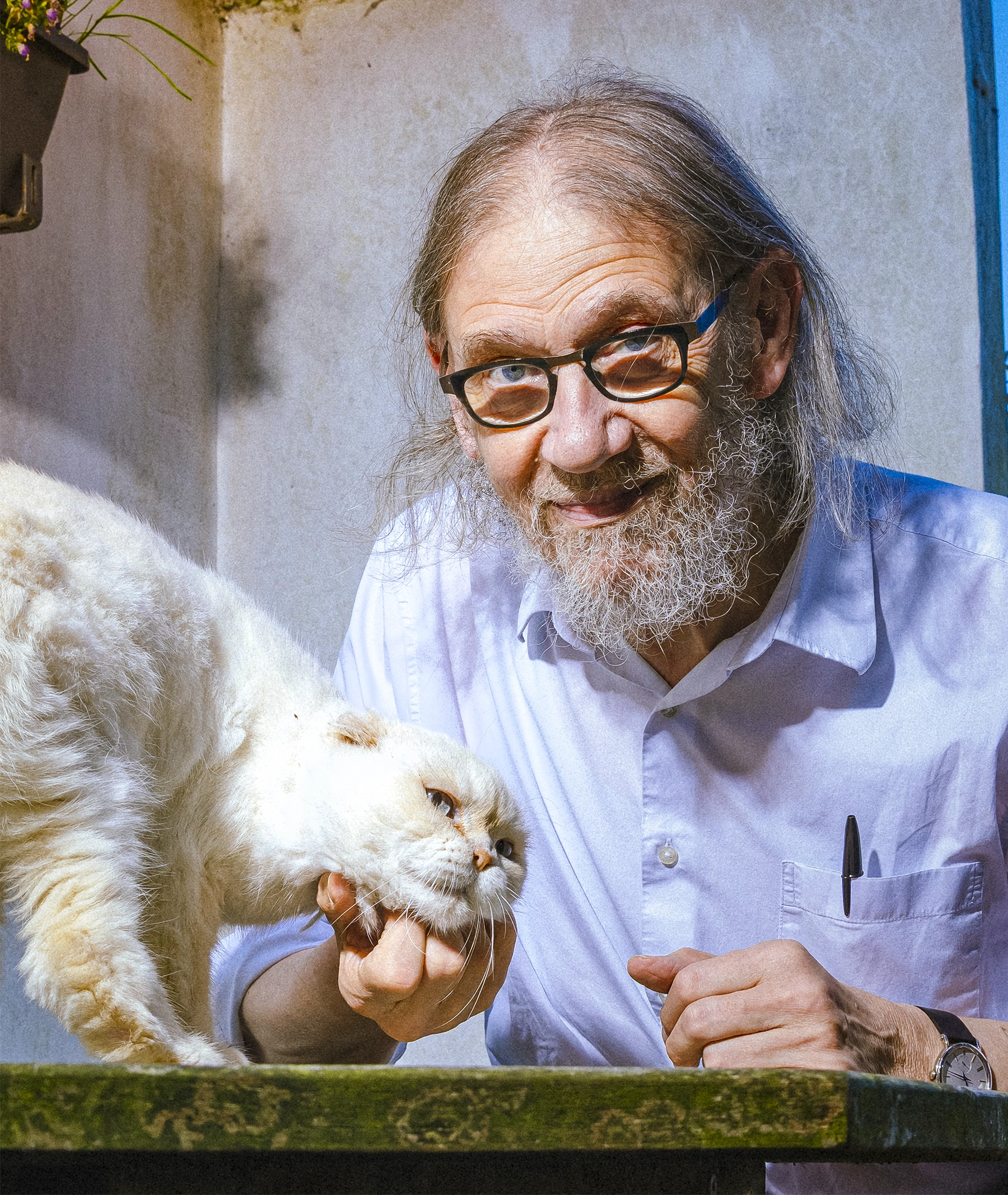
Jean-Paul van Bendegem developed a finite version of geometry in which points and curves have width.
Inge Kinnet
Van Bendegem, who would become a leading scholar on ultrafinitist logic, later addressed these concerns by considering a geometry in which a line or curve has width and is both finite and finitely divisible. It can be broken up into an array of points that, though incredibly small, are not infinitely so. Any structure one then builds with these points, lines, and curves must also be finite, providing a discrete analogue of classical geometry. While these tools remain limited, they have been explored deeply over the past few decades — not just for the sake of ultrafinitism, but because sorting out the shape of things is important for developing a finite physics.
While we often imagine the physical universe as both endlessly vast and endlessly divisible, physicists themselves question this assumption. There are fundamental limits, such as the Planck scale (sometimes called the pixel size of the universe), beyond which the very idea of distance loses meaning. And when infinity does crop up in physicists’ equations, it can be problematic, something they want to avoid. “To make predictions about what to expect in a universe that grows without bounds and repeats itself and things like that turns out to be really, really hard,” said Sean Carroll, a physicist at Johns Hopkins University who has experimented with finitistic models of quantum mechanics. “The way that most cosmologists deal with that problem is by pretending it’s not there.”
For Nicolas Gisin, a quantum physicist at Constructor University in Bremen, Germany, and the University of Geneva, intuitionist mathematics provides a way to think about one of the core mysteries in physics: At large scales, the behavior of physical systems is deterministic, predictable. But in the quantum realm, randomness reigns; a particle comes with multiple quantum states, collapsing to just one of them in unpredictable ways. Physicists have been trying to understand the source of this mismatch for the past century.

Nicolas Gisin proposed that one of the greatest mysteries in physics might be due to incorrect assumptions about infinity.
Carole Parodi
Gisin posits that it’s due to a faulty assumption. Researchers implicitly believe, he says, that from the start of the universe, a particle’s quantum state can be defined with infinite precision, by real numbers with infinitely many digits. But, according to Gisin, using the real numbers is a mistake. If you use intuitionist mathematics instead, then it becomes clear that determinism is but an artifact of having unrealistically perfect information. The large-scale, deterministic behavior of physical systems naturally becomes imprecise and unpredictable, dissolving the divide between the classical and quantum realms. Gisin’s theory has proved intriguing to other physicists, in part because it could help resolve paradoxes about phenomena like the Big Bang.
But it’s important to note that his work does not abolish potential infinity, in the Aristotelian sense of something that can potentially be reached. In the tradition of the intuitionist mathematician calculating larger or more precise numbers with time and effort, Gisin allows for more and more information to be created. Someday, the universe will contain perfect, infinitely precise information. But it doesn’t matter, because that someday will never come. “The potential infinity here is really waiting infinite time, which has nothing to do with reality,” Gisin said. The important thing is that infinity is no longer the default assumption.
These physics-based challenges to the infinite tend to delight ultrafinitist mathematicians, who hold them up as evidence that their mathematics is a truer description of reality. At the 2025 conference, Carroll’s talk on whether the universe is truly infinite or “merely quite large,” as he put it, made him something of a celebrity in the Columbia University halls. But the burden of proof, he cautions, remains with the infinity doubters. If you could somehow prove experimentally that the physical universe is indeed finite, even the most ardent backers of the higher infinite would likely take a moment to pause and reflect. They would probably even wonder about the consistency of set theory, given the towers of actual infinities that it allows. That’s a healthy thing to do from time to time, anyway.
Even if this were to happen, set theorists who study and use infinity would still be within their rights to continue their work unfazed — to say that perhaps this is where physics and math must branch off from each other. It is no requirement that math and physics describe the same things (though many believe it is), and infinity might live on in some larger Platonic sense.
But if those experiments proved the opposite — that infinity does exist in nature — the ultrafinitist would have far less room to negotiate. “It would be hard to be an ultrafinitist if the actual physical world had infinities in it,” Carroll said.
Rebranding the Ultrafinite
“I feel bad for the ultrafinitists because people dismiss it without understanding it,” Carroll told me later. “But on the other hand, the ultrafinitists don’t do a good enough job of marketing their product.”
Within mathematics, a better marketing campaign would probably look like a coherent theory, the kind Nelson sought — a set of formal rules, like those underlying modern math, that excludes infinity but is powerful enough to do useful mathematics.
There is no shortage of ideas, Clarke-Doane said — though there’s perhaps a shortage of graduate students willing to stake their early careers on developing them. To him, the gathering in New York was a sign of change, that people are curious enough to give it another look, and not too scared of the potential backlash. “People are talking about the view and actively trying to think about how to put the view on a serious foundation,” he said.
Most mathematicians live outside all this. Formal theories encompassing the totality of mathematics do not concern them. They are interested in what works, in solving specific problems and building proofs. Foundational questions — do numbers exist beyond physical reality? Is math a process of invention or discovery? — can feel a little cringe, the sort of thing mathematicians only do when they wake up one day in a state of crisis.
But the working mathematician might find common ground with Zeilberger, who is similarly unbothered by the arguments of set theorists and philosophers. His is a method of ruthless practicality, of taking apart mathematics piece by piece and asking what is necessary. Perhaps, he says, we have assumed too much, made infinity too much of a default, put faith in illusions. One doesn’t need to declare oneself an ultrafinitist to get some satisfaction from that, to add it to the menu of truthful options.
Zeilberger is fond of quoting himself in a BBC documentary from 2010 — what he considers his 15 seconds of fame. “Infinity may or may not exist; God may or may not exist,” he said. “But in mathematics, there should not be any place, neither for infinity nor God.” He was replying, asynchronously, to Hugh Woodin, a leading set theorist and one of the most intrepid explorers of the higher infinite, who had said he felt sorry for Zeilberger, unable to look up at the sky and grasp the beauty of the infinite expanse. “I feel sorry for him that he needs the opiate of infinity to keep him going,” Zeilberger said. “There’s so much beauty in the trees and in the ground. You don’t have to look toward fiction.”
“So we both feel sorry for each other,” he said. Sorry that the other should feel imprisoned in a world of his chosen faith.


What did you think of this news? Leave a comment below and/or share it on your social media. This way, we can inform more people about the hottest things in technology, science, innovation, and gaming!
This news was originally published in:
Original source
