

Evolution Favored Genes Linked to Red Hair – And Vitamin D May Be Why
The DNA blueprint we carry around with us today has been influenced far more by natural selection than we thought, a massive new study reveals, with gene variants behind red hair and pale skin among those selected for survival.
According to the team behind the study, led by Harvard University researchers, the findings offer fresh insight into the evolution of our species across relatively recent history.
In short, our evolutionary journey seems to be far from over.
Natural selection is sometimes called survival of the fittest, because those organisms best suited to survive are more likely to reproduce and pass on their genes.
Previously, the consensus was that since we switched from hunting to farming, our genetic evolution had largely paused. Scientists had found only 21 spots on the genome shaped by natural selection over the last 10,000 years or so in Europeans.
With this new research, that number is well into the hundreds: 479 genetic variants appear to have been strongly selected for or against. In addition to variants controlling hair color and skin paleness, other variants associated today with disease risk and psychiatric traits were identified.
“This single paper doubles the size of the ancient human DNA literature,” says geneticist David Reich, from Harvard University.
“It reflects a focused effort to fill in holes that limited the power of previous studies to detect selection.”

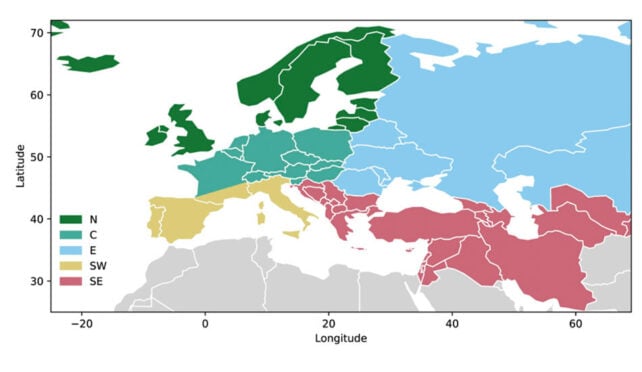
The discoveries were enabled by an unusually large collection of ancient genomes – from the remains of nearly 16,000 individuals spanning the last 10,000 years in West Eurasia – and applying a new computational method to track the rise and fall of gene variants over extended periods.
The system used by the researchers isolates genes affected by natural selection by examining relationships among individuals (and the DNA of over 6,000 living people) to exclude genes influenced by factors such as migration and random chance, rather than by an impact on survival.
While the study didn’t directly test why these variants were favored, the researchers have some ideas.
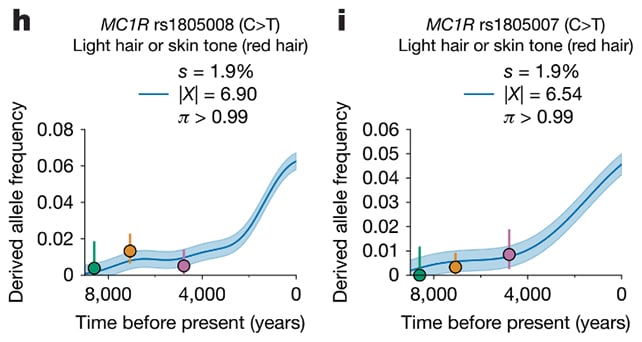
Variants of the MC1R gene that are strongly associated with red hair and pale skin may have spread because pale skin absorbs vitamin D in sunlight more easily.
This could have become more beneficial as we shifted from a hunter diet to a farmer diet, with more plants and grains. Sunshine became a more important source of vitamin D, and Europeans’ skin adapted accordingly – at least, that’s the hypothesis.
Teasing out the gene variants that are selected for survival or reproductive advantage isn’t easy, but this new approach shows that the natural-selection variants are there if we know the right way to look for them.
“If the goal is to uncover changes in the frequency of genetic variants in the last ten millennia that are greater than can be expected by chance, then we need to detect subtle effects, which requires having thousands of genomes spanning that time period,” says Reich.
Some of the identified variants were working in groups, the researchers found, while others rose and fell over time – not all have proved as robust to change as the red-hair and pale-skin variants.
While this is a major step forward in understanding, the researchers emphasize that caution is warranted in interpretation. Traits linked to genes don’t necessarily remain the same over thousands of years, and many aspects of modern life have no equivalents in the ancient world.
The researchers think there’s much more to discover, and have made their analysis methods available for others to use. These can now be applied to DNA records from other parts of the world, for example, and may eventually lead to a greater understanding of disease risk.
Related: Humans Are Still Evolving Before Our Eyes on The Tibetan Plateau
“With these new techniques and large amounts of ancient genomic data, we can now watch how selection shaped biology in real time,” says geneticist Ali Akbari, from Harvard University.
“Instead of searching for the scars natural selection leaves in present-day genomes using simple models and assumptions, we can let the data speak for itself.”
The research has been published in Nature.
What did you think of this news? Leave a comment below and/or share it on your social media. This way, we can inform more people about the hottest things in technology, science, innovation, and gaming!
This news was originally published in:
Original source
