

Birdwatching May Help Protect Your Brain From Age-Related Decline
Research suggests you can keep your brain sharp into old age by learning languages and creating art – and it seems birdwatching may have similar effects.
A new study from scientists in Canada found that the brains of experienced birdwatchers showed denser, more complex tissue structures in brain regions linked to attention and perception, compared to novices.
The findings feed into the idea of neuroplasticity, that the way we work our brains can actually rewire them to some extent – potentially in ways that can protect against cognitive decline through later life.
“Regions involved in attention and perception showed structural modification in experts, and these same regions were selectively engaged to support identification in challenging circumstances,” write the researchers in their published paper.
“Results also suggest that knowledge acquisition might mitigate age-related decline in circumscribed brain regions supporting expert performance.”
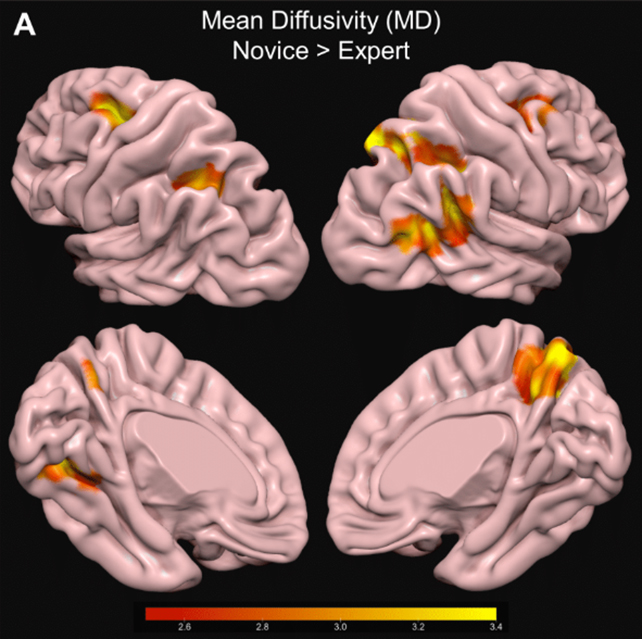
The study examined both brain structure and brain processing at the same time. To this end, MRI scans were carried out on 29 birdwatching experts and 29 birdwatching novices, matched for age and education. During the MRI, the participants were asked to identify images of different birds, and the scans were later analyzed for a measure of brain complexity called “mean diffusivity.”
“The measure we used is the diffusion of water molecules in the brain,” says neuroscientist Erik Wing, at the Rotman Research Institute in Canada. “One way of putting it is that there’s less constraint on where water goes in the brains of experts.”
Sure enough, experienced birdwatchers were found to have lower mean diffusivity in areas of their brains linked to spotting birds, as if these had undergone a system upgrade. What’s more, when these participants were shown birds they weren’t familiar with, it was these brain regions that lit up.

There were more subtle hints towards protection against cognitive decline in later life, too: brain tissue naturally gets less complex (a higher mean diffusivity) as we get older, but this appeared to be progressing more slowly than normal in the expert birders.
“Acquiring skills from birding could be beneficial for cognition as people age,” says Wing.
Birdwatchers are a suitable study group for research like this, because their hobby involves a combination of picking out key details from a lot of visual information, and keeping attention levels high over extended periods – after all, you never know when a rare bird may appear.
While these brain differences are positive though, it’s important not to interpret the findings too broadly. These participants weren’t given memory or cognition tests, for example, so all we can say for sure is that the experts’ brains seemed fine-tuned to their particular speciality.
It’s also difficult to prove cause and effect in a one-off study like this, in which the participants weren’t tracked over time. It’s possible that there were already specific, beneficial characteristics of the experts’ brains that led them to get into birdwatching in the first place.

However, it’s more likely that years of engaging in this hobby have tuned the birdwatchers’ brains in this way – and the researchers suggest that future studies could investigate whether these optimizations might be used for other cognitive tasks outside the realm of birdwatching.
We know from related studies that learning to play an instrument or speak a new language can shift the structures of the brain and potentially delay some of the natural decline as we age. The new study suggests that birdwatching could also exercise related brain regions and potentially protect against cognitive decline.
Related: Superagers’ ‘Secret Ingredient’ May Be The Growth of New Brain Cells
“Given findings that older experts can harness specialized knowledge to support cognition involving their domain of experience, future work will be needed to uncover how age-related structural trajectories affect specialized performance later in life,” write the researchers.
The research has been published in The Journal of Neuroscience.
What did you think of this news? Leave a comment below and/or share it on your social media. This way, we can inform more people about the hottest things in technology, science, innovation, and gaming!
This news was originally published in:
Original source
