
How some skills become second nature
Expertise isn’t easy to pass down. Take riding a bike: A seasoned cyclist might talk a beginner through the basics of how to sit and when to push off. But other skills, like how hard to pedal to keep balanced, are more intuitive and harder to articulate. This implicit know-how is known as tacit knowledge, and very often, it can only be learned with experience and time.
But a team of MIT engineers wondered: Could an expert’s unconscious know-how be accessed, and even taught, to quickly bring a novice up to an expert’s level?
The answer appears to be “yes,” at least for a particular type of visual-learning task.
In a study published today in the Journal of Neural Engineering, the engineers identified tacit knowledge in volunteers who were tasked with classifying images of various shapes and patterns. As the volunteers were shown images to organize, the team recorded their eye movements and brain activity to measure their visual focus and cognitive attention, respectively.
The measurements showed that, over time, the volunteers shifted their focus and attention to a part of each image that made it easier to classify. However, when asked directly, the volunteers were not aware that they had made such a shift. The researchers concluded that this unconscious shift in attention and focus was a form of tacit knowledge that the volunteers possessed, even if they could not articulate it. What’s more, when the volunteers were made aware of this tacit knowledge, their accuracy in classifying images improved significantly.
The study is the first to directly show that visual attention can reveal unconscious, tacit knowledge during image classification tasks. It also finds for the first time that bringing this concealed knowledge to the surface can enhance experts’ performance.
While the results are specific to the study’s experiment, the researchers say they suggest that some forms of hidden know-how can be made explicit and applied to boost one’s learning experience. They suspect that tacit knowledge could be accessed for disciplines that require keen observation skills, including certain physical trades and crafts, sports, and image analysis, such as medical X-ray diagnoses.
“We as humans have a lot of knowledge, some that is explicit that we can translate into books, encyclopedias, manuals, equations. The tacit knowledge is what we cannot verbalize, that’s hidden in our unconscious,” says study author Alex Armengol-Urpi, a research scientist in MIT’s Department of Mechanical Engineering. “If we can make that knowledge explicit, we can then allow for it to be transferred easier, which can help in education and learning in general.”
The study’s co-authors include Andrés F. Salazar-Gomez, research scientist at the MIT Media Lab; Pawan Sinha, professor of vision and computational neuroscience in MIT’s Department of Brain and Cognitive Sciences; and Sanjay Sarma, the Fred Fort Flowers (1941) and Daniel Fort Flowers (1941) Professor in Mechanical Engineering.
Hidden gaze
The concept of tacit knowledge is credited to the scientist and philosopher Michael Polyani, who in the mid 20th century was the first to investigate the notion that “we know more than we can tell.” His insights revealed that humans can hold a form of knowledge that is internalized, almost second nature, and often difficult to express or translate to others.
Since Polyani’s work, many studies have highlighted how tacit knowledge may play a part in perfecting certain skills, spanning everything from diagnosing medical images to discerning the sex of cats from images of their faces.
For Armengol-Urpi, these studies raised a question: Could a person’s tacit knowledge be revealed through unconscious signals, such as patterns in their eye movements? His PhD work focused on visual attention, and he had developed methods to study how humans focus their attention, by using cameras to follow the direction of their gaze, and electroencephalography (EEG) monitors to record their brain activity. In his research, he learned of a previous study that used similar methods to investigate how radiologists diagnose nodules in X-ray images. That study showed that the doctors unconsciously focused on areas of an image that helped them to correctly detect the nodules.
“That paper didn’t focus on tacit knowledge, but it suggested that there are some hidden clues in our gaze that could be explored further,” Armengol-Urpi says.
The shape of knowledge
For their new study, the team looked at whether they could identify signs of tacit knowledge from measurements of visual focus and attention. In their experiment, they asked 30 volunteers to look sequentially at over 120 images. They could look at each image for several seconds and then were asked to classify the image as belonging to either group A, or group B, before they were shown the next image.
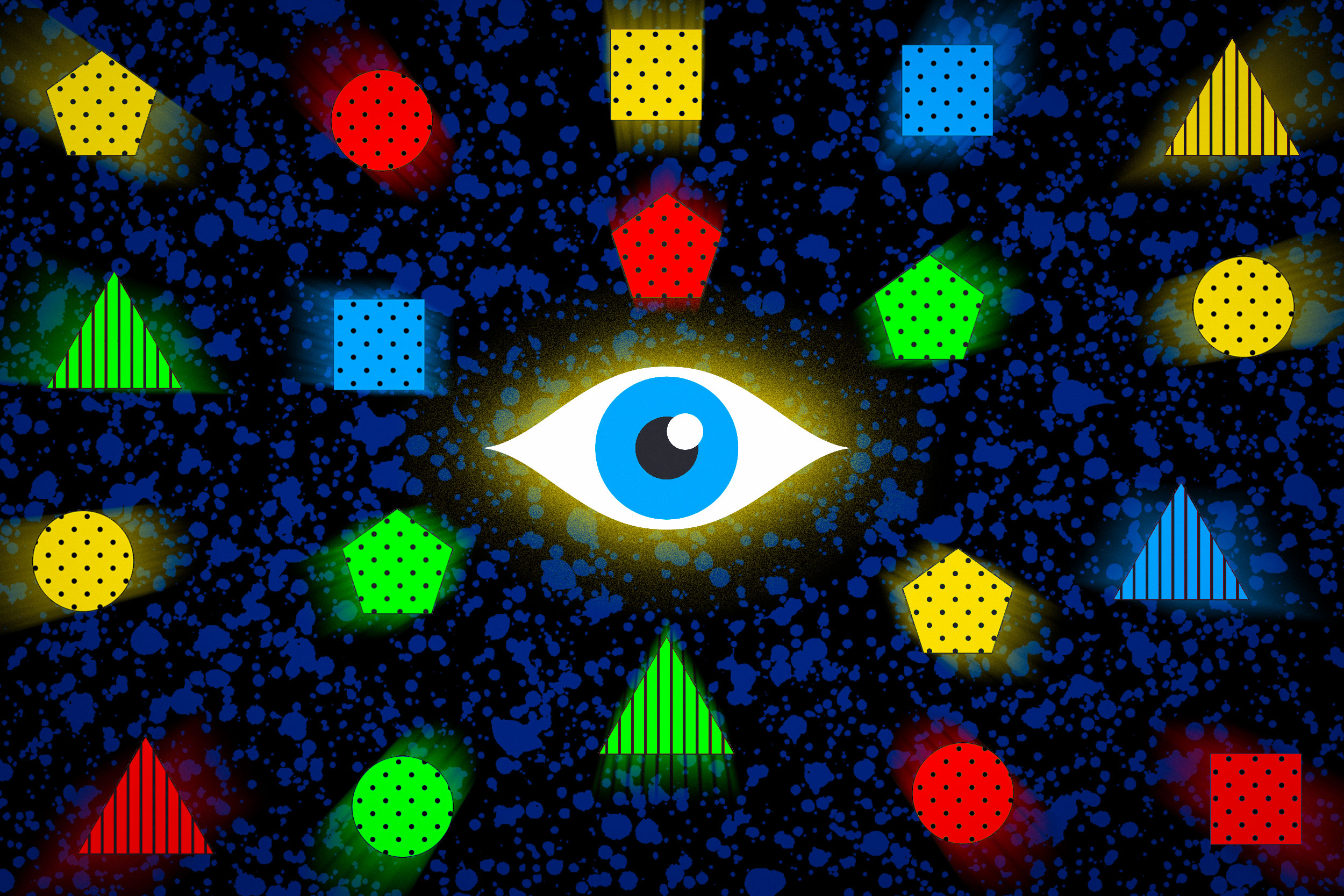
Each image contained two simple shapes on either side of the image — a square, a triangle, a circle, and any combination of the three, along with different colors and patterns for each shape. The researchers designed the images such that they should be classified into one of two groups, based on an intricate combination of shape, color, and pattern. Importantly, only one side of each image was relevant for the classification.
The volunteers, however, were given no guidelines on how to classify the images. Therefore, for about the first half of the experiment, they were considered “novices,” and more or less guessed at their classifications. Over time, and many more images, their accuracy improved to a level that the researchers considered “expert.” Throughout the experiment, the team used cameras to follow each participant’s eye movements, as a measure of visual focus.
They also outfitted volunteers with EEG sensors to record their brain waves, which they used as a measure of cognitive attention. They designed each image to show two shapes, each of which flickered at different, imperceptible frequencies. They found they could identify where a volunteer’s attention landed, based on which shape’s flicker their brain waves synced up with.
For each volunteer, the team created maps of where their gaze and attention were focused, both during their novice and expert phases. Overall, these maps showed that in the beginning, the volunteers focused on all parts of an image as they tried to make sense of how to classify it. Toward the end, as they got a grasp of the exercise and improved their accuracy, their attention shifted to just one side of each image. This side happened to be the side that the researchers designed to be most relevant, while the other side was just random noise.
The maps showed that the volunteers picked up some knowledge of how to accurately classify the images. But when they were given a survey and asked to articulate how they learned the task, they always maintained that they focused on each entire image. It seemed their actual shift in focus was an unconscious, tacit skill.
“They were unconsciously focusing their attention on the part of the image that was actually informative,” Armengol-Urpi says. “So the tacit knowledge they had was hidden inside them.”
Going a step further, the team then showed each participant the maps of their gaze and attention, and how the maps changed from their novice to expert phases. When they were then shown additional images, the volunteers seemed to use this once-tacit knowledge, and further improved their classification accuracy.
“We are currently extending this approach to other domains where tacit knowledge plays a central role,” says Armengol-Urpi, who is exploring tacit knowledge in skilled crafts and sports such as glassblowing and table tennis, as well as in diagnosing medical imaging. “We believe the underlying principle — capturing and reinforcing implicit expertise through physiological signals — can generalize to a wide range of perceptual and skill-based domains.”
This research was supported, in part, by Takeda Pharmaceutical Company.
What did you think of this news? Leave a comment below and/or share it on your social media. This way, we can inform more people about the hottest things in technology, science, innovation, and gaming!
This news was originally published in:
Original source
