
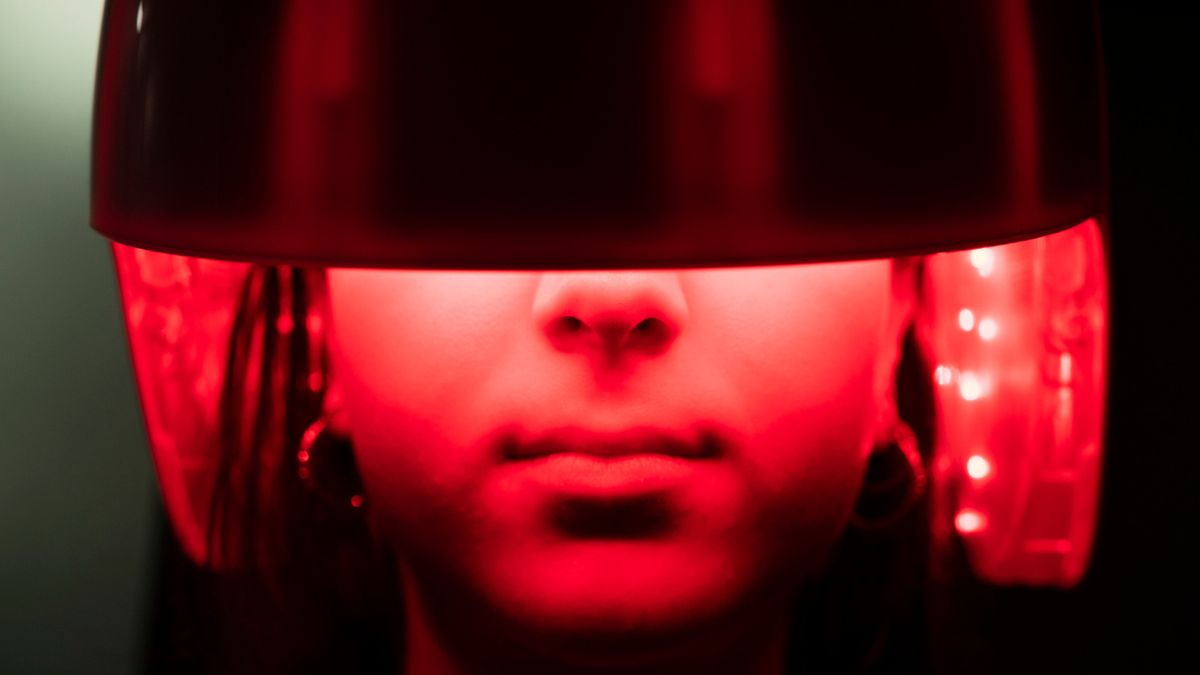
New Light Therapy Can Suppress a Key Marker of Hair Loss by 92%
Scientists in Korea are developing a comfortable light therapy hat that they hope will help with hair loss and growth.
In lab experiments, the invention’s finely tuned system suppressed age-associated changes in human hair cells by nearly 92 percent compared to untreated cells.
That’s much greater than what occurs under red light therapy, which is used by many current ‘hair loss helmets’.
This new technology is based on near-infrared wavelengths that are specially tuned to target human dermal papilla cells (hDPCs) – critical players in hair regeneration at the base of hair follicles.
Unlike other phototherapy treatments for hair loss, this new platform doesn’t have to sit on a hard, bulky helmet. It can be put within a flexible cap that fits closer to the scalp and can be worn out in public with greater ease and style.
The light it emits onto the scalp is also more diffuse than current treatments, which tend to use LEDs or lasers. Organic Light-Emitting Diodes (OLEDs) emit widespread light that is more uniformly spread.
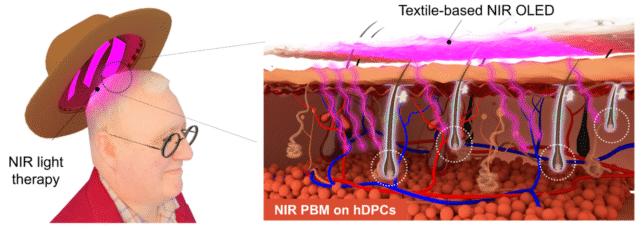
“Because OLEDs are thin and flexible, they can closely conform to the curved surface of the scalp, delivering uniform light stimulation across the entire area,” explains electrical engineer Kyung Cheol Choi from the Korea Advanced Institute of Science & Technology (KAIST).
An actual wearable ‘hat’ has not yet been tested on the head of a human, but the underlying technology has performed well in initial experiments at KAIST, with financial support from City University of Hong Kong.
Aging hair cells play a pivotal role in many forms of hair loss, including hereditary patterned hair loss (androgenetic alopecia), which is the most common form worldwide.
As hair follicles grow old and begin to die, they express a biomarker called β-galactosidase. First described in 1995, this enzyme is now used to assess the effects of anti-hair-loss treatments.
The novel OLED platform from Korea is associated with very positive results for this enzyme. It is also customized to emit near-infrared light in the 730–740 nm range, which the team says is optimal for activating dermal papilla cells.
Compared to hair cells treated with red OLED, those treated with this customized OLED light had 92 percent fewer markers of age-associated decline.
If replicated in real clinical trials, this technology could prove to be a superior treatment for hair loss.
In the US, hereditary patterned hair loss impacts up to 40 percent of the population, and yet there are only a couple of approved treatments with some serious downsides.
An over-the-counter topical treatment, called minoxidil, can slow hair loss and promote some regrowth, but it doesn’t work for everyone.

Meanwhile, an oral drug called finasteride (brand name Propecia) can also slow hair loss. Unfortunately, this medicine comes with several deterring side effects, including erectile dysfunction, testicular or breast pain, reduced libido, and depression. It also is not approved for use in female patients.
Related: Surprise Hair Loss Breakthrough: A DNA Sugar Gel Sparks Robust Regrowth
To avoid invasive hair transplants, a growing number of people experiencing hair loss have turned to low-level light therapy, which shows some effectiveness in treating androgenic alopecia in both sexes.
Researchers at KAIST want to improve upon those results. They now hope to make a fully washable version of their hair-loss hat that can withstand daily use.
“Going forward, we plan to verify safety and efficacy through preclinical studies and progressively evaluate the potential for real therapeutic applications,” says Choi.
The study was published in Nature Communications.
What did you think of this news? Leave a comment below and/or share it on your social media. This way, we can inform more people about the hottest things in technology, science, innovation, and gaming!
This news was originally published in:
Original source
