
Sea Levels Are Rising Globally. Around Greenland, They’re Projected to Fall.
Around the world, sea levels are rising. But, strangely, in Greenland, they’re actually forecast to fall in the coming decades.
In a new study, a team led by geophysicist Lauren Lewright at Columbia University combined real-world measurements with computer modeling to estimate how relative sea level around Greenland will change this century.
“The Greenland coastline is going to experience quite a different outcome,” says Lewright.
Sea-level rise is the result of increased greenhouse gases in our atmosphere, which trap heat that would otherwise be reflected back into space.
The ocean absorbs much of that heat, and as it does, the water expands. This is called thermal expansion, and it’s predicted to be the largest contributor to future global sea-level rise.
But experts say melting ice sheets will play a large role in Greenland’s future sea levels, which are forecast to fall rather than rise.
Greenland is a special case because its landmass is currently weighed down by a mile-thick layer of glacial ice, which covers around 80 percent of the island.
At the moment, that ice is being lost at a rate of around 200 billion tons each year. And as that weight lifts, so too does the land below.
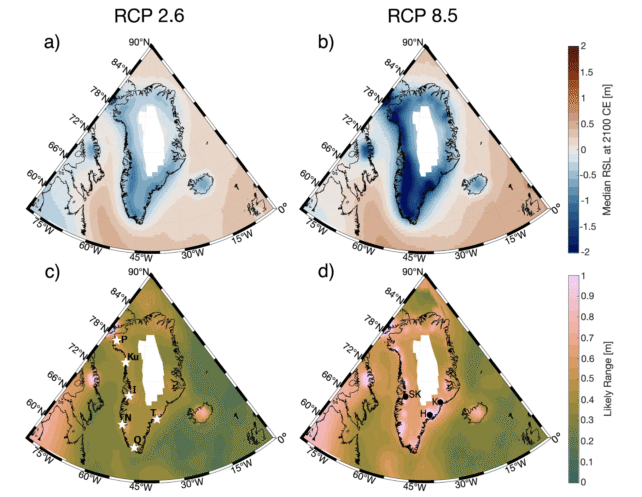
In the best-case scenario, with limited greenhouse gas emissions, the autonomous territory is set to gain about 0.9 meters (around 3 feet) of exposed land due to falling sea levels by the end of the 21st century.
If we do nothing to curb our greenhouse gas emissions, Greenland will rise a whole 2.5 meters (8.2 feet) out of the ocean.
Lewright and colleagues from the US, UK, and Canada arrived at these estimates by pairing real-world observations of historic sea-level and land-elevation changes with a model that predicts land movement once it emerges from beneath melted glaciers.

Gravity plays an important role in Greenland’s rising heights, too.
“When the ice sheet is very large, it has a lot of mass. The sea surface is pulled toward the ice sheet because of that gravitational pull,” Lewright says.
“As the ice sheet loses mass, its gravitational pull on the sea surface decreases. That translates into sea level fall.”
Related: A Geologist Explains What Makes Greenland So Incredibly Special
A reduced sea level will affect the economy, near-shore infrastructure, and food security of Greenland’s predominantly coastal human population.
This research was published in Nature Communications.
What did you think of this news? Leave a comment below and/or share it on your social media. This way, we can inform more people about the hottest things in technology, science, innovation, and gaming!
This news was originally published in:
Original source
